06 – 18 April 2026
By Chris Lotz
This was a massively successful and enjoyable private version of our usual Hawaii set departure birding tour. We saw nine of Hawaii’s endemic honeycreepers, including the Critically Endangered (IUCN classification) Palila (which is now often missed on Hawaii birding tours as it is on the verge of extinction) and four Endangered (IUCN) ones, the absolutely bizarre-billed Akiapolaau, the bright orange Hawaii Akepa, the yellow Anianiau and the branch-foraging Hawaii Creeper. The “less rare” honeycreeper species like Iiwi (this spectacular bird is, however, sadly declining and classified as Vulnerable) and the relatively ubiquitous Apapane, were also wonderful to see during this tour. Other Hawaiian endemics encountered were all three elepaio (native monarch flycatcher) species (including all three morphs of the Big Island species), and the thrush Omao.
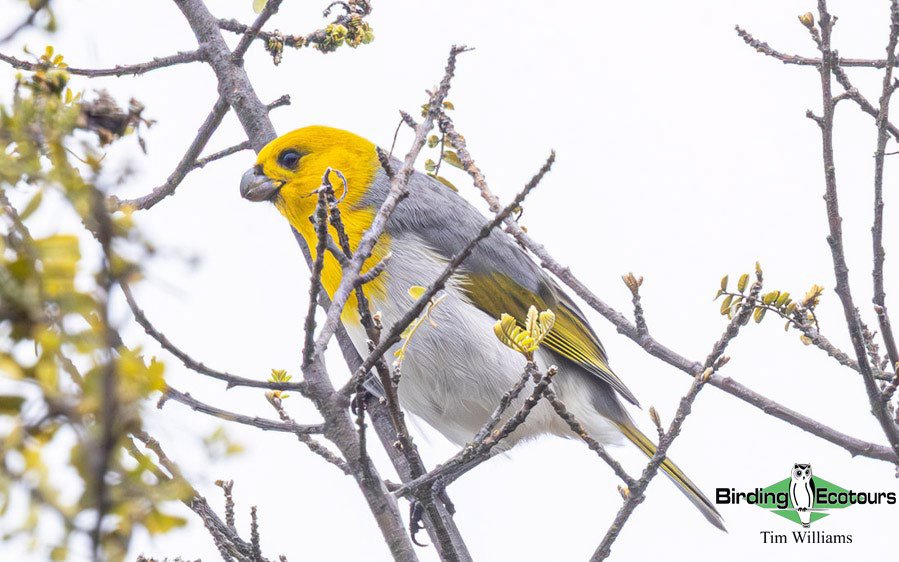
Palila, the only finch-billed Hawaiian honeycreeper that is still (very rarely, being on the verge of extinction) seen by birders. Tim got this and other photos of this rare bird on this tour!
Highlights of the Hawaii tours we run are always the pelagic trips, and the Big Island one we did on this trip did not disappoint, with four Hawaiian Petrels, a great many Bulwer’s Petrels, three Leach’s Storm Petrels, two shearwater species, Cocos Booby and other booby species, many Black Noddies, and lots of other great seabirds. We also saw very close-up Laysan Albatrosses and a close Black-footed Albatross, two tropicbird species, and various other excellent seabirds from the land at other times during this tour. The trip was also great for cetaceans and sea turtles; see the end of the report for lists of all birds and other taxa we saw.
As usual, we also saw many introduced bird species that are tickable and countable for the American Birding Association (ABA) listing area. Do consult the detailed report and bird list below, and the full eBird trip report for this tour.
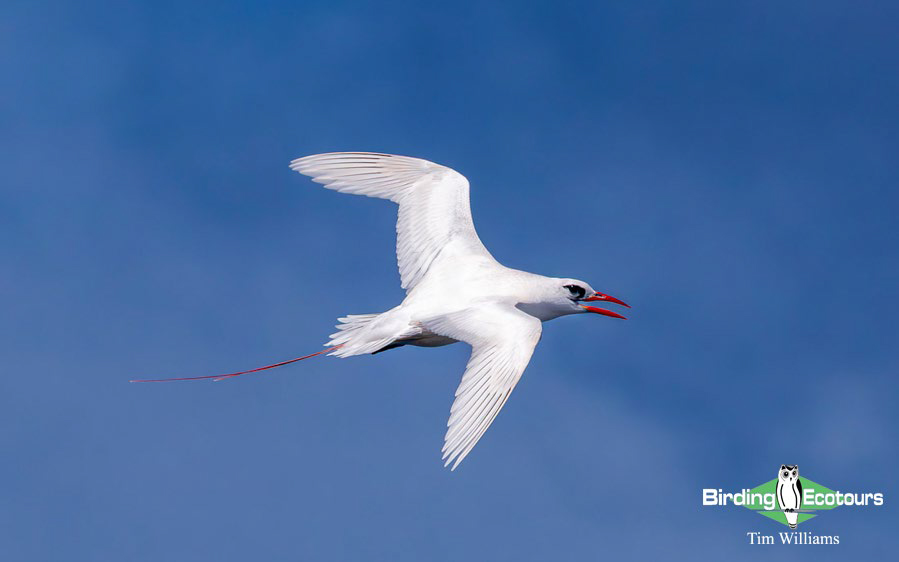
Seabirds, like this beautiful Red-tailed Tropicbird, were a real feature of this Hawaii birding tour.
Hawaii is, of course, also incredible for spectacular scenery including towering volcanoes, canyons, waterfalls and so much more. We savored the other-worldly scenery as we toured Kauia, the Big Island (Hawaii) and Oahu. While searching for birds on these stunning islands, we also visited Volcanoes National Park, Waimea Canyon (the “Grand Canyon of the Pacific”), the breathtaking Kalalau Valley, and so much more.
Detailed Report
Day 1, 6th April 2026. Arrival in Kauai and initial birding
This was our official arrival day in Kauai, and we had time to bird the hotel grounds in the afternoon. Here, we enjoyed seeing close-up Pacific Golden-Plovers, some in splendid full breeding plumage, some in non-breeding plumage, and some inbetween, in various stages of molt. There were many Chestnut Munias, Western Cattle Egrets, Zebra Doves, Warbling White-eyes and Red-crested Cardinals around, and a couple of Brown Boobies flew past.
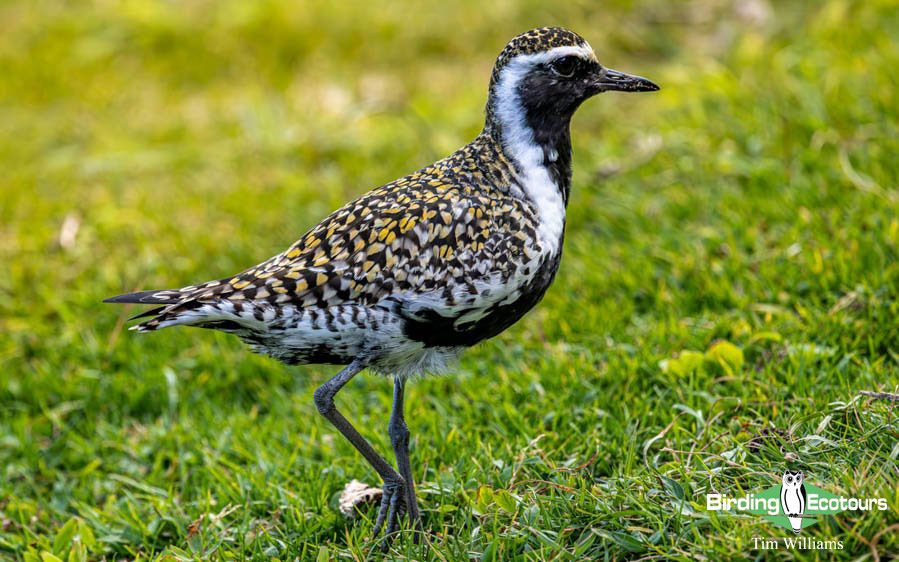
Confiding Pacific Golden Plovers, some in breeding plumage, were all over the place.
Day 2, 7th April 2026. Koke’e State Park
As we headed towards Koke’e State Park, we stopped to look at a flock of African Silverbills and Scaly-breasted Munias along the way. Once we reached Koke’e State Park, although atmospherically foggy, we were very pleased to find Anianiau (a pair), a species which recently became difficult to find, along with the most numerous remaining Hawaiian honeycreeper, the bright red Apapane (lots of them), and a Kauai Elapaio. This was a great start on the Hawaiian Island endemic birds! We also found a number of introduced species, including Japanese Bush Warbler, Erckel’s Spurfowl, a great many Warbling (Japanese) White-eyes and various other birds. We heard Chinese Hwamei and White-rumped Shama, birds we’d see very well the next day. By the time we’d finished our birding, the sun had come out and we were able to enjoy spectacular views of the incomparable Kalalau Valley.
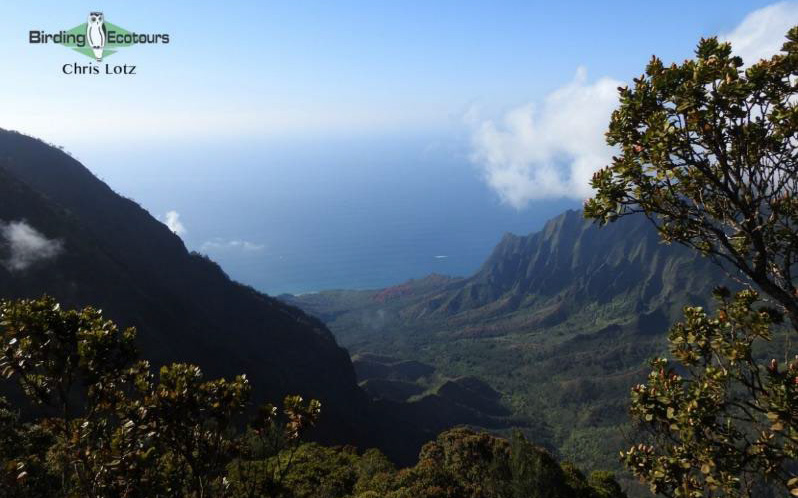
The Kalalau Valley – Apapanes were all around the viewpoint here and Anianiau was below.
As we descended back towards the coast we stopped to admire a view of Waipo’o Falls from the spectacular Waimea Canyon lookout. From here we saw a White-tailed Tropicbird gliding gracefully in front of “The Grand Canyon of the Pacific”. Further down, we briefly saw a Short-eared Owl (we’d see this bird far better on the Big Island later in the trip), some Rose-ringed Parakeets and various other birds. At the bottom, before going for dinner, we stopped at the Waimea Athletic Fields, getting great views of six Java Sparrows, a few Saffron Finches and House Finches, and an overflying Hawaiian Duck (a species which we’d see very nicely the next day).
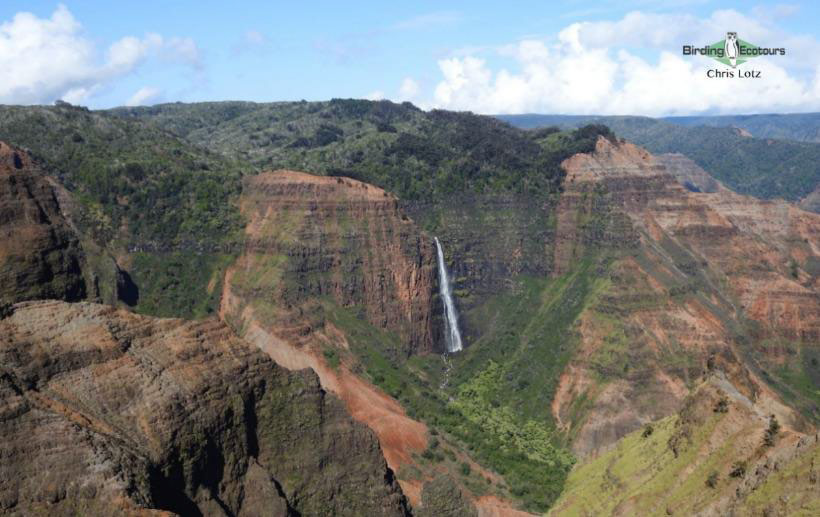
Waipo’o Falls from the Waimea Canyon lookout – we saw White-tailed Tropicbird here.
Day 3, 8th April 2026. Birding around the whole island of Kauai
We covered lots of ground today as we targeted bird species all over the beautiful “Garden Island” of Kauai. We started the day with a birding walk at the Sleeping Giant (Nounou Mountain) on the eastern side of the island, in search of introduced Asian bird species now tickable as ABA area/American bird species. The forest here is beautiful, but non-native (like the birds we were looking for), with lots of Norfolk Island Pines for example. Hawaii sure is a strange part of the world, with a handful of top endemic/native bird targets left (sadly, others have gone extinct), and numerous “exotics” (that are however “countable” for listers). Our main targets at this site were Chinese Hwamei, which we saw very well, and Greater Necklaced Laughingthrush, which we only glimpsed. There were also plenty of White-rumped Shamas around. All three of these bird species, originally from the Far East, are beautiful songsters and mimics, and we heard their wonderful but alien vocalizations a lot. Other species we saw around here included stacks (as usual) of Warbling (Japanese) White-eyes, a few Rose-ringed Parakeets, Northern Mockingbird, Northern and Red-crested Cardinals, House Finch, Scaly-breasted Munia, and Western Meadowlark.
We then took a scenic drive, first northwards and then westwards, to our next birding site, Hanalei National Wildlife Refuge near the north-central coast of Kauai. Our main targets here were Hawaiian Duck, Nene (Hawaiian Goose), and Hawaiian Coot, all of which we saw well (although the coot was quite far away). We also saw the Hawaiian endemic subspecies of Common Gallinule, plus Black-crowned Night Heron, Chestnut Munia and various other birds we’d already seen previously.
Staying on the north coast, we then visited the Kilauea National Wildlife Refuge next to the Kilauea Lighthouse. Here, we were able to admire our first Laysan Albatrosses, along with Brown Boobies and nesting Red-footed Boobies, White-tailed and Red-tailed Tropicbirds (tropicbirds are arguably the most beautifully graceful birds on the entire planet, wow!), Great Frigatebirds, and various other species.
The nearby Princeville Makai Golf Course was our next stop and we managed to find three Snow Geese with several Nenes here. In nearby gardens, we admired really close-up Laysan Albatrosses with their cute big chicks!
A pair of close-up Laysan Albatrosses with a chick!
We then did a long drive around the coast again, all the way to the south-central part of Kauai where we visited Poipu Beach Park to admire a stack of Endangered (IUCN) Green Sea Turtles and a humongous Hawaiian Monk Seal. We were very pleased to also see a close-up Wandering Tattler and some Wedge-tailed Shearwaters just offshore.
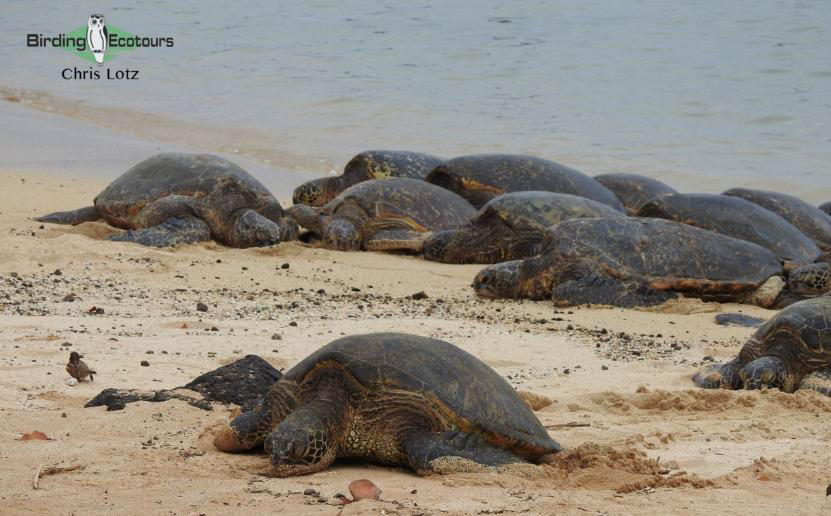
Green Sea Turtles at Poipu Beach Park. There was a Hawaiian Monk Seal here as well.
We ended the day with a seawatch at Makahuena Point to enjoy closer views of seabirds such as boobies and Wedge-tailed Shearwaters. A close-up Humpback Whale and some Pantropical Spotted Dolphins added to the excitement – wow!
Day 4, 9th April 2026. Rest day before evening flight to the Big Island
Rainy weather arrived this morning and lasted the whole day, and since we had seen our targets by squeezing everything into previous days, we took today as a rest and regrouping day (and also an opportunity to process photos, etc.). In the evening we flew to Kona on the island of Hawaii (the Big Island).
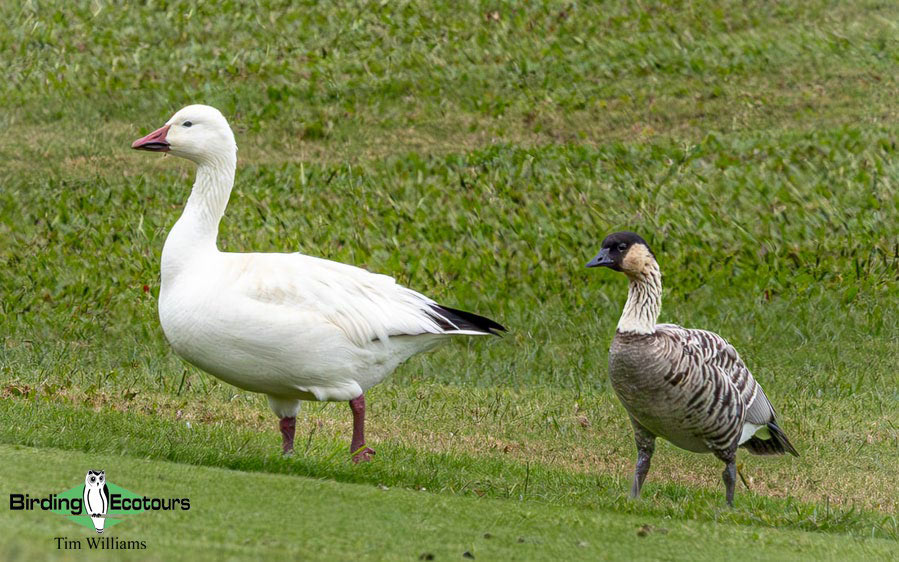
Nene and Snow Goose buddies!
Day 5, 10th April 2026. A first day on the Big Island
We started the day at the Kealakehe Wastewater Treatment Works. This was productive, with prolonged, good scope views of a Black Francolin sitting on top of a rock (this species can be elusive), a number of close-up Grey Francolins, and various waterbirds such as the Hawaiian subspecies of Black-necked Stilt, a dozen or so Wandering Tattlers, a lot of Ruddy Turnstones, a couple of Sanderlings, many Black-crowned Night Herons, and a few Northern Shovelers, etc. We also saw our first of many Yellow-billed Cardinals and Yellow-fronted Canaries.
We then embarked on the long, scenic drive around the southern part of the island to Hawai’i Volcanoes National Park, finding a few nice birds such as Nenes and stopping to look at the amazing Punaluu black (volcanic) sand beach along the way. Volcanoes National Park boasts two active volcanoes. We looked down into two calderas and walked through a lava tube, amazing stuff. We added two new birds to our list, Hawaii Elapaio and some confiding Kalij Pheasants. We also admired some species we’d seen already, including numerous Apapanes.
On our way back to Kona, after dark, we saw an American Barn Owl flying across the road in front of us.
Day 6, 11th April 2026. Kona pelagic
We enjoyed a superb pelagic seabird trip off the Big Island today. Highlights included four Hawaiian Petrels during the course of the day, three Leach’s Storm Petrels, stacks of Bulwer’s Petrels, a Cocos Booby among good numbers of Brown Boobies, Sooty Shearwaters and Wedge-tailed Shearwaters, many Black Noddies, a few White-tailed Tropicbirds,and Sooty Terns, and a number of other species.
Cetaceans were amazing, with (Hawaiian) Spinner Dolphins just as we were leaving Honokohau Harbor, and Rough-toothed Dolphins and Cuvier’s Beaked (Goose-beaked)Whales later on. When we arrived back in the harbor, we were glad to see a close-up Hawksbill Turtle, a Critically Endangered (IUCN) species.
Views of the western side of the Big Island and of the island of Maui were very grand from the pelagic. All-in-all it was a very enjoyable day out at sea.
Day 7, 12th April 2026. Birding Hakalau Forest National Wildlife Refuge
This was arguably the best day of this amazing birding tour of Hawaii, with the biggest endemics haul of the trip, at the magically beautiful Hakalau Forest. On the way up to this site we found Eurasian Skylark, Wild Turkey, Kalij Pheasant, and various other introduced bird species. Once we arrived at Hakalau Forest NWR we slowly but surely found all our targets. These were the gorgeous red and black Iiwi (including ones drinking from giant lobelia flowers shaped perfectly for this species’ long, curved bill, which happens to be pink in color), a bright orange male Hawaii Akepa, Hawaii Creeper, the bizarre Akiapolaau (these last three species are all classified as Endangered by the IUCN), Hawaii Amakihi, and an endemic thrush, Omao. We also saw the introduced (from Asia) Red-billed Leiothrix well.
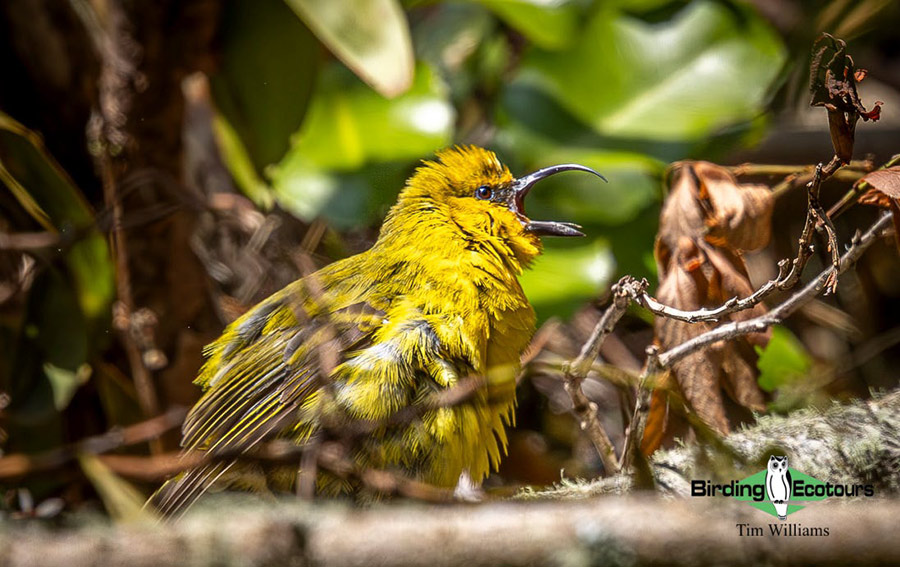
Akiapola’au, the weirdest-billed Hawaiian honeycreeper of all!
After our birding session at Hakalau, we visited our site for Tanimbar Corella back near Kona, we saw eight of them very well, along with a Red-masked Parakeet. These are yet more non-native species that are becoming naturalized in Hawaii.
Day 8, 13th April 2026. Birding the Palila Discovery Trail and other Big Island sites
This morning after breakfast we headed to the Palila Discovery Trail on the slopes of the snow-capped 13,803 feet (4,207 m) Mauna Kea shield volcano, in search of the Critically Endangered (IUCN/BirdLife International) Palila. This is the only finch-billed Hawaiian Honeycreeper that is accessible to birders but, being on the verge of extinction, is now often missed on Hawaii birding tours. We spent most of the morning looking for this amazing bird, and we finally managed to find one and get great views and photos of it just before lunch. How wonderful!
Here at the Palila Discovery Trail we also found our third and final form of Hawaii Elapaio (we’d seen one of each of the other two morphs of these attractive flycatchers on each of the previous days here on the Big Island). The male of this form has an attractively patterned head with lots of white on it, and it was at a nest, so quite an awesome experience. The other highlight of the morning was a couple of Short-eared Owls showing wonderfully well and close-up.
After a celebratory picnic lunch (although it’s bittersweet to see one of the world’s rarest birds that might go extinct soon), we headed back towards Kona looking for various birds, the main target being Hawaiian Hawk (Io), but didn’t have success, yet.
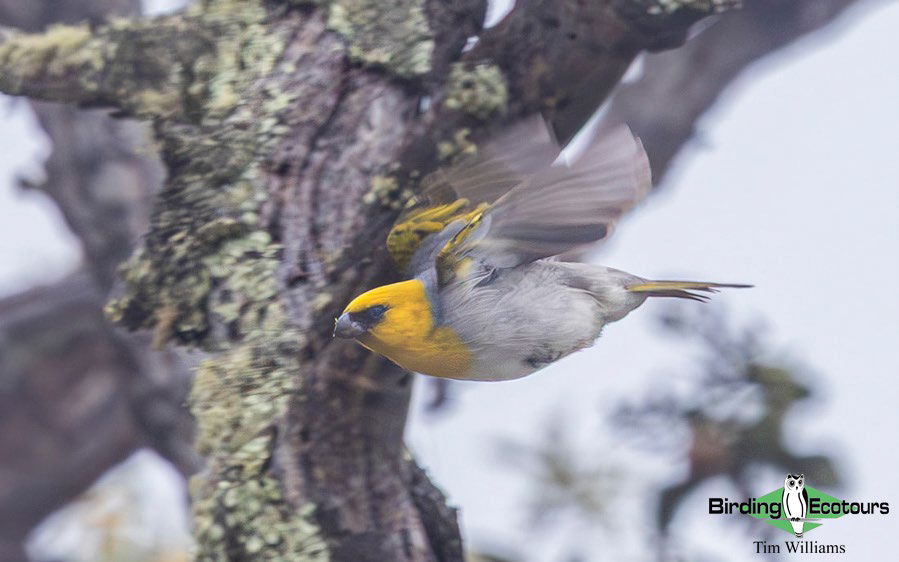
Tim managed to photograph the Palila as it flew (it landed in a tree closer to us!).
Day 9, 14th April 2026. Final Big Island birding followed by flight to Honolulu
We spent the whole morning searching for Hawaiian Hawk and eventually found a pair of them circling and interacting with each other. One of them was a dark morph individual and the other a pale morph.
We then headed to the airport to fly to Honolulu on the island of Oahu. After checking in at our hotel on Waikiki Beach, Honolulu, we did a short walk to look at Blue-billed White Terns, such incredibly beautiful birds!
Day 10, 15th April 2026. Oahu birding
This was a massively successful last day of the tour. We started the day finding Oahu Amikiki, then went to our site for Oahu Elapaio which, after a bit of patience, showed well. We also saw a number of introduced species such as Red-whiskered and Red-vented Bulbuls, and Red-billed Leiothrix, among others.
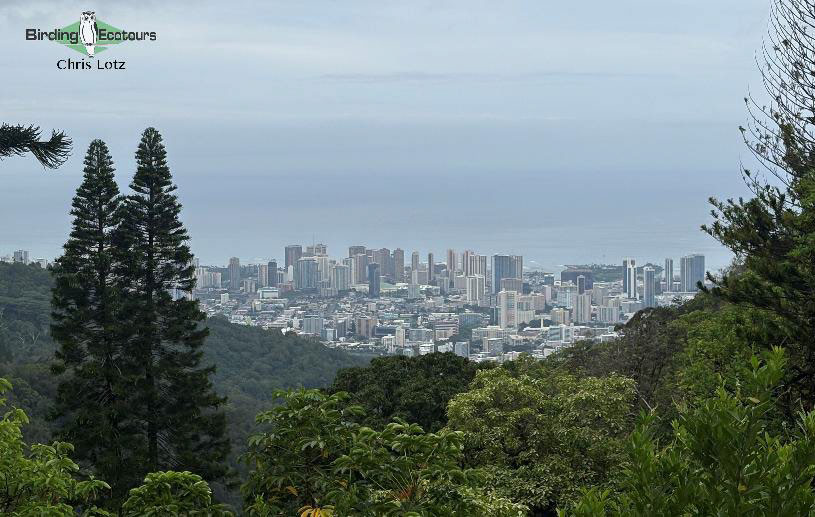
The view of Honolulu from our Oahu Amikiki birding site.
We stopped at some sites for seabirds and waterbirds, seeing some nice species we’d also seen earlier during the tour. Our final stop was awesome, not only for our main target, Bristle-thighed Curlew, but also for close up Laysan and Black-footed Albatrosses, three booby species including Masked Booby, which was new for the trip, a distant Brown Noddy, and lots of Wedge-tailed Shearwaters, including some close ones. We then had time to drive back to Honolulu via what is arguably the surfing capital of the world, the beautiful North Shore. The next day we flew home.
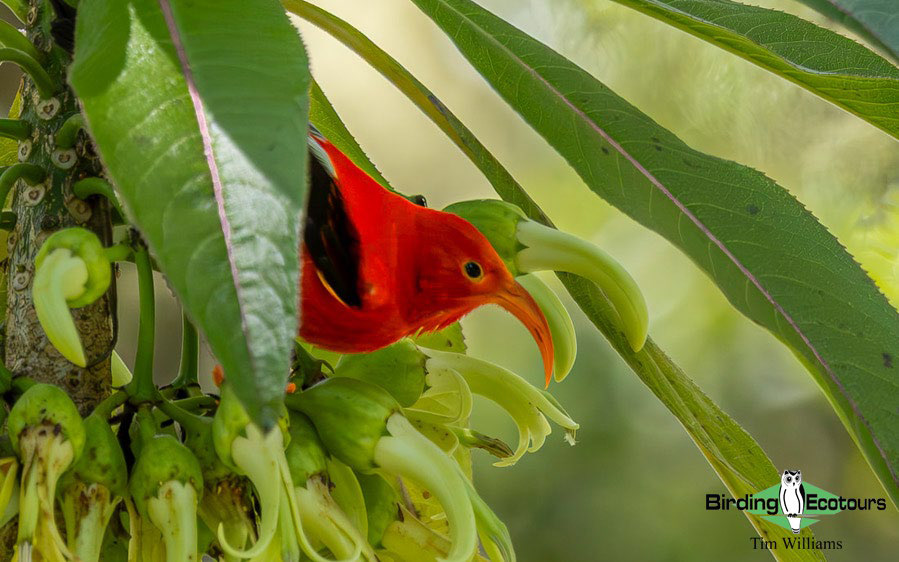
I’iwi has a bill shaped like these lobelia flowers it was sipping nectar from.
Bird List – Following IOC 15.1 (February 2025)
The following notation after species names is used to show conservation status following BirdLife International: CE = Critically Endangered, EN = Endangered, VU = Vulnerable, NT = Near Threatened.
| Common name | Scientific name |
| Ducks, Geese, Swans (Anatidae) | |
| Nene (Endemic) | Branta sandvicensis |
| Snow Goose | Anser caerulescens |
| Northern Shoveler | Spatula clypeata |
| Hawaiian Duck (Endemic) – VU | Anas wyvilliana |
| Pheasants & Allies (Phasianidae) | |
| Wild Turkey | Meleagris gallopavo |
| Common Pheasant | Phasianus colchicus |
| Kalij Pheasant | Lophura leucomelanos |
| Indian Peafowl | Pavo cristatus |
| Red Junglefowl | Gallus gallus |
| Grey Francolin | Ortygornis pondicerianus |
| Black Francolin | Francolinus francolinus |
| Erckel’s Spurfowl | Pternistis erckelii |
| Pigeons, Doves (Columbidae) | |
| Rock Dove | Columba livia |
| Spotted Dove | Spilopelia chinensis |
| Zebra Dove | Geopelia striata |
| Mourning Dove | Zenaida macroura |
| Rails, Crakes & Coots (Rallidae) | |
| Common Gallinule | Gallinula galeata |
| Hawaiian Coot (Endemic) | Fulica alai |
| Stilts, Avocets (Recurvirostridae) | |
| Black-necked Stilt | Himantopus mexicanus |
| Plovers (Charadriidae) | |
| Pacific Golden Plover | Pluvialis fulva |
| Sandpipers, Snipes (Scolopacidae) | |
| Bristle-thighed Curlew | Numenius tahitiensis |
| Wandering Tattler | Tringa incana |
| Ruddy Turnstone | Arenaria interpres |
| Sanderling | Calidris alba |
| Gulls, Terns, Skimmers (Laridae) | |
| Blue-billed White Tern | Gygis candida |
| Brown Noddy | Anous stolidus |
| Black Noddy | Anous minutus |
| Sooty Tern | Onychoprion fuscatus |
| Tropicbirds (Phaethontidae) | |
| Red-tailed Tropicbird | Phaethon rubricauda |
| White-tailed Tropicbird | Phaethon lepturus |
| Albatrosses (Diomedeidae) | |
| Laysan Albatross | Phoebastria immutabilis |
| Black-footed Albatross | Phoebastria nigripes |
| Northern Storm Petrels (Hydrobatidae) | |
| Leach’s Storm Petrel – VU | Hydrobates leucorhous |
| Petrels, Shearwaters, Diving Petrels (Procellariidae) | |
| Hawaiian Petrel – EN | Pterodroma sandwichensis |
| Wedge-tailed Shearwater | Ardenna pacifica |
| Sooty Shearwater | Ardenna grisea |
| Bulwer’s Petrel | Bulweria bulwerii |
| Frigatebirds (Fregatidae) | |
| Great Frigatebird | Fregata minor |
| Gannets, Boobies (Sulidae) | |
| Red-footed Booby | Sula sula |
| Brown Booby | Sula leucogaster |
| Cocos Booby | Sula brewsteri |
| Masked Booby | Sula dactylatra |
| Herons, Bitterns (Ardeidae) | |
| Black-crowned Night Heron | Nycticorax nycticorax |
| Western Cattle Egret | Ardea ibis |
| Kites, Hawks, Eagles (Accipitridae) | |
| Hawaiian Hawk (Endemic) | Buteo solitarius |
| Barn Owls (Tytonidae) | |
| American Barn Owl | Tyto furcata |
| Owls (Strigidae) | |
| Short-eared Owl | Asio flammeus |
| Cockatoos (Cacatuidae) | |
| Tanimbar Corella | Cacatua goffiniana |
| African & New World Parrots (Psittacidae) | |
| Red-masked Parakeet | Psittacara erythrogenys |
| Old World Parrots (Psittaculidae) | |
| Rose-ringed Parakeet | Psittacula krameri |
| Rosy-faced Lovebird | Agapornis roseicollis |
| Monarchs (Monarchidae) | |
| Kauai Elepaio (Endemic) | Chasiempis sclateri |
| Oahu Elepaio (Endemic) – VU | Chasiempis ibidis |
| Hawaii Elepaio (Endemic) | Chasiempis sandwichensis |
| Larks (Alaudidae) | |
| Eurasian Skylark | Alauda arvensis |
| Bulbuls (Pycnonotidae) | |
| Red-whiskered Bulbul | Pycnonotus jocosus |
| Red-vented Bulbul | Pycnonotus cafer |
| Cettia Bush Warblers & Allies (Cettiidae) | |
| Japanese Bush Warbler | Horornis diphone |
| White-eyes (Zosteropidae) | |
| Warbling White-eye | Zosterops japonicus |
| Laughingthrushes & Allies (Leiothrichidae) | |
| Red-billed Leiothrix | Leiothrix lutea |
| Chinese Hwamei | Garrulax canorus |
| Greater Necklaced Laughingthrush | Pterorhinus pectoralis |
| Mockingbirds, Thrashers (Mimidae) | |
| Northern Mockingbird | Mimus polyglottos |
| Starlings, Rhabdornises (Sturnidae) | |
| Common Myna | Acridotheres tristis |
| Thrushes (Turdidae) | |
| Omao (Endemic) | Myadestes obscurus |
| Chats, Old World Flycatchers (Muscicapidae) | |
| White-rumped Shama | Copsychus malabaricus |
| Old World Sparrows, Snowfinches (Passeridae) | |
| House Sparrow | Passer domesticus |
| Waxbills, Munias & Allies (Estrildidae) | |
| African Silverbill | Euodice cantans |
| Java Sparrow – EN | Padda oryzivora |
| Scaly-breasted Munia | Lonchura punctulata |
| Chestnut Munia | Lonchura atricapilla |
| Common Waxbill | Estrilda astrild |
| Finches, Euphonias (Fringillidae) | |
| Palila (Endemic) – CR | Loxioides bailleui |
| Iiwi (Endemic) – VU | Drepanis coccinea |
| Apapane (Endemic) | Himatione sanguinea |
| Akiapolaau (Endemic) – EN | Hemignathus wilsoni |
| Anianiau (Endemic) – EN | Magumma parva |
| Hawaii Creeper (Endemic) – EN | Loxops mana |
| Hawaii Akepa (Endemic) – EN | Loxops coccineus |
| Hawaii Amakihi (Endemic) | Chlorodrepanis virens |
| Oahu Amakihi (Endemic) | Chlorodrepanis flava |
| House Finch | Haemorhous mexicanus |
| Yellow-fronted Canary | Crithagra mozambica |
| Oropendolas, New World Orioles, Blackbirds (Icteridae) | |
| Western Meadowlark | Sturnella neglecta |
| Cardinals & Allies (Cardinalidae) | |
| Northern Cardinal | Cardinalis cardinalis |
| Tanagers & Allies (Thraupidae) | |
| Saffron Finch | Sicalis flaveola |
| Red-crested Cardinal | Paroaria coronata |
| Yellow-billed Cardinal | Paroaria capitata |
| Total seen | 88 |
Mammal List – Following Mammal Watching (April 2024)
EN = Endangered (IUCN)
| Common name | Scientific name |
| Earless Seals (Phocidae) | |
| Hawaiian Monk Seal (Endemic) – EN | Neomonachus schauinslandi |
| Mongooses (Herpestidae) | |
| Small Indian Mongoose | Urva auropunctata |
| Rorquals (Balaenopteridae) | |
| Humpback Whale | Megaptera novaeangliae |
| Oceanic Dolphins (Delphinidae) | |
| Pantropical Spotted Dolphin | Stenella attenuata |
| Spinner Dolphin | Stenella longirostris |
| Melon-headed Whale | Peponocephala electra |
| Rough-toothed Dolphin | Steno bredanensis |
| Beaked Whales (Ziphiidae) | |
| Cuvier’s Beaked Whale | Ziphius cavirostris |
| Total seen | 8 |
Reptile List – Following Reptiles of the World (October 2023)
EN = Endangered, CR = Critically Endangered (IUCN)
| Common name | Scientific name |
| Typical Sea Turtles (Cheloniidae) | |
| Green Sea Turtle – EN | Chelonia mydas |
| Hawksbill Sea Turtle – CR | Eretmochelys imbricata |
This is a sample trip report. Please email us ([email protected]) for more trip reports from this destination.