19 OCTOBER – 04 NOVEMBER 2025
By Andrew Walker
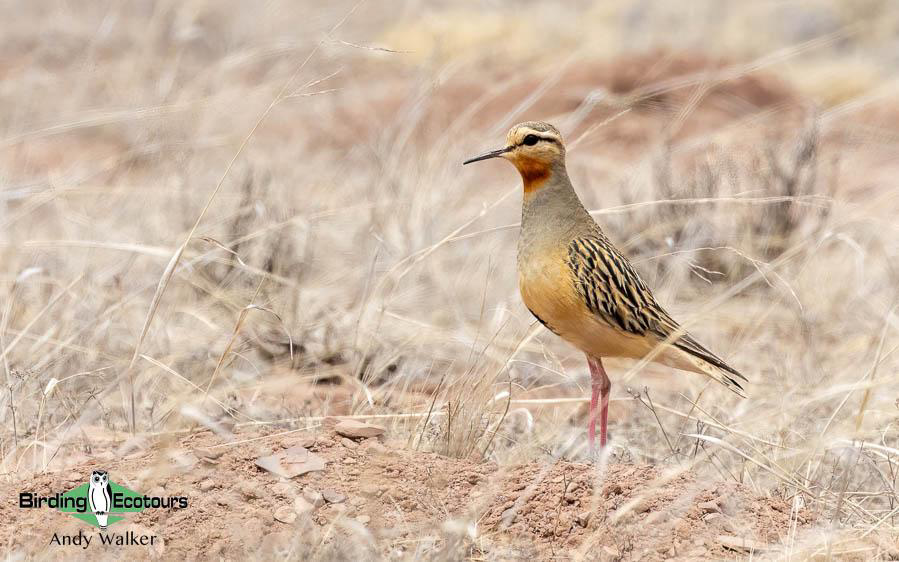
Tawny-throated Dotterel was a big client target and we enjoyed very nice views of several birds at close range. A beautiful and elegant South American shorebird.
Overview
This birding tour of northwest Argentina started in Buenos Aires on the 19th of October 2025 and ended back there on the 4th of November 2025. We started our northwest Argentina birding tour by birding the lowland wetlands and plains around Buenos Aires. We then flew to Tucumán and traveled through the dry Chaco shrublands and the lush Yungas cloudforest, before we climbed into the dry Andean valleys and Puna mountains and up to the high Andes in the Altiplano at over 13,000 feet (3,900 meters). We ended the tour by flying from Jujuy back to Buenos Aires.
We recorded 403 bird species on this northwest Argentina birdwatching tour (12 of these were heard only) and you can also see our eBird trip report, here. Highlights were many and included the following seven Argentinian endemic birds: Moreno’s Ground Dove, White-throated Cacholote,Sandy Gallito, White-browed Tapaculo, Yellow-striped Brushfinch, Tucuman Mountain Finch, and Monte Yellow Finch.
Plenty of near-endemics, shared with Bolivia and currently likely best seen in Argentina, were also found, and included Red-faced Guan, Yungas Guan, Yungas Dove, Rothschild’s Swift, Wedge-tailed Hillstar, Red-tailed Comet, Blue-capped Puffleg, Slender-tailed Woodstar, Dot-fronted Woodpecker, Tucuman Amazon, Grey-hooded Parakeet, Zimmer’s Tapaculo, Brown-capped Tit-Spinetail, Spot-breasted Thornbird, Brown-backed Mockingbird, Rufous-throated Dipper, Yungas Sparrow, Moss-backed Sparrow, Fulvous-headed Brushfinch, Brown-capped Whitestart, Rusty-browed Warbling Finch, Black-and-chestnut Warbling Finch, Citron-headed Yellow Finch, and Rufous-bellied Mountain Tanager.
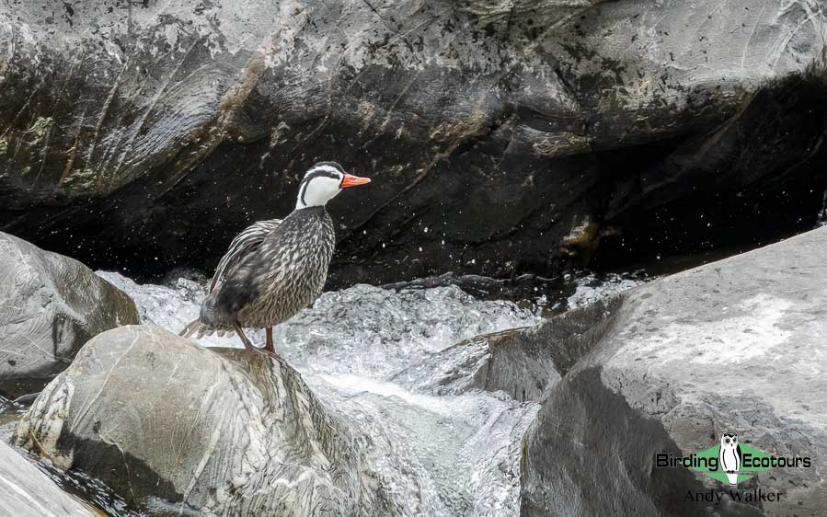
Torrent Duck is a popular inhabitant of fast-flowing rivers in the Andes.
Other non-passerine highlights from the tour included some incredible birds of southern South America, such as Greater Rhea, Lesser Rhea, Andean Tinamou, Puna Tinamou, Southern Screamer, Andean Goose, Torrent Duck, Puna Teal, Lyre-tailed Nightjar, Bare-faced Ground Dove, Horned Coot, Giant Coot, Andean Flamingo, James’s Flamingo, Chilean Flamingo, Andean Avocet, Tawny-throated Dotterel, Puna Plover, Puna Snipe, several species of Nearctic migrant shorebirds (including Short-billed Dowitcher (a national rarity), Stilt Sandpiper, and Wilson’s Phalarope), Grey-breasted Seedsnipe, Rufous-bellied Seedsnipe, Snowy-crowned Tern, Andean Gull, Andean Condor, Black-chested Buzard-Eagle, Black-bodied Woodpecker, Black-legged Seriema, Red-legged Seriema, Spot-winged Falconet, Aplomado Falcon, Golden-collared Macaw, Burrowing Parrot, and Mountain Parakeet.
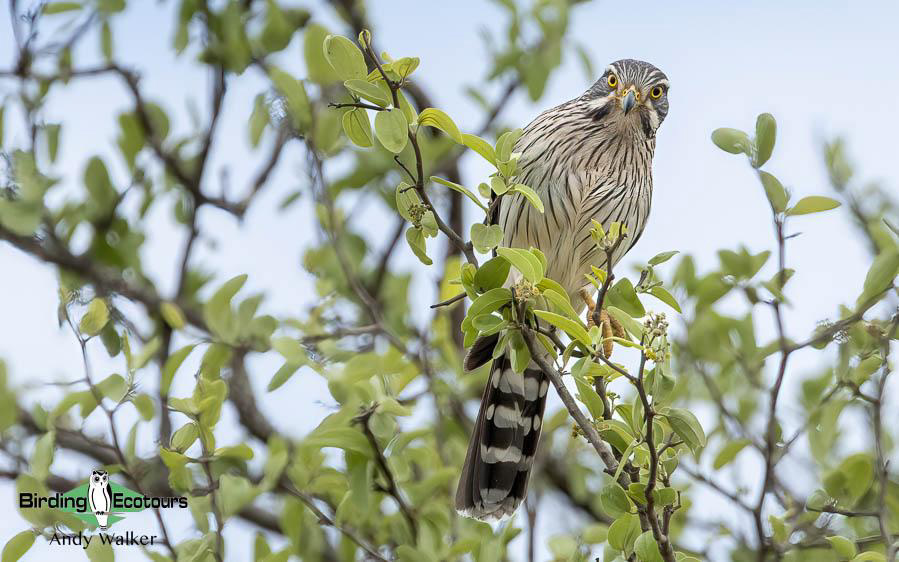
We enjoyed amazing views of the sought after Spot-winged Falconet in the Chaco forest.
Passerine highlights seen during the tour included many other top quality birds found in southern South America, including Sharp-tailed Streamcreeper, Lark-like Brushrunner, Giant Antshrike, White-throated Antpitta, White-tipped Plantcutter, Yungas Manakin, Many-colored Rush Tyrant, White Monjito, Andean Negrito, Andean Slaty Thrush, Plush-crested Jay, Scarlet-headed Blackbird, Brown-and-yellow Marshbird, Many-colored Chaco Finch, Pampa Finch, Boulder Finch, Puna Yellow Finch, Black-hooded Sierra Finch, Grey-hooded Sierra Finch, and Red-backed Sierra Finch.
We also found several great animals (many with fascinating names!), such as Guanaco, Vicuna, Common Mountain Viscacha, Conejo Del Palo (Chacoan Mara), Chilla (South American Grey Fox), Culpeo, Grey Brocket, Northwestern Red Brocket, Brazilian Guinea Pig, Andean Tuco-tuco, Mountain Degu, Argentine Black-and-white Tegu, Four-toed Tegu, and Chaco Tortoise. Bird and animal lists for this northwest Argentina birding tour follow the report.
Detailed Report
Day 1, 19th October 2025. Arrival in Buenos Aires, birding at Costanera Sur Ecological Reserve
After a morning arrival into Buenos Aires and some time to freshen up and take some lunch, we went for a relaxed walk around Costanera Sur Ecological Reserve, a stunning reserve sandwiched between the city and the coast. It was a great introductory birding session with over 50 species seen with minimal effort over a couple of hours. Some of the highlights included the giant Southern Screamer, several Black-necked Swans, many Rosy-billed Pochards, and lots of other ducks with young, including the attractive Silver Teal. Spot-flanked Gallinule, Red-fronted Coot, Common Gallinule, Great Grebe, and White-tufted Grebe were also seen in the marshy areas, which also held Rufescent Tiger Heron and Cattle Tyrant. The trees were busy with birds, and we saw Monk Parakeet, Rufous Hornero, Sooty-fronted Spinetail, Masked Gnatcatcher, Greyish Baywing, and Saffron Finches. Overhead Harris’s Hawk, Crested Caracara, Chimango Caracara, White-rumped Swallow, Blue-and-white Swallow, and Barn Swallow were all seen well.
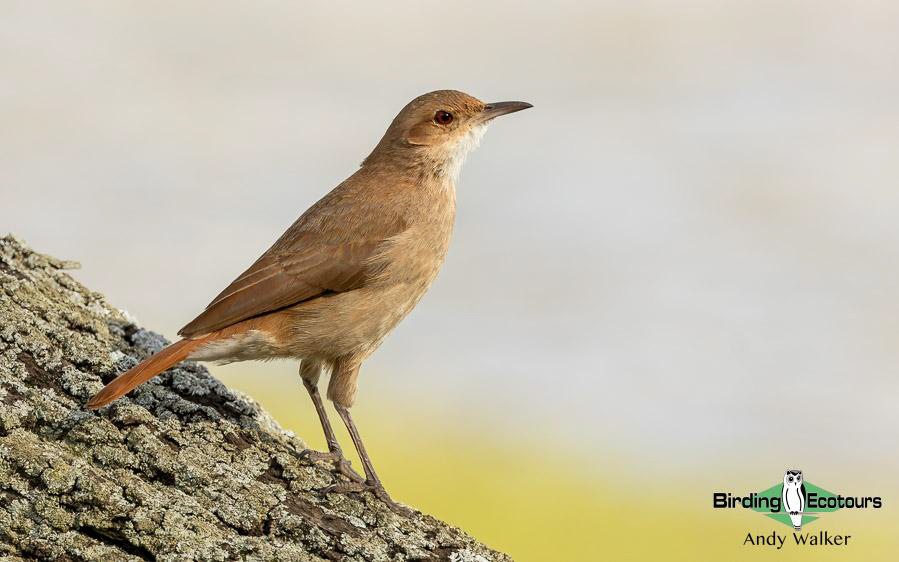
Rufous Hornero is an interesting and common sight while birding in Buenos Aires and we enjoyed watching them at close range as they tended their oven-like mud nests.
Day 2, 20th October 2025. Birding near Buenos Aires
We spent the day birding in a marshland to the north of Buenos Aires, where we found lots of great birds, but had to deal with pretty constant strong wind, which made birding tougher than was ideal. We first birded along a dusty track, where we found Picui Ground Dove, Brown-chested Martin, Grey-breasted Martin, Freckle-breasted Thornbird, Bran-colored Flycatcher, Brown-and-yellow Marshbird, and Black-and-rufous Warbling Finch.
Continuing on our way we found several massive Southern Screamers, a few Giant Wood Rails (and as their name suggests, they are also huge!), Rufous Horneros and Monk Parakeets both tending their nests. A pair of Ringed Teals burst out of the marsh and alighted in a tree close to us, and nearby we saw several Guira Cuckoos, Narrow-billed Woodcreeper, Spectacled Tyrant, Yellow-browed Tyrant, and Brown-capped Blackbird. Overhead were multiples of Rosy-billed Pochards, White-faced Whistling Ducks, Crested Caracaras, Chimango Caracaras, Snail Kites, Maguari Storks, and Bare-faced Ibises.
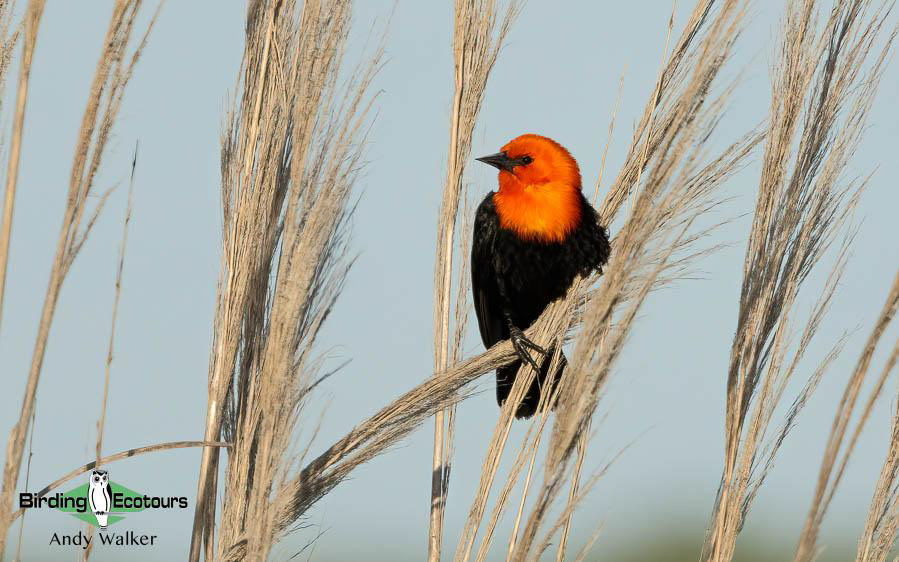
The stunning Scarlet-headed Blackbird showed nicely.
We spent a lot of time focusing on tough and secretive birds in the grasses, which was not easy given the wind, but we were successful in seeing additional Freckle-breasted Thornbirds, along with Yellow-bearded Reedhaunter, Curve-billed Reedhaunter, Spix’s Spinetail, and Rufous-capped Antshike. We also saw some showy Sooty Tyrannulets. Yellow-winged Blackbirds were quite numerous at one location we paused at, though they and most other birds of the day were outshone by several stunning Scarlet-headed Blackbirds. We enjoyed some nice looks at the beautiful Spectacled Tyrant, and other attractive birds seen included Long-winged Harrier, Green-barred Woodpecker, White Woodpecker, Vermilion Flycatcher, Pampa Finch, and Sayaca Tanager. As we scanned the marshes, we also noted Spot-flanked Gallinule, Striated Heron, Rufescent Tiger Heron, and Cocoi Heron.
After our day of birding we headed back into Buenos Aires for an impressive buffet dinner and packed up ready for our early morning airport trip tomorrow.
Day 3, 21st October 2025. Flight from Buenos Aires to Tucumán and transfer to Tafi del Valle
We took our morning flight from Buenos Aires across to Tucumán and all went nice and smoothly. After a quick baggage delivery we were soon on the road heading across the plains and into the mountains. As we gained elevation we made a couple of brief stops overlooking a river. We had some incredible views of a singing Andean Slaty Thrush, along with Rufous-bellied Thrush, Creamy-bellied Thrush, Chivi Viero, Tropical Parula, Golden-winged Cacique, Fawn-breasted Tanager, and Sayaca Tanager. Overhead we saw common species such as Roadside Hawk, Turkey Vulture, and Black Vulture.
At a slightly higher elevation, we stopped and scanned the river and were handsomely rewarded with great looks at both Torrent Duck and Rufous-throated Dipper. The Torrent Duck sighting included a lone male, which we saw first, followed by a male and female with three ducklings, all battling the rapids. The Rufous-throated Dipper flew in and sat on a rock under an overhanging cliff for a prolonged view, it even sang a couple of times. Great views were therefore had of two big tour targets. We continued our journey to Tafi del Valle, where, after a late lunch, we checked into our accommodation for the next two nights.
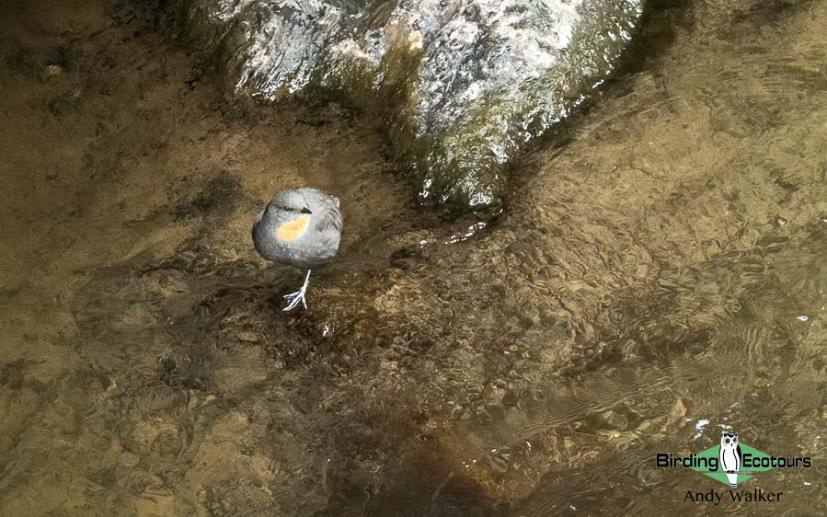
Rufous-throated Dipper was a big tour target that showed nicely.
In the late afternoon we visited a nearby lake, which was highly rewarding with lots of birds and interesting observations. The lake held a breeding colony of the attractive Grey-headed Gulls and Andean Gulls, and both species had young. Also breeding at the site were Black-necked (White-backed) Stilt, Southern Lapwing, Red-gartered Coot, Andean Coot, and Pied-billed Grebe. Great Grebes were present and showed better than our previous sighting. Neotropic Cormorants were positioned all along the lake shore and a flock of Coscoroba Swans and distant Andean Geese were noted, as were two distant Chilean Flamingos, Snowy Egret, Cocoi Heron, and Western Cattle Egret. Much closer to us, we enjoyed good views of Red Shoveler, Cinnamon Teal, Yellow-billed Teal, and Yellow-billed Teal, along with a couple of Greater Yellowlegs. A few Snowy-crowned Terns were seen, with one briefly landing near us, and giving some good views. Passerines were thin on the ground around the lake, though we had a close sighting of Yellowish Pipit.
Day 4, 22nd October 2025. Birding the Tafi del Valle highlands
We started our birding in a canyon below Tafi del Valle and successfully found our two main endemic targets, White-browed Tapaculo and Yellow-striped Brushfinch, and both showed nicely. Here we also found Variable Hawk, Red-tailed Comet, Streak-throated Bush Tyrant, Common Chlorospingus, and Brown-capped Whitestart.
As we drove to some higher elevations to continue our birding, we noted a pair of Burrowing Owls by the side of the road, and once we reached our intended birding spot, the new birds came quickly. Our main target was the endemic Tucuman Mountain Finch and it was one of the first birds we saw, with a pair of birds showing nicely.
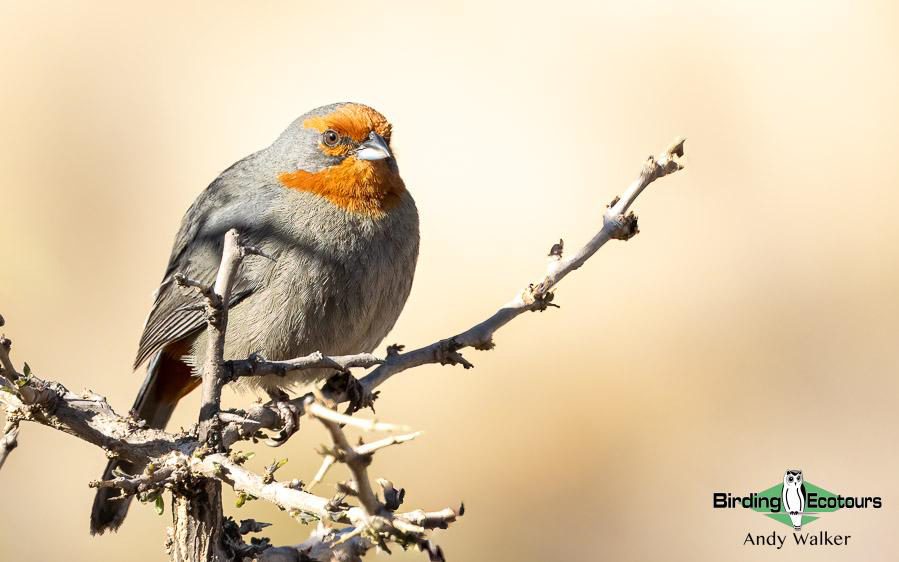
The endemic Tucuman Mountain Finch gave excellent close views.
Black-winged Ground Doves were coming to a waterhole to drink (as was a White-rumped Swallow), and a pair of Yellow-billed Teals were present too. As we explored the area, checking out the interesting vegetation as well as the birds, we saw Andean Tinamou and heard Huayco Tinamou, and also saw Streak-fronted Thornbird, White-browed Chat-Tyrant, Grass Wren, Hooded Siskin, and Plumbeous Sierra Finch. A pair of Red-tailed Comets were nesting and the male looked incredible, while a pair of Grey-hooded Parakeets remained distant, unfortunately. A couple of Brazilian Guinea Pigs were seen briefly too.
We gained some further elevation, picking up Andean Condor and Black-chested Buzzard-Eagles along the way. On reaching our next birding spot, at just over 9,800 feet (3,000 meters), we commenced a hike up a river valley. A stunning location full of interesting birds, plants, and rocks. We quickly found Cream-winged Cinclodes, Black Siskin, and Ash-breasted Sierra Finch. Another endemic was quick to fall, and we enjoyed some very close views of multiple Moreno’s Ground Doves as they came to a puddle to drink. While we hiked through the river valley we picked up multiple furnarids (ovenbirds), including Buff-breasted Earthcreeper, Brown-capped Tit-Spinetail, Streak-fronted Thornbird, Rusty-vented Canastero, Streak-backed Canastero, Cordilleran Canastero, and Scribble-tailed Canastero. Many of these were breeding, with birds noted entering nest burrows, or flying around with food or nesting material. Also present during our hike were Rufous-naped Ground Tyrant, d’Orbigny’s Chat-Tyrant, Plumbeous Sierra Finch, Plain-colored Seedeater, and Hellmayr’s Pipit. The commonest species were the ever present Rufous-collared Sparrow and Chiguanco Thrush. After an enjoyable morning and with threatening looking clouds building, we came back down to Tafi del Valle for lunch and a siesta.
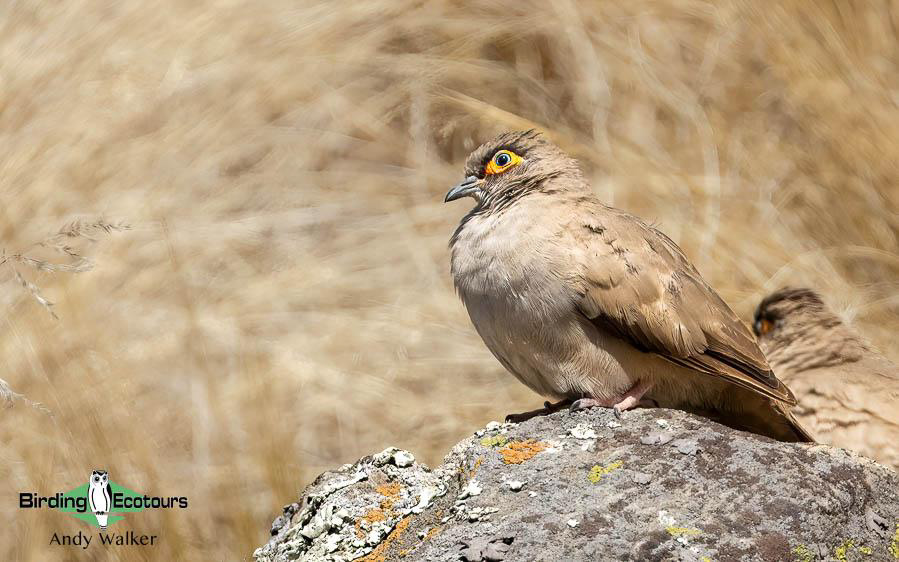
The endemic Moreno’s Ground Dove was seen very well.
In the late afternoon we again visited the nearby lake and gained repeated views of the species seen the previous afternoon. We did however enjoy better and closer views of both Andean Goose and Chilean Flamingo. Breeding birds were much in evidence all around the lake, and included Andean Coot, Red-gartered Coot, Pied-billed Grebe, Grey-headed Gull, Andean Gull, Southern Lapwing, and Black-necked (White-backed) Stilt. A pair of Southern Screamers were also present, sitting on the lake shore with a large flock of Neotropic Cormorants.
Day 5, 23rd October 2025. Birding the monte desert
We left Tafi del Valle after breakfast and drove over the mountain pass down to the town of Cafayate, a big wine region, where we arrived in time for lunch. We made several birding stops along the way, picking up a wide range of exciting birds.
At our first stop we had a huge flock of Greenish Yellow Finches, along with Ash-breasted Sierra Finch and several Band-tailed Sierra Finches. We also had good views of two or three Ornate Tinamous, Moreno’s Ground Dove, and a flock of Burrowing Parrots. Our next stop, a bit lower in elevation, gave us several new trip birds, like Rufous-banded Miner, Plain-mantled Tit-Spinetail, Patagonian Mockingbird, and Grey-hooded Sierra Finch. We also had improved views of Streak-fronted Thornbird, Rusty-vented Canastero, and Plain-colored Seedeater. Several further stops, in an area full of stunning cacti, gave us our first Andean Swifts, White-fronted Woodpeckers, White-winged Black Tyrant, and Cliff Flycatcher of the tour. We also saw even more Burrowing Parrots and Patagonian Mockingbirds.
We made a longer stop in a dry valley, where we saw our main endemic target of the morning, Sandy Gallito, a member of the tapaculo family found in the monte desert of Argentina. Unfortunately, the other endemic of the region, White-throated Cachalote, was heard only distantly, though we did see evidence of many of their older nests. Here we also found Mountain Parakeet, Greater Wagtail-Tyrant, Black-crowned Monjita, Ringed Warbling Finch, and Diuca Finch. Nearby, we also found our first White Monjita of the trip – a stunning bird indeed.
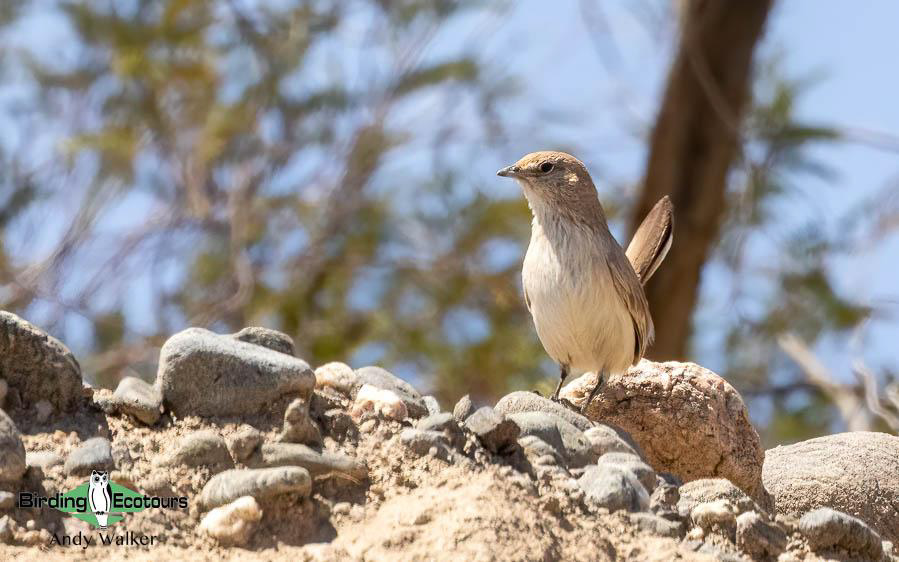
The Argentinian endemic Sandy Gallito had a far-carrying call.
Over our lunch in Cafayate we had a Southern Martin cruising around overhead, while a Harris’s Hawk built a nest in the town square, and Rufous Hornero, Cattle Tyrant, and Saffron Finch all foraged on the lawn.
After a siesta we took a drive out of town to an area of geological interest and while doing so we found another Argentinian endemic, with a pair of nesting White-throated Cacholotes showing very nicely. We saw dozens of dazzling Grey-hooded Sierra Finches and had our best looks at Rufous-banded Miner, Hooded Siskins, and Golden-billed Saltator. A very vocal Chaco Earthcreeper eventually showed well, we enjoyed further sightings of Andean Swifts (a noisy pair of birds screaming overhead), and another singing White-winged Black Tyrant. Here ended another enjoyable day of birding in northwest Argentina.
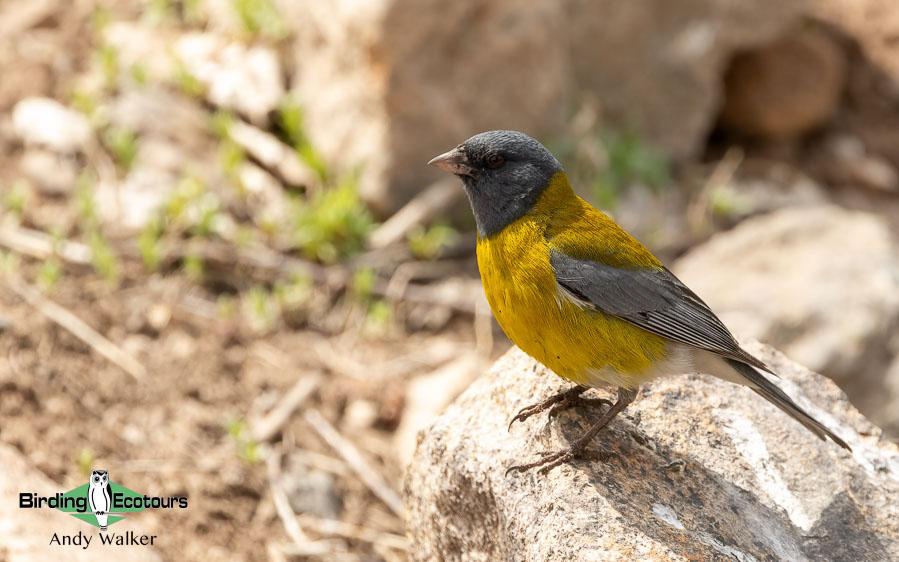
Grey-hooded Sierra Finch provided a splash of color and is endemic to Argentina and Chile.
Day 6, 24th October 2025. Cafayate to Chicoana
We spent the morning driving from Cafayate to Chicoana. Our drive took us through some spectacular scenery, and we made several stops to soak in the wonderful sights. We also found plenty of great birds as we followed the river valley. The top bird of the morning was Monte Yellow Finch, another Argentinian endemic, which eventually showed nicely after checking several spots for them. Firstly a female, quickly followed by a stunning male that showed very nicely. Other birds seen on our scenic drive included Andean Condor, American Kestrel, Andean Swift, Burrowing Parrot, Sandy Gallito, Cliff Flycatcher, Southern Martin, Diuca Finch, and Blue-and-yellow Tanager. We also enjoyed sightings of three different Chillas (South American Grey Foxes).
A pre-lunch stop at a wetland near our accommodation was very productive, despite the heat and here we found a range of species. A huge Southern Screamer was present on the lake shore and numerous ducks of multiple species were present, including White-cheeked Pintail, Ringed Teal, Brazilian Teal, Silver Teal, Rosy-billed Pochard, and Fulvous Whistling Duck. Several White-faced Ibises were in evidence, as were Great Egrets, Western Cattle Egrets, Black-crowned Night Herons, White-winged Coots, and Red-fronted Coots. A couple of Savanna Hawks and Crested Caracaras were present and occasionally causing the waterbirds to flush. Around the edge of the lakes we found Chaco Chachalaca, Picui Ground Dove, Green-barred Woodpecker, Rufous-fronted Thornbird, Rufous Hornero, Fork-tailed Flycatcher, White Monjita, Yellow-billed Tit-Tyrant, Black-capped Warbling Finch, Red Pileated Finch, and Many-colored Chaco Finch.
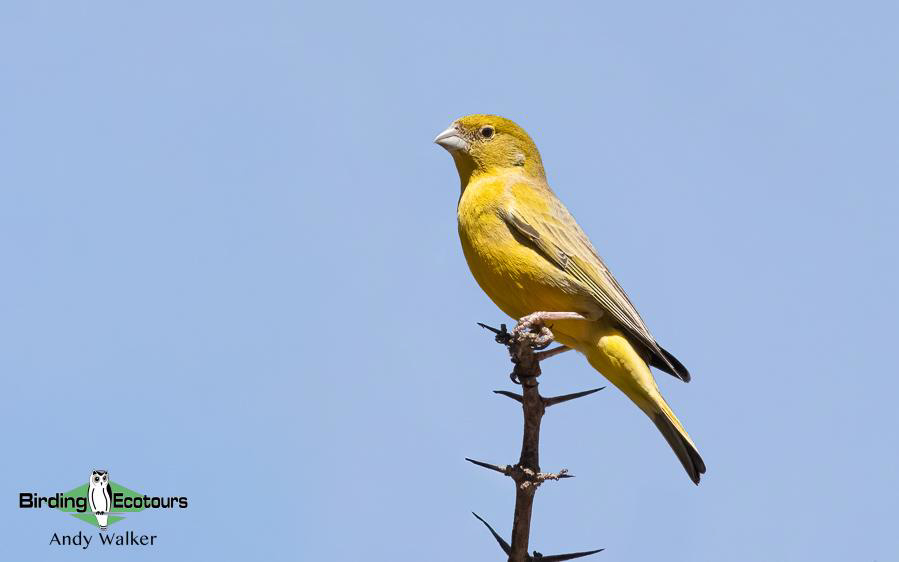
Monte Yellow Finch eventually gave us some really nice views at an incredible geological site.
In the late afternoon we had some relaxed birding around our accommodation grounds, picking up several great birds, the best being the scarce and uncommon Tucuman Amazon. We also enjoyed our first sighting of the spectacular Plush-crested Jay and vociferous Crested Oropendola. A fruiting mulberry tree was pulling in numerous species and we had good views of Ultramarine Grosbeak, Orange-billed Saltator, Blue-and-yellow Tanager, Yungas Sparrow, Black-capped Warbling Finch, and Red Pileated Finch. A pair of Variable Orioles passed through the garden and a Rufous-browed Peppershrike showed well nearby. We then enjoyed a fabulous home cooked dinner (and locally made delicious wine) at our accommodation.
Day 7, 25th October 2025. Birding Los Cardones National Park
We spent the day birding at Los Cardones National Park, another simply stunning landscape full of interesting and sought after birds. We left our accommodation after an early breakfast, and as we drove up to around 9,800 feet (3,000 meters) we made a few stops along the way, finding Moreno’s Ground Dove, Yungas Dove, Andean Condor, Red-tailed Commet, White-tipped Plantcutter, Yellow-browed Tyrant, Tufted Tit-Tyrant, Tucuman Mountain Finch, and the most hoped for Rufous-bellied Mountain Tanager along the way.
Once in the national park the birds came quickly and it was rather exciting. We had a showy pair of Andean Flickers – large, primarily ground-feeding woodpeckers, a flight-displaying Slender-billed Miner, a close up Black-billed Shrike-Tyrant, a cute Spot-billed Ground Tyrant, and many finches of several species. After a strategic stop we were getting some close views of a pair of the rather tiny Puna Snipe. Following a change of location we were suddenly eye-to-eye with a pair of roosting Lesser Horned Owls, which was a fantastic sight, and nearby we got good views of Andean Hillstar, Zimmer’s Tapaculo, Chaco Earthcreeper, Streak-fronted Thornbird, Black Siskin, and Common Mountain Viscacha – an interesting looking mammal.
After an early picnic lunch (with Andean Condors overhead), and with the threatening-looking clouds starting to come up the valley we again changed areas within the park. A fortuitous stop at a small wetland yielded Andean Goose, Yellow-billed Teal, Yellow-billed Pintail, Andean Lapwing, Baird’s Sandpiper, and Cinereous Ground Tyrant. However, probably the most thrilling sight was watching a confrontation between a pair of Aplomado Falcons and a pair of Crested Caracaras – the falcons were not happy at the presence of caracaras in their territory.
Our next stop in the national park was the plateau at around 10,800 feet (3,300 meters). Here we got some close looks at a group of Guanacos (a large mammal in the camel family) and this was quickly followed by a pair of Least Seedsnipes and a small group of gorgeous Tawny-throated Dotterels – a tour highlight. We followed this up by a drive around different areas of the park taking in some scenic views, including a few cactus. We then drove down off the mountain through the cloud and some rain before arriving back at our comfortable accommodation.
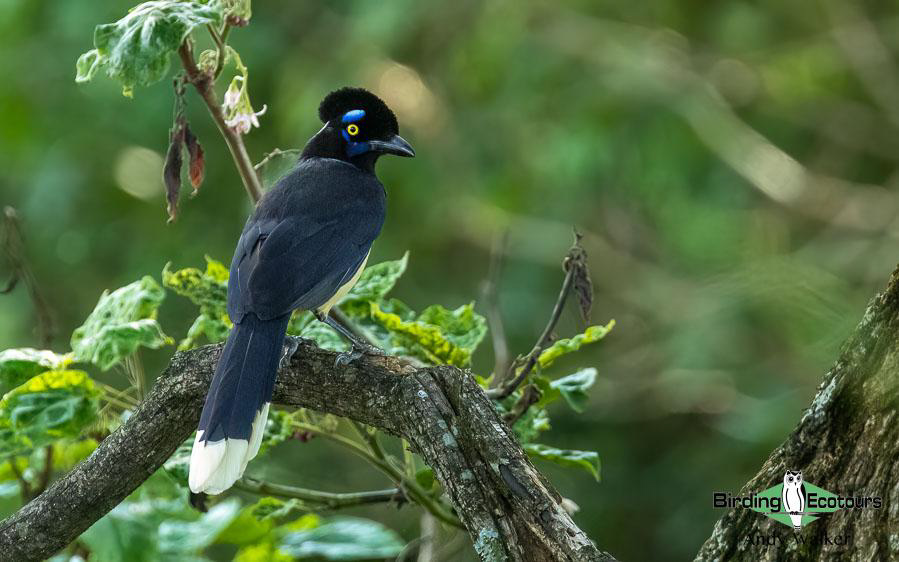
The strikingly plumaged Plush-crested Jay was a feature of our time in Chicoana.
A short walk before dinner in our accommodation grounds resulted in sightings of many of the species seen the previous afternoon, such as Plush-crested Jay, Crested Oropendola, Red Pileated Finch, and Ultramarine Grosbeak. The walk also gave up a few new birds too, such as Whistling Heron, Buff-necked Ibis, Bran-colored Flycatcher, Southern Yellowthroat, and Black-backed Grosbeak. We ended the action-packed and bird-filled day with another lovely home cooked meal.
Day 8, 26th October 2025. Chicoana to Las Lajitas
After an early breakfast we left Chicoana and drove for a couple of hours into a wonderful area of Chaco habitat, featuring a mix of farmland and a great wetland area near General Güemes. We spent a few hours birding here, and saw a huge number of species and individual birds.
At our first stop we found a lot of action, including Small-billed Elaenia, Large Elaenia, Cinereous Tyrant, Crowned Slaty Flycatcher, Variable Oriole, Tropical Parula, Ultramarine Grosbeak, Black-capped Warbling Finch, Red Pileated Finch, Golden-billed Saltator, and many other birds.
After continuing to a different area we spotted our first Red-legged Seriema, it was a bit distant, though there was no need to worry about that as we saw plenty more at a much closer range over the next couple of hours, getting repeated great views as we continued our exploration. While driving along a farm track we had perched views of both Scaly-headed Parrots and Blue-crowned Parakeets,and while checking these out we also saw Brushland Tinamou, Yungas Guan, Chaco Chachalaca, Guira Cuckoo, Great Black Hawk, Black-chested Buzard-Eagle, Spot-backed (Chaco) Puffbird, Aplomado Falcon, Grassland Sparrow, and Many-colored Chaco Finch.
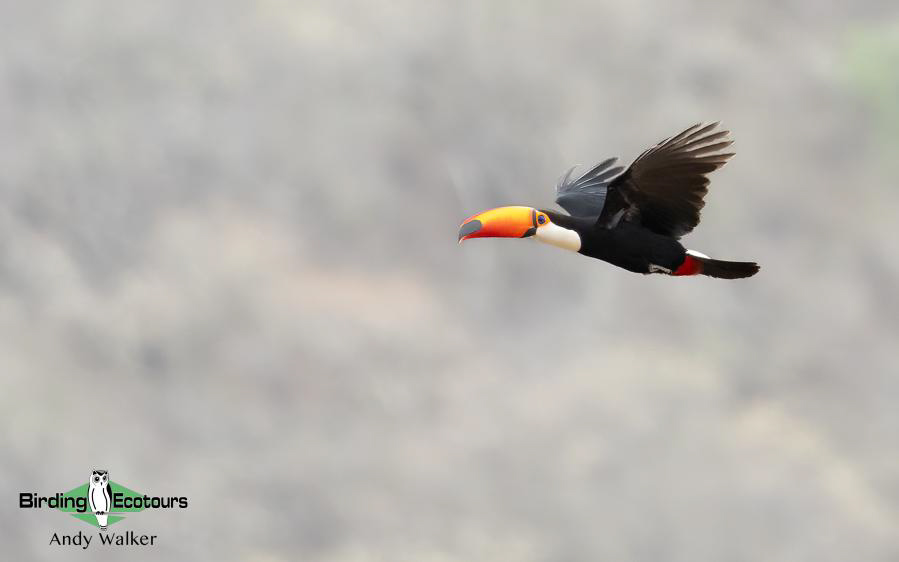
Toco Toucan gave a nice fly by view after we’d watched several birds feeding in a fruiting tree.
The wetland area we reached was absolutely buzzing with birds. One of the highlights on our arrival was a flock of vocal Toco Toucans – always a stunning sight and quite the distraction! As we scanned the waterbody we found that Coscoroba Swans were nesting, as were Pied-billed Grebe and White-winged Coot. A pair of huge Comb Ducks dwarfed nearby species, which included Ringed Teal, Brazilian Teal, and White-cheeked Pintail. Ruddy (Andean) Ducks were numerous on the lake, a few Great Grebes were interspersed in their flock, and a lone Muscovy Duck was keeping to the shadows. Wattled Jacanas were vocal and feeding on the lake edge, along with Black-necked (White-backed) Stilts, Bare-faced Ibis, White-faced Ibis, and gorgeous Buff-necked Ibis. Black-crowned Night Heron and Striated Heron were keeping themselves fairly hidden, but a Snowy Egret was foraging out in the open. Overhead Andean Condor was noted, as were an adult and juvenile Great Black Hawk, half a dozen Sick’s Swifts, and several species of hirundines, including Southern Martin and Southern Rough-winged Swallow. Wren-like Rushbird was vocal in a reedbed and Black-legged Seriema was heard calling distantly, but remained hidden. A range of flycatchers were sallying for insects along the edge of the lake, and included the impressive Fork-tailed Flycatcher and attractive White Monjita, while the periphery vegetation was full of doves, pigeons, finches, and seedeaters.
After a great morning of birding we continued our journey towards Las Lajitas, stopping for some empanadas for lunch along the way. We made another stop at a small wetland on a finca, which was surprisingly productive, here we found several species seen earlier in the day, but also added Least Grebe and Chilean Flamingo, and improved our views of Muscovy Duck and Ringed Teal. A few Andean Condors were doing aerobatics above us and a striking King Vulture graced us with its presence. Around the finca buildings we also saw Giant Cowbird, Screaming Cowbird, Shiny Cowbird, and Greyish Baywing. Continuing the final part of our journey we picked up Whistling Heron, Savanna Hawk, Burrowing Owl, American Kestrel, Red-legged Seriema, Grassland Sparrow, and Pampa Finch, before arriving at our accommodation for the next two nights.
Day 9, 27th October 2025. Chaco birding around Las Lajitas and Taco Pozo
We enjoyed a sensational day of Chaco birding out from our base at Las Lajitas with many high quality and new species seen well. We made some random roadside stops when we picked up birds of note whilst driving, and made a couple of longer walks, drives, and stakeouts for key birds once in good habitat.
As we started out from our accommodation a pair of cute and rather characterful (and well named) Lark-like Brushrunners flew in and landed on the lawn right in front of us, giving excellent views. As we drove through arable farmland interspersed by flooded areas and small woodland patches, we found Greater Rhea, Comb Duck, Maguari Stork, Guira Cuckoo, Smooth-billed Ani, Spot-winged Pigeon, Cream-backed Woodpecker, Red-legged Seriema, Monk Parakeet (hundreds of nesting birds seen everywhere we went today!), Aplomado Falcon, Brown Cacholote, Pampa Finch, and Many-colored Chaco Finch, to name a few.
Our first scheduled stop was at a wetland with some adjacent woodland. Shortly after our arrival at the site a Peregrine Falcon was spotted hunting the area. It put up a load of waterbirds, including a large flock of Comb Ducks, Fulvous Whistling Ducks, White-faced Whistling Ducks, White-faced Ibises, and Roseate Spoonbills. Several species, such as Brazilian Teal, Ringed Teal, and Rosy-billed Pochards remained on the water, along with Least Grebe and Common Gallinule.
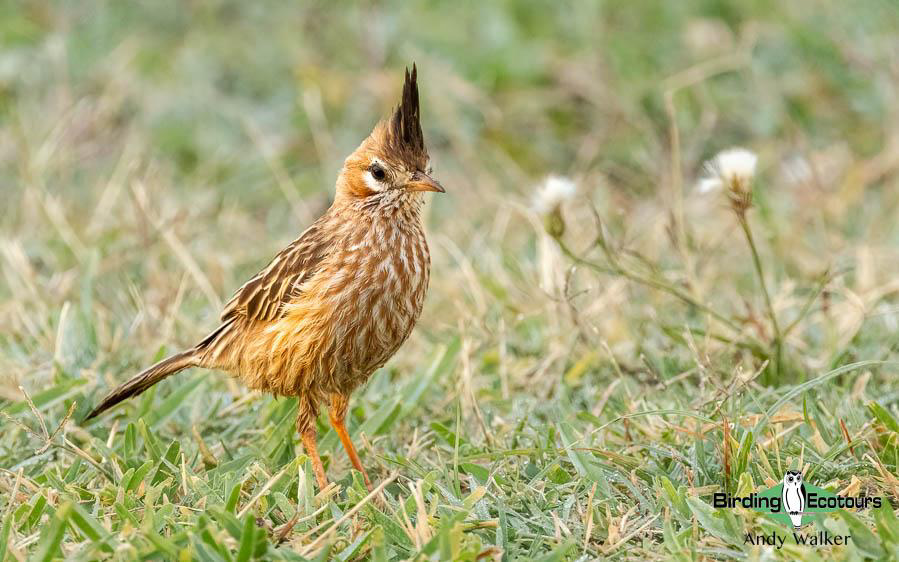
Lark-like Brushrunner was an exciting sight on the lawn outside our accommodation.
A pair of Black-backed Water Tyrants were flycatching along the edge of the lake and this vegetation also gave us some great looks at a beautiful Southern Yellowthroat. A couple of Snail Kites were working the area too, with a scattering of Fork-tailed Flycatchers and Wattled Jacanas. We also had a brief sighting of a Grey Brocket (a native deer species), though it was flushed by a truck all too quickly.
After finishing up at the lake we took a short walk through some woodland, where after not too long we found our main target – the rare (and rather attractive and impressively large) Black-bodied Woodpecker. We enjoyed great views of this mega woodpecker, a male, that even did some drumming for us. While birding in this area we also found Lesser Yellow-headed Vulture, White-fronted Woodpecker, Great Antshrike, Chivi Vireo, Solitary Cacique, and Grassland Yellow Finch. Monk Parakeets and an assortment of pigeons and doves were abundant. A most impressive sight involved a low-flying Southern Screamer, which landed on the top of a nearby tree, where it then sat and gave some nice close perched views.
After the success with the big woodpecker target, we continued to another woodland patch in a much drier area. As we were driving into some nice habitat we quickly (and rather luckily) found a low perching Spot-winged Falconet, which showed incredibly well. A bit further into the habitat we parked up and spent a wonderful session of birding, finding many species, including Quebracho Crested Tinamou, White-barred Piculet, White Woodpecker, Crested Hornero, Crested Gallito, and numerous tyrant flycatchers, including Brown-chested Flycatcher, Suiriri Flycatcher, Straneck’s Tyrannulet, and Southern Scrub Flycatcher.
Moving on to our final birding spot in the woodland we quickly found our hoped for Black-legged Seriema, which showed really nicely and was a particularly attractive bird. Here we also found several other great birds, including the staggeringly large billed Scimitar-billed Woodcreeper, a Narrow-billed Woodcreeper, more Lark-like Brushrunners, these ones tending to their twiggy nests, the rather cute Greater Wagtail-Tyrant (our best views to date of this species), and more, including a Conejo Del Palo (also known as Chacoan Mara) and Chaco Tortoise.
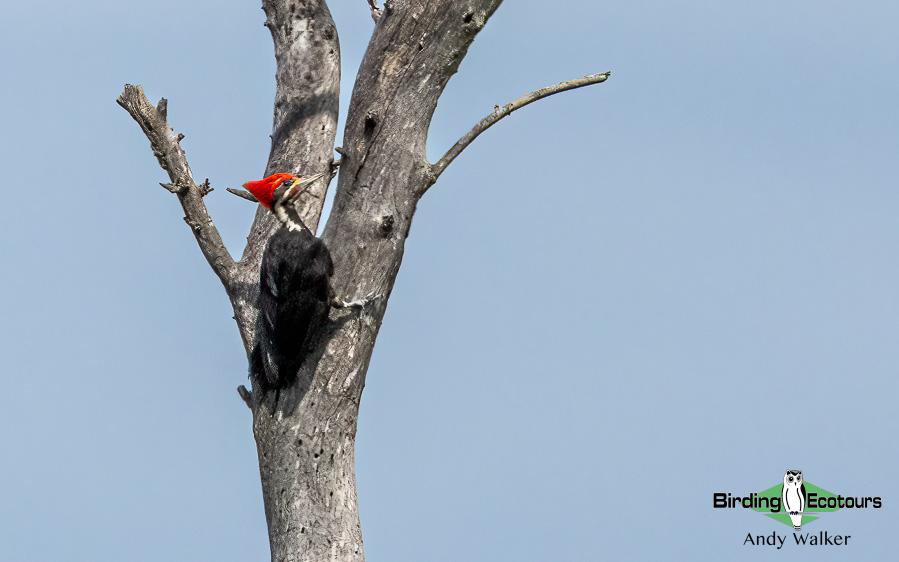
We were thrilled to get a good sighting of the rare Black-bodied Woodpecker.
As we drove the long way back to our accommodation at Las Lajitas during the afternoon we picked up White-tailed Kite, Savanna Hawk, Great Black Hawk, Black-chested Buzard-Eagle, Burrowing Owl, Aplomado Falcon, American Kestrel, and White-browed Meadowlark, amongst others. On arrival back at our accommodation the Lark-like Brushrunners were present to greet us, a pair of Variable Oriole were in a palm tree, and a small group of White-collared Swifts were overhead to round off a seriously good day of birding.
Day 10, 28th October 2025. Las Lajitas to Libertador General San Martin and birding in Calilegua National Park
We awoke to a cold, wet, and gusty morning in Las Lajitas and after breakfast commenced our journey west, after again having some sightings of the local Lark-like Brushrunners. During the journey we noted many Plush-crested Jays on the roadside, and several other species we’d seen lots of times before. We made a stop at a river which was very productive, with masses of activity after the rain had paused. Small-billed Elaenia, Large Elaenia, Brown-crested Flycatcher, Cliff Flycatcher, and several other flycatcher species were seen. Plenty of Southern Martins and Southern Rough-winged Swallows were hawking insects low over the river, on which a pair of Muscovy Ducks and a Neotropic Cormorant were present. A fruiting tree was busy with Blue-and-yellow Tanagers and plenty of other birds seen, including the attractive Red Pileated Finch. We then continued our journey to Libertador General San Martin, making a brief stop at another river, where we saw White-faced Ibis, White-cheeked Pintail, White-eyed Parakeet, and several Toco Toucans, arriving in town in time for lunch.
In the afternoon we made our first birding trip to Calilegua National Park, focusing on the lower elevations of the park and the entrance road. Most of the birds seen were new for the trip, which was rather exciting. Along the entrance road we found perched Plumbeous Kites, the secretive Ochre-cheeked Spinetail, beady eyed Pearly-vented Tody-Tyrant, treetop dwelling Rough-legged Tyrannulet, and several chunky Yungas Guans.
Within the park itself we found several new species of parrots, including Turquoise-fronted Amazon, Green-cheeked Parakeet, and Golden-collared Macaw, as well as the now familiar Scaly-headed Parrot, all four species rather beautiful sights. As we were looking for the parrots we also had sightings of the tiny and incredibly cute Ochre-faced Tody-Flycatcher, along with Moss-backed Sparrow, Mottle-cheeked Tyrannulet, and a pair of Hepatic Tanagers. We also picked up a couple of mixed species feeding flocks and given our position were able to get fantastic (eye-level or below) looks at Streaked Xenops, Yellow-olive Flatbill, Chivi Vireo, Two-banded Warbler, Orange-headed Tanager, Guira Tanager, and Chestnut-vented Conebill. Blue-crowned Trogon put in a brief appearance for some but heard by others, but Amazonian Motmot and Giant Antshrike were heard only and would be looked for over coming days.
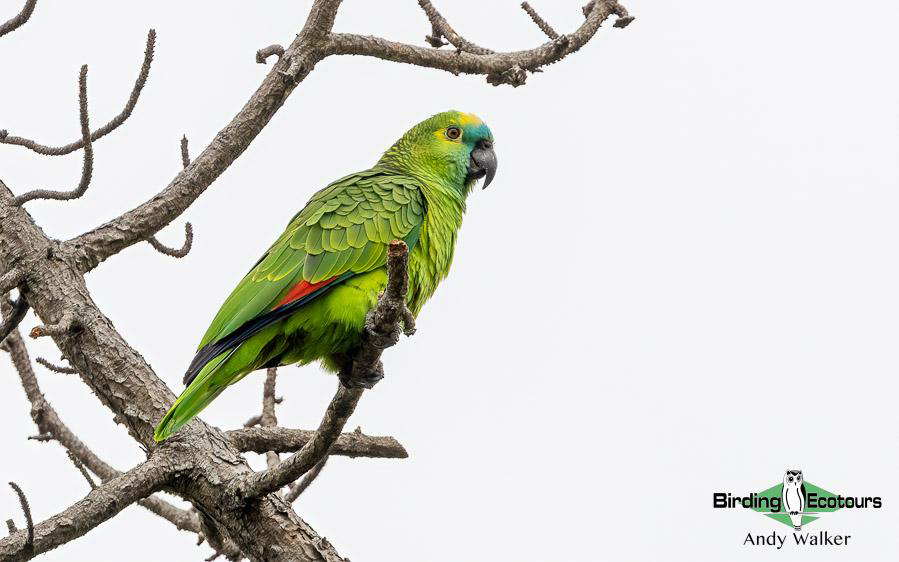
Turquoise-fronted Amazon, is a stunning and large parrot.
Day 11, 29th October 2025. Birding Calilegua National Park
We spent the majority of the day birding in and around Calilegua National Park, however the weather was poor throughout the day, with very low cloud, lots of drizzle and temperatures way below where they should have been for the time of the year. However, we tried to make the most of the day as we were in some gorgeous forest with lots of new and thrilling bird possibilities. As we drove into the park, a Grey-cowled Wood Rail walked across the road and numerous Yungas Guans were sat on the roadside verges, looking a bit damp and miserable. As we gained some elevation we proceeded to higher ground than the previous afternoon and made a brief stop when a Smoke-colored Pewee was spotted from the vehicle. A subsequent short walk in the forest here gave us sightings of Buff-browed Foliage-gleaner, Streaked Flycatcher, Two-banded Warbler, Tropical Parula, and Fawn-breasted Tanager.
Continuing up the mountain until another stop, the result of a pair of Moss-backed Sparrows flying across the road, gave us a fair bit of activity, with Dot-fronted Woodpecker, Buff-browed Foliage-gleaner, Azara’s Spinetail, Slaty Elaenia, Highland Elaenia, and Sclater’s Tyrannulet all seen. The area was busy with thrushes and tanagers (and allies) feeding on fruiting bushes, with Andean Slaty Thrushes, Rufous-bellied Thrushes, Fawn-breasted Tanagers, Orange-headed Tanagers, and Common Chlorospingus making up the bulk of numbers, however a single Speckled Nightingale-Thrush, several migrant Swainson’s Thrushes (our first of the tour) and a gorgeous pair of Fulvous-headed Brushfinches were also noted.
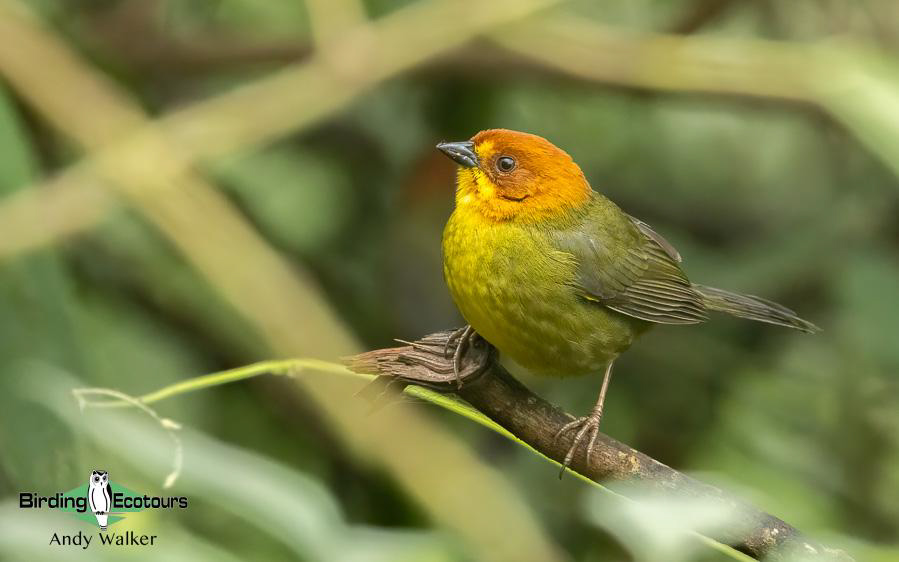
The pretty Fulvous-headed Brushfinch is found in just a small area of Argentina and Bolivia.
Several warblers were also present in the same area, no doubt attracted by all of the activity, and included Tropical Parula, Pale-legged Warbler, Two-banded Warbler, and Brown-capped Whitestart. Several species were heard but, given the conditions, were not visible, these included both White-throated Antpitta and Yungas Manakin, we would have to hope for better luck for these and the weather tomorrow.
Further driving around the park road and to the nearby village of San Francisco, where we had a welcome warming drink and lunch, gave us further poor weather. Despite the weather we still found several interesting birds, with highlights including Pale-vented Pigeon, Swallow-tailed Kite, Planalto Hermit, White-throated Tyrannulet, Sclater’s Tyrannulet, Euler’s Flycatcher, and Mountain Wren. Unfortunately, a White-throated Quail Dove that flew off the road was not seen by everyone. Given the continued poor weather we decided to cut our losses and drop down to some different habitat at a lower elevation, where we hoped conditions would be better.
After a short drive we arrived along the San Francisco River, where in a short amount of time we amassed a large list of species. Straight out of the vehicle we found Variegated Flycatcher (along with four other large common tyrant flycatchers), as well as Sooty Tyranulet, Ochre-faced Tody-Flycatcher, and Pearly-vented Tody-Tyrant, and soon after our first Yellow-billed Cardinals and first proper looks at Bluish-grey Saltators. Careful scanning along the river resulted in a sighting of some distant shorebirds, so we commenced a short walk along the river to get a bit closer, this resulted in us having some very nice looks at two White-rumped Sandpipers and a pair of Collared Plovers. The river was busy, with Bare-faced Ibises, Roseate Spoonbills, Wood Stork, Great Egret, Snowy Egret, and Neotropic Cormorants all present. A lone Large-billed Tern flew over, as did a pair of Amazon Kingfishers. Scanning of the sky resulted in good views of huge White-collared Swifts and much smaller Sick’s Swifts, along with many hirundines and a small group of Swallow-tailed Kites. Parrots were also much in evidence, with five species seen, including some very nice flyover views of Golden-collated Macaws. We rounded the day off with a big warming dinner back in town and hoped for better weather for tomorrow.
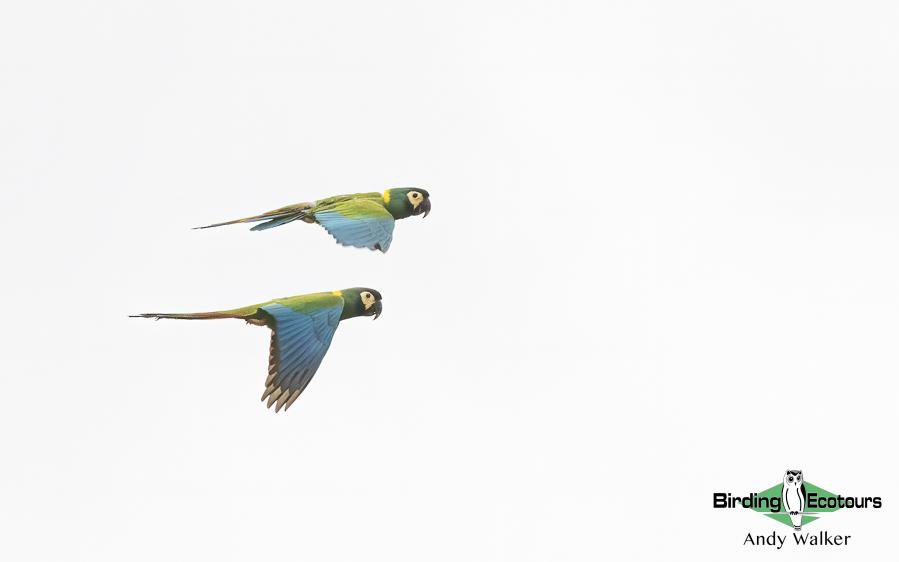
It was nice to see Golden-collared Macaws in flight after previously seeing them perched.
Day 12, 30th October 2025. Birding Calilegua National Park
Our second day of birding at Calilegua National Park and surrounds featured moderately better weather conditions, the morning wasn’t great but the late afternoon was much better. However, despite the challenges we still found some really great birds by birding across a range of elevations and by trying to avoid the worst of the weather. The highlights included seeing a singing White-throated Antpitta at very close range and getting walk-away views of a stunning and massive Giant Antshrike – what an incredible bird! The “supporting cast” for the day wasn’t too bad either! We recorded many of the species we had seen the previous day, but new birds (or better views of birds seen before) included Pale-vented Pigeon, White-tipped Swift, Blue-capped Puffleg, Slender-tailed Woodstar, Swallow-tailed Kite, Blue-crowned Trogon, Great Rufous Woodcreeper, Sharp-tailed Streamcreeper, Sclater’s Tyrannulet, Buff-banded Tyrannulet, Plumbeous Tyrant, Streak-throated Bush Tyrant, Yungas Manakin, Glossy-black Thrush, White-browed Brushfinch, Fulvous-headed Brushfinch, Golden-winged Cacique, and Black-backed Grosbeak. In the late afternoon, as we left the site for the final time, the cloud had lifted enough for us to finally see what a beautiful place it was, stunning forest. Despite the less than ideal weather for the majority of our time in the area we left very happy with the species we had seen, which had included some really special birds that will be remembered for a long time.
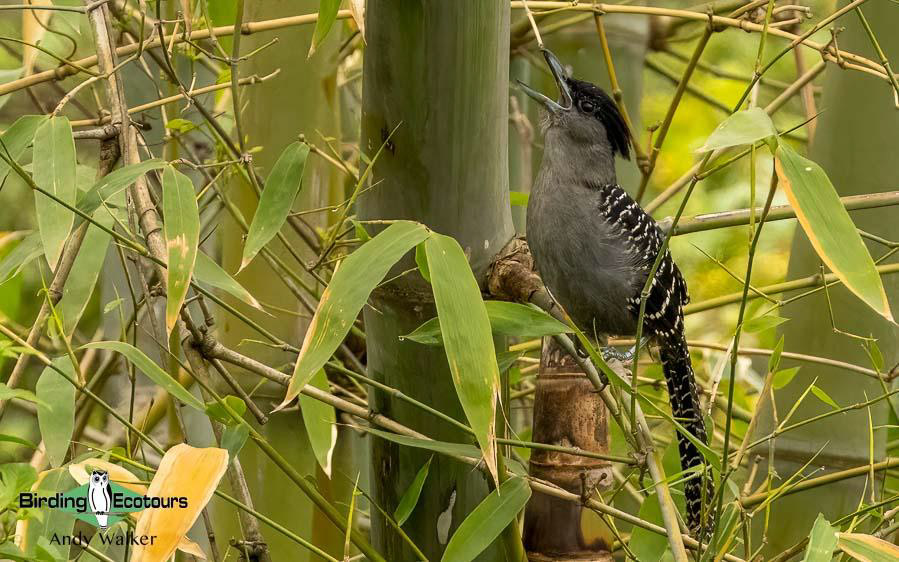
Giant Antshrike is very well named! This male interrupted our lunch as it started calling in the garden below us. After quickly finishing up our welcome warm meal we quickly found this ginormous antshrike as it continued singing, and we eventually left it still doing so… this species has a length of 14.2 inches (36 centimeters)!
Day 13, 31st October 2025. Libertador General San Martin to Yala Provincial Park
We left Liberatador General San Martin after breakfast and continued our tour around northwest Argentina. We arrived at the picturesque Yala Provincial Park in the middle of the morning and immediately commenced our birding with a walk along the river. We quickly found a small group of Yungas Guans in trees around the river and while scanning the area we picked up our first Rusty-browed Warbling Finches, along with White-throated Tyrannulet and several other flycatchers.
We took a drive around a gorgeous valley, seeing plenty of great birds along the way, with some of the highlights including good views of Dot-fronted Woodpecker, Spot-breasted Thornbird, Buff-browed Foliage-gleaner, Azara’s Spinetail, Crested Becard, Chilean Elaenia, Smoke-colored Pewee, Plumbeous Black Tyrant, Yellow-browed Tyrant, Fulvous-headed Brushfinch, Black-backed Grosbeak, Black-and-chestnut Warbling Finch, Band-tailed Seedeater, and Plain-colored Seedeater.
Later in the morning we stopped at a small lake, where we saw lots of Snowy Egrets and Neotropic Cormorants, White-winged Coots, and Pied-billed Grebes, and a few Black-crowned Night Herons, Black-necked (White-backed) Stilt, Yellow-billed Teal, and Yellow-billed Pintail. Overhead we noted Andean Condor, Swallow-tailed Kite, and Roadside Hawk, the latter dropping down to the lake for a drink.
At the end of the morning, as we were driving out of the park we found another of our target birds, the near-endemic Red-faced Guan. We found a small group of four birds sitting in the shade near the ground and they allowed for close views. Happy with our success we checked into our new hotel, grabbed some lunch, and enjoyed a relaxing afternoon.
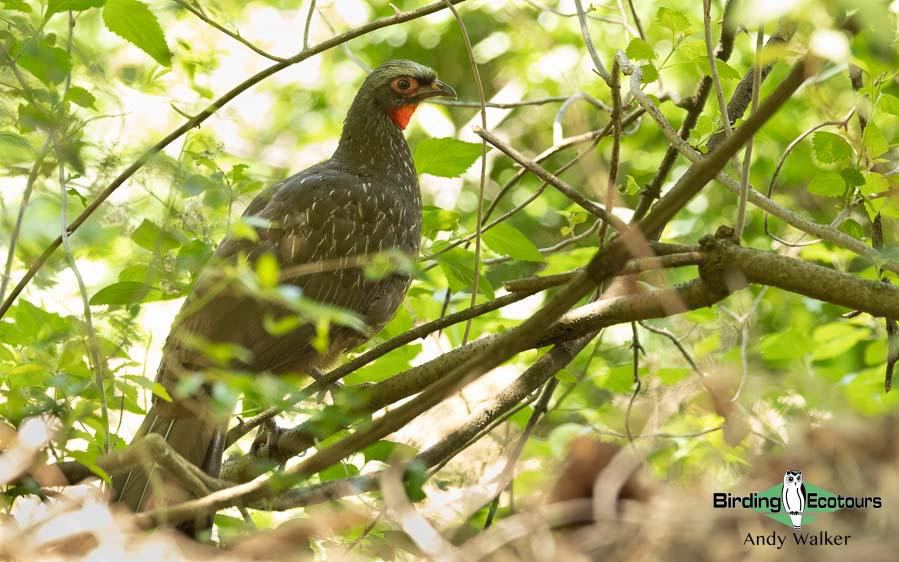
We were successful in our search for Red-faced Guan while birding in Yala Provincial Park.
In the late afternoon we again visited Yala Provincial Park, where we found a few more good birds, however, prior to that, right near our accommodation we had a flock of around 40 Tucuman Amazons feeding in a mulberry tree, it was such an incredible sight to have them low down, feeding, and totally unbothered by our presence.
Once back in the park, we drove up the mountain to a spot that was productive in the morning and we saw several of the same species from earlier in the day, including Red-tailed Comet, Spot-breasted Thornbird, and Fulvous-headed Brushfinch, but also a couple of new ones for the day/trip, such as Band-tailed Pigeon and Brown-capped Tit-Spinetail. As dusk approached we dropped back down in elevation, where we placed ourselves near a river and a cliff face (where there was a Cinnamon Flycatcher sallying out occasionally for food). A quick look at the river here gave us some nice views of a pair of Torrent Ducks with their cute chicks and amazingly a Rufous-throated Dipper flew in and landed next to them there too! As the light was fading a flock of swifts flew in and made a few circuits overhead, this flock contained both Rothschild’s Swifts and White-collared Swifts. For a final highlight of the day, we watched a male and two female Lyre-tailed Nightjars foraging around the cliff face, the male, with his massively long tail was very impressive to see. This rounded off another fun day of birding in northwest Argentina and we went to bed excited for the adventures awaiting over the next few days in the high Andes.
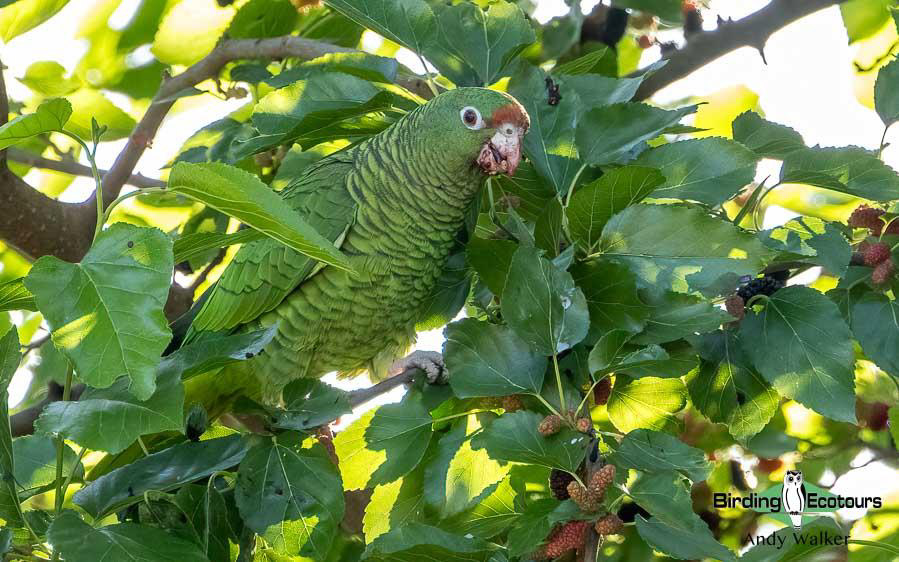
We couldn’t really have asked for better views of the sought after Tucuman Amazon.
Day 14, 1st November 2025. Yala to Tilcara, the Humahuaca Ravine, and to the Puna/Andean plateau, including the Puna lakes (with a quick look over the border into Bolivia!)
What a fantastic day! We departed Yala after a lovely breakfast and drove north to Tilcara where we made a stop at the botanical garden, home to an interesting range of cactus. The garden was also busy with stunning Blue-and-yellow Tanagers and a few other species, but here our focus was firmly on the plants. Near Humahuaca we made a strategic stop and found two pairs of the widespread Patagonian Mockingbird, and our target, a pair of Brown-backed Mockingbirds.
Further north, we stopped at some Puna lakes near the quaint town of Abra Pampa, and this was where we spent the majority of our birding time today, and it was such a pleasure to bird in this incredible landscape. Our first stop, involving a picnic lunch gave us lots of great views of some really special birds at close range. First up we enjoyed watching a flock of about 20 Chilean Flamingos and as we scanned the lake we could see multiple pairs of Silvery Grebes, which looked amazing and were glowing. As we scanned through the throng of Andean Coots, we started picking up coots that were much larger, with different bill and shield patterns and colors. We were suddenly enjoying great looks at Giant Coots, what a sight! Hiding around the edges, dwarfed by the coots and other grebes, were a few pairs of attractive White-tufted Grebes. Ducks were also much in evidence and we enjoyed seeing our first Crested Ducks and Puna Teals of the tour. Other, more familiar ducks were also present, and we saw Ruddy (Andean) Duck, Yellow-billed Teal, Yellow-billed Pintail, and Cinnamon Teal. The edges of the lake were busy with several Andean Gulls, Puna Ibises, and Andean Lapwings, with the noisy Black-necked (White-backed) Stilts also in attendance. While enjoying our empanadas over lunch a striking Mountain Caracara flew low overhead, Spot-billed Ground Tyrant and Rufous-naped Ground Tyrant, Many-colored Rush Tyrant, Andean Swallow, Wren-like Rushbird, and Cream-winged Cinclodes were all noted too.
After lunch we moved to another set of lakes/flooded areas and this was even better than the first stop, which we found tough to believe. As we pulled up to the site a flock of five outrageously beautiful Andean Flamingos were waiting for us. While we were soaking in these birds we suddenly saw there was an Andean Avocet quietly standing nearby, so we spent some time looking at this major target bird. Andean Geese were paired up on the lake vegetation, more of the ducks we had seen earlier in the day were also much in evidence, and several Puna Ibises were also present.
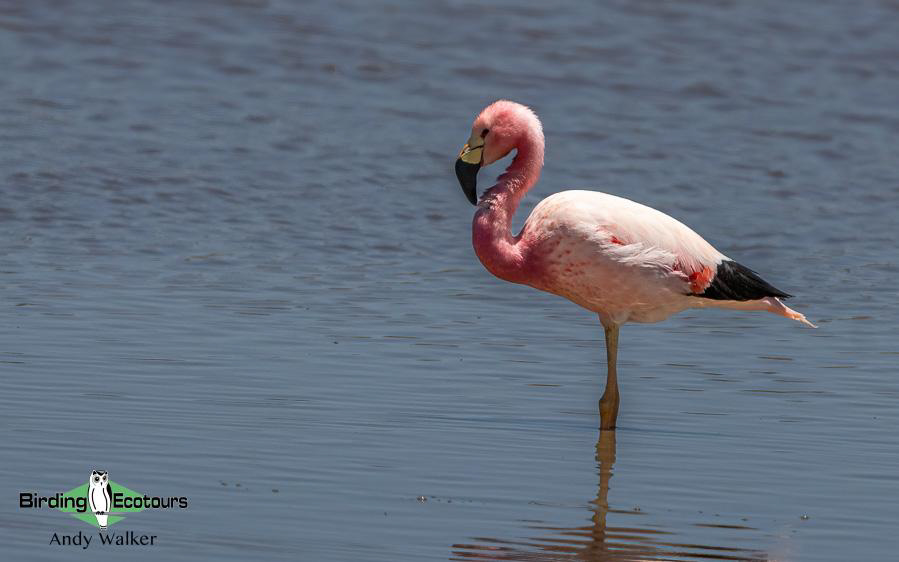
We had some excellent views of the gorgeous Andean Flamingo.
We saw a few distant sandpipers so jumped out of the vehicle for better looks with the scope and then found we’d got a flock of Baird’s Sandpipers of various ages. As we were watching these birds, which were in a range of plumages a lone Wilson’s Phalarope flew in and started feeding. We could see a distant flock of Andean Geese, flamingos, and ibises in the distance, so decided to change position to take a better look at those.
As we drove to the new site we spotted an American Kestrel and followed that up with sightings of Puna Miner and Puna Pipit – both showing very nicely. On getting closer to the flock of flamingos it was suddenly apparent that the flock contained several James’s Flamingo’s, our final flamingo target of the day, and the country. As we watched these birds we noted there were a few migrant shorebirds in the next field across, so moved over there to take a look. The area was full of hirundines, including Sand Martins, Barn Swallows, and American Cliff Swallows amongst others, and many Andean Swifts too. The ground appeared to be crawling with colorful Andean Negritos which were full of character too, as they chased insects along the ground, sometimes showing closely.
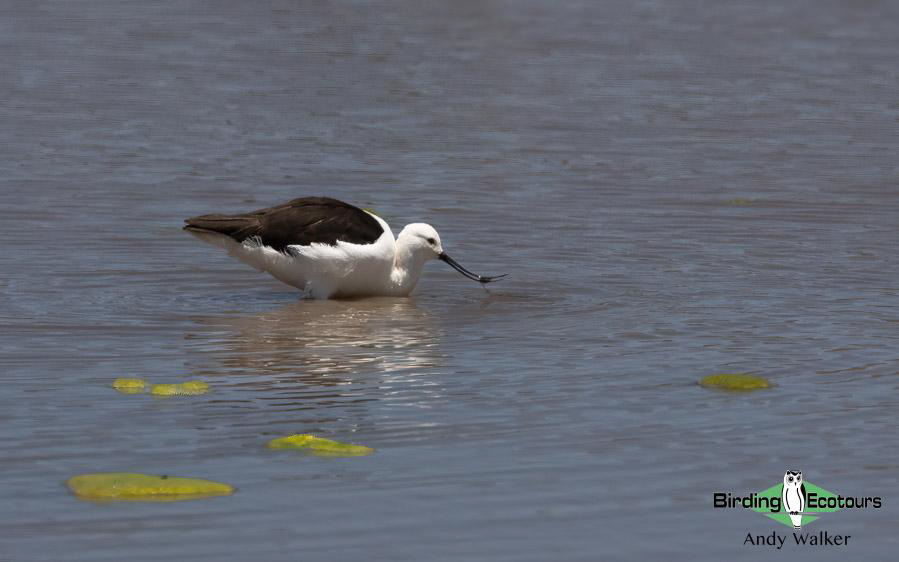
The bulky Andean Avocet showed well at a small lagoon we visited.
Once we got to the new swampy area we found ourselves quickly watching a load of migrant shorebirds. One bird immediately jumped out because of its feeding pattern – a Short-billed Dowitcher, a national rarity. It was feeding within the presence of several Greater Yellowlegs and Lesser Yellowlegs, a lone Pectoral Sandpiper, and two Stilt Sandpipers. A moderate sized flock of Baird’s Sandpipers were present, and several American Golden Plovers were walking around on the muddy flats with the resident Andean Lapwings. All showed fairly well and it was a real treat to see these long-distance migrants. We of course enjoyed further views of three species of flamingo, tons of Puna Ibises, and Andean Avocets again. Occasionally pandemonium would erupt when a Black-chested Buzzard-Eagle would fly overhead – getting seen off by screaming Andean Gulls and more.
Very happy with our success at the Puna lakes we headed into town for a celebratory ice cream! We then continued north right up to the Argentina-Bolivia border, where some good road selection enabled us to get into a quiet area to look into Bolivia for a short birding stop… on the Argentinian side of the border we had great close views of Bare-eyed Ground Dove, Brown-backed Mockingbird, and Mourning Sierra Finch and, for our fledgling Bolivia lists, we spotted Andean Swift, Andean Gull, Bare-eyed Ground Dove, Spot-winged Pigeon, Chiguanco Thrush, Blue-and-white Swallow, and most importantly, Rufous-collared Sparrow all in Bolivia!
After a shopping trip for our next picnic lunch we arrived at our really comfortable accommodation in Yavi. It had been a long but really fun day. We had driven through some seriously incredible landscapes, seen some fantastic birds and plants, ticked off seeing Bolivia, and had also seen our first pretty Vicuna of the tour too. How could tomorrow compete? We were excited to find out…
Day 15, 2nd November 2025. Puna and high Andes birding at Yavi
We started off with some birding around our accommodation in Yavi and had some great views of several really stunning birds, including a large flock (100+) of Citron-headed Yellow Finches, along with lower numbers of Greenish Yellow Finch, Black-hooded Sierra Finch, and Diuca Finch. As we investigated a little further we found the localized Wedge-tailed Hillstar, a gorgeous high elevation hummingbird that just makes it into Argentina and it was busy chasing off, or being chased off, by both Red-tailed Comet and Giant Hummingbird. A flock of tiny Grey-hooded Parakeets flew in showed very nicely and after a brief and distant view much earlier in the tour it was fantastic to be able to appreciate them properly.
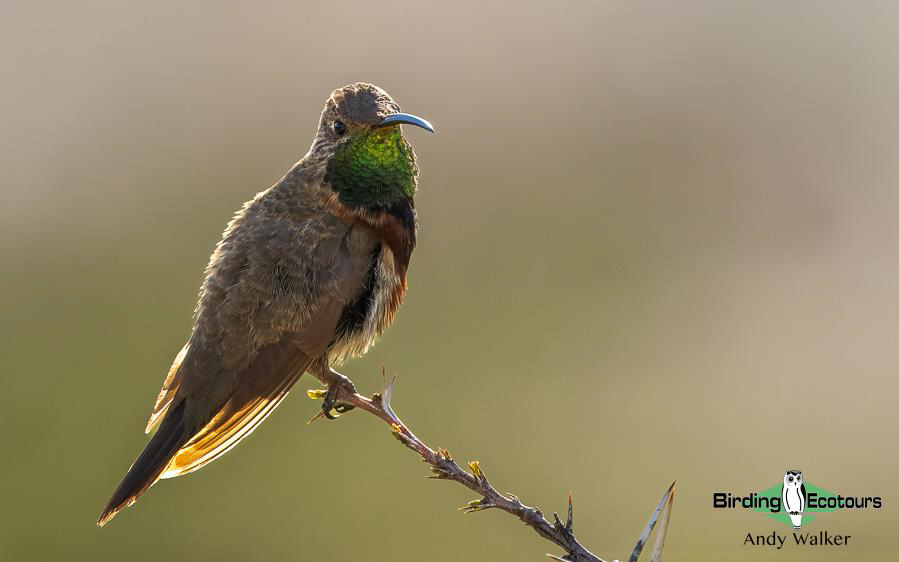
Wedge-tailed Hillstar is almost a Bolivian endemic, it just reaches northern Argentina at Yavi.
After our birding in Yavi we commenced our long and windy drive up to, and beyond, the Abra de Lizoite pass, at a staggering 14,950 feet (4,555 meters). During the drive throughout the day we found many top birds, including Ornate Tinamou, Andean Condor, Grey-breasted Seedsnipe, Rufous-bellied Seedsnipe, some really showy Mountain Parakeets, several furnarids (ovenbirds), including Puna Miner, Cordilleran Canastero, Buff-breasted Earthcreeper, and Straight-billed Earthcreeper), Black Siskin, and the rare Boulder Finch.
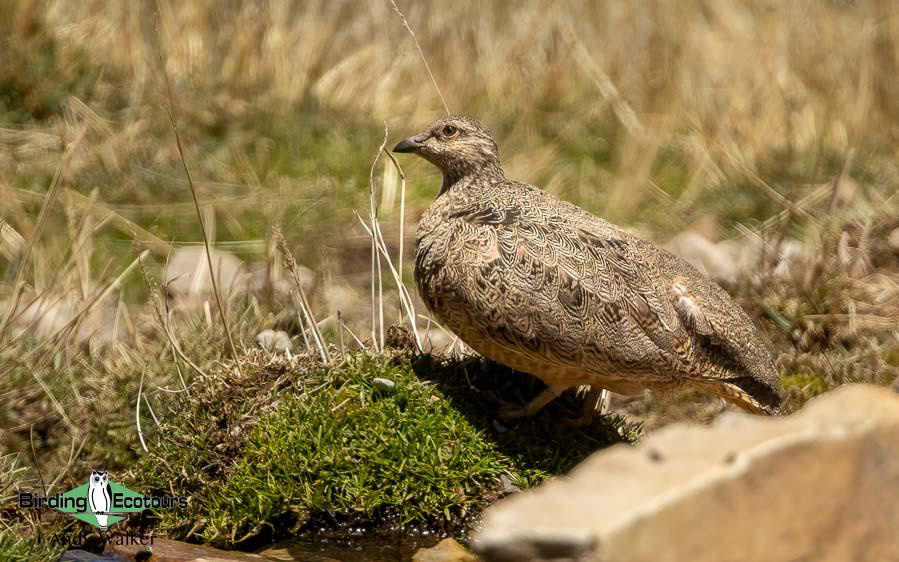
One of the top birds of our exploration of the high Andes was this Rufous-bellied Seedsnipe.
We also explored some areas on foot while in the mountains, and had some great looks at Andean Goose, Andean Lapwing, Puna Snipe, Andean Flicker, Variable Hawk, Mountain Caracara, White-winged Cinclodes, Cinereous Ground Tyrant, Plumbeous Sierra Finch, and the chunky Red-backed Sierra Finch. The landscape views today were sensational at every twist and turn of the mountain roads, and it was a real privilege to bird here.
Day 16, 3rd November 2025. Birding the high Puna
Our final full day birding of the tour started with the coldest morning of the trip at 39oF (4oC). We drove out from our base in Yavi and spent the majority of the day birding in the high Puna. As we tried to locate our preferred road we found a flock of Puna Yellow Finches, which was a rather nice bonus. Once properly on our way we made good progress and a few roadside stops gave us some very good birds, with the pick of the bunch being Puna Tinamou and Golden-spotted Ground Dove. We also found our first Andean Tuco-tuco (a guinea pig sized mammal). In addition to the main highlights, we saw numerous Andean Lapwings, Burrowing Owls, American Kestrels, Puna Miners, and tons of assorted finches.
We spent most of the morning (including having a picnic lunch) birding at a small lake, which was absolutely stacked with birds and in the most picturesque of settings. It didn’t take us too long to locate one of our main targets, Puna Plover, with several birds noted foraging in typical plover manner along the lake shore. Our second target took a little more patience and perseverance, but after a fair bit of scanning through hundreds of Andean Coots and Giant Coots (and various ducks), we located an adult Horned Coot – a bizarre looking bird indeed.
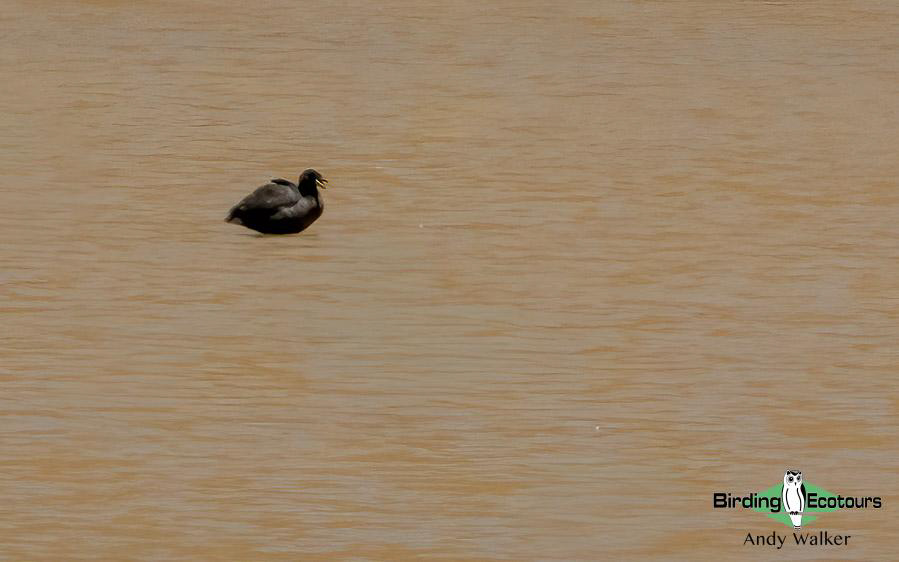
After some considerable effort we located our hoped for rare Horned Coot.
Three species of flamingos were feeding on the lake (Chilean, Andean, and James’s Flamingos), along with an assortment of resident shorebirds like Andean Avocet, Black-necked (White-backed) Stilt, and Andean Lapwing. Several northern migrant shorebirds were present too, such as Wilson’s Phalarope, Baird’s Sandpiper, Greater Yellowlegs, and Lesser Yellowlegs. It was great to get a final look at all of these shorebirds before our tour departure. Andean Gulls were nesting on the lake and an assortment of wildfowl was present, and included Andean Goose, Crested Duck, Yellow-billed Teal, Puna Teal, and Yellow-billed Pintail. While we ate our picnic lunch we saw a Mountain Degu running through the bushes and an Andean Flicker acting like a shorebird feeding on the lake shore.
After our lakeside birding we took a drive back through the Puna to Yavi, along the way we found a pair of Lesser Rheas, an Ornate Tinamou, a small flock of Black-winged Ground Doves, two juvenile Black-chested Buzzard-Eagles, some more Burrowing Owls, a pair of Grey-bellied Shrike-Tyrants, and yet more cute Andean Negritos – a firm favorite.
Day 17, 4th November 2025. Yavi to Jujuy and flight to Buenos Aires where tour concluded
Unfortunately Aerolineas Argentinas moved our flight forward by several hours so we needed to depart Yavi earlier than expected and just drive straight to Jujuy for our flight to Buenos Aires, where this exciting northern Argentina tour ended. However, all clients were continuing onto our northeastern Argentina tour, so the birding fun would continue (after an exciting short trip to Uruguay to fill in an eBird map – see the eBird trip report for our afternoon birding trip, here!).
Bird List – Following IOC (15.1) (March 2025)
Birds ‘heard only’ are marked with (H) after the common name, all other species were seen. Common names with an alternative common name in parenthesis indicate name changes/splits/lumps following the announcement of the new AviList v2025 global bird checklist. The following notation after species names is used to show conservation status following BirdLife International: VU = Vulnerable.
| Common Name | Scientific Name |
| Rheas (Rheidae) | |
| Greater Rhea | Rhea americana |
| Lesser Rhea | Rhea pennata |
| Tinamous (Tinamidae) | |
| Tataupa Tinamou (H) | Crypturellus tataupa |
| Huayco Tinamou (H) | Rhynchotus maculicollis |
| Ornate Tinamou | Nothoprocta ornata |
| Brushland Tinamou | Nothoprocta cinerascens |
| Andean Tinamou | Nothoprocta pentlandii |
| Quebracho Crested Tinamou | Eudromia formosa |
| Puna Tinamou | Tinamotis pentlandii |
| Screamers (Anhimidae) | |
| Southern Screamer | Chauna torquata |
| Ducks, Geese, Swans (Anatidae) | |
| White-faced Whistling Duck | Dendrocygna viduata |
| Fulvous Whistling Duck | Dendrocygna bicolor |
| Greylag Goose | Anser anser |
| Coscoroba Swan | Coscoroba coscoroba |
| Black-necked Swan | Cygnus melancoryphus |
| Torrent Duck | Merganetta armata |
| Comb Duck | Sarkidiornis sylvicola |
| Andean Goose | Chloephaga melanoptera |
| Muscovy Duck | Cairina moschata |
| Brazilian Teal | Amazonetta brasiliensis |
| Ringed Teal | Callonetta leucophrys |
| Crested Duck | Lophonetta specularioides |
| Puna Teal | Spatula puna |
| Silver Teal | Spatula versicolor |
| Red Shoveler | Spatula platalea |
| Cinnamon Teal | Spatula cyanoptera |
| White-cheeked Pintail | Anas bahamensis |
| Yellow-billed Pintail | Anas georgica |
| Yellow-billed Teal | Anas flavirostris |
| Rosy-billed Pochard | Netta peposaca |
| Masked Duck | Nomonyx dominicus |
| Andean Duck (Ruddy Duck) | Oxyura ferruginea |
| Lake Duck | Oxyura vittata |
| Chachalacas, Curassows, Guans (Cracidae) | |
| Chaco Chachalaca | Ortalis canicollis |
| Red-faced Guan | Penelope dabbenei |
| Yungas Guan | Penelope bridgesi |
| Nightjars (Caprimulgidae) | |
| Lyre-tailed Nightjar | Uropsalis lyra |
| Scissor-tailed Nightjar | Hydropsalis torquata |
| Swifts (Apodidae) | |
| Rothschild’s Swift | Cypseloides rothschildi |
| White-collared Swift | Streptoprocne zonaris |
| Sick’s Swift | Chaetura meridionalis |
| White-tipped Swift | Aeronautes montivagus |
| Andean Swift | Aeronautes andecolus |
| Hummingbirds (Trochilidae) | |
| Planalto Hermit | Phaethornis pretrei |
| Red-tailed Comet | Sappho sparganurus |
| Andean Hillstar | Oreotrochilus estella |
| Wedge-tailed Hillstar | Oreotrochilus adela |
| Blue-capped Puffleg | Eriocnemis glaucopoides |
| Giant Hummingbird | Patagona gigas |
| Blue-tufted Starthroat | Heliomaster furcifer |
| Slender-tailed Woodstar | Microstilbon burmeisteri |
| Glittering-bellied Emerald | Chlorostilbon lucidus |
| Gilded Sapphire | Hylocharis chrysura |
| White-bellied Hummingbird | Elliotomyia chionogaster |
| Cuckoos (Cuculidae) | |
| Guira Cuckoo | Guira guira |
| Smooth-billed Ani | Crotophaga ani |
| Striped Cuckoo (H) | Tapera naevia |
| Pigeons, Doves (Columbidae) | |
| Rock Dove | Columba livia |
| Picazuro Pigeon | Patagioenas picazuro |
| Spot-winged Pigeon | Patagioenas maculosa |
| Band-tailed Pigeon | Patagioenas fasciata |
| Pale-vented Pigeon | Patagioenas cayennensis |
| Ruddy Ground Dove | Columbina talpacoti |
| Picui Ground Dove | Columbina picui |
| Bare-faced Ground Dove | Metriopelia ceciliae |
| Moreno’s Ground Dove (Endemic) | Metriopelia morenoi |
| Black-winged Ground Dove | Metriopelia melanoptera |
| Golden-spotted Ground Dove | Metriopelia aymara |
| White-tipped Dove | Leptotila verreauxi |
| Yungas Dove | Leptotila megalura |
| White-throated Quail-Dove | Zentrygon frenata |
| Eared Dove | Zenaida auriculata |
| Rails, Crakes & Coots (Rallidae) | |
| Plumbeous Rail (H) | Pardirallus sanguinolentus |
| Grey-cowled Wood Rail | Aramides cajaneus |
| Giant Wood Rail | Aramides ypecaha |
| Spot-flanked Gallinule | Porphyriops melanops |
| Common Gallinule | Gallinula galeata |
| Red-fronted Coot | Fulica rufifrons |
| Horned Coot | Fulica cornuta |
| Giant Coot | Fulica gigantea |
| Red-gartered Coot | Fulica armillata |
| Andean Coot | Fulica ardesiaca |
| White-winged Coot | Fulica leucoptera |
| Rufous-sided Crake (H) | Laterallus melanophaius |
| Limpkin (Aramidae) | |
| Limpkin | Aramus guarauna |
| Grebes (Podicipedidae) | |
| Least Grebe | Tachybaptus dominicus |
| Pied-billed Grebe | Podilymbus podiceps |
| White-tufted Grebe | Rollandia rolland |
| Great Grebe | Podiceps major |
| Silvery Grebe | Podiceps occipitalis |
| Flamingos (Phoenicopteridae) | |
| Chilean Flamingo | Phoenicopterus chilensis |
| Andean Flamingo – VU | Phoenicoparrus andinus |
| James’s Flamingo | Phoenicoparrus jamesi |
| Stilts, Avocets (Recurvirostridae) | |
| White-backed Stilt (Black-necked Stilt) | Himantopus melanurus |
| Andean Avocet | Recurvirostra andina |
| Plovers (Charadriidae) | |
| American Golden Plover | Pluvialis dominica |
| Tawny-throated Dotterel | Oreopholus ruficollis |
| Southern Lapwing | Vanellus chilensis |
| Andean Lapwing | Vanellus resplendens |
| Collared Plover | Anarhynchus collaris |
| Puna Plover | Anarhynchus alticola |
| Jacanas (Jacanidae) | |
| Wattled Jacana | Jacana jacana |
| Seedsnipes (Thinocoridae) | |
| Rufous-bellied Seedsnipe | Attagis gayi |
| Grey-breasted Seedsnipe | Thinocorus orbignyianus |
| Least Seedsnipe | Thinocorus rumicivorus |
| Sandpipers, Snipes (Scolopacidae) | |
| Short-billed Dowitcher – VU | Limnodromus griseus |
| Puna Snipe | Gallinago andina |
| Wilson’s Phalarope | Phalaropus tricolor |
| Lesser Yellowlegs – VU | Tringa flavipes |
| Greater Yellowlegs | Tringa melanoleuca |
| Stilt Sandpiper | Calidris himantopus |
| Baird’s Sandpiper | Calidris bairdii |
| White-rumped Sandpiper – VU | Calidris fuscicollis |
| Pectoral Sandpiper | Calidris melanotos |
| Gulls, Terns, Skimmers (Laridae) | |
| Large-billed Tern | Phaetusa simplex |
| Snowy-crowned Tern | Sterna trudeaui |
| Andean Gull | Chroicocephalus serranus |
| Grey-headed Gull | Chroicocephalus cirrocephalus |
| Storks (Ciconiidae) | |
| Wood Stork | Mycteria americana |
| Maguari Stork | Ciconia maguari |
| Cormorants, Shags (Phalacrocoracidae) | |
| Neotropic Cormorant | Nannopterum brasilianum |
| Ibises, Spoonbills (Threskiornithidae) | |
| Buff-necked Ibis | Theristicus caudatus |
| Bare-faced Ibis | Phimosus infuscatus |
| White-faced Ibis | Plegadis chihi |
| Puna Ibis | Plegadis ridgwayi |
| Roseate Spoonbill | Platalea ajaja |
| Herons, Bitterns (Ardeidae) | |
| Rufescent Tiger Heron | Tigrisoma lineatum |
| Black-crowned Night Heron | Nycticorax nycticorax |
| Whistling Heron | Syrigma sibilatrix |
| Snowy Egret | Egretta thula |
| Striated Heron | Butorides striata |
| Great Egret | Ardea alba |
| Western Cattle Egret | Ardea ibis |
| Cocoi Heron | Ardea cocoi |
| New World Vultures (Cathartidae) | |
| King Vulture | Sarcoramphus papa |
| Andean Condor – VU | Vultur gryphus |
| Black Vulture | Coragyps atratus |
| Turkey Vulture | Cathartes aura |
| Lesser Yellow-headed Vulture | Cathartes burrovianus |
| Kites, Hawks, Eagles (Accipitridae) | |
| White-tailed Kite | Elanus leucurus |
| Swallow-tailed Kite | Elanoides forficatus |
| Rufous-thighed Hawk (Sharp-shinned Hawk) | Accipiter erythronemius |
| Long-winged Harrier | Circus buffoni |
| Plumbeous Kite | Ictinia plumbea |
| Snail Kite | Rostrhamus sociabilis |
| Savanna Hawk | Buteogallus meridionalis |
| Great Black Hawk | Buteogallus urubitinga |
| Roadside Hawk | Rupornis magnirostris |
| Harris’s Hawk | Parabuteo unicinctus |
| Variable Hawk | Geranoaetus polyosoma |
| Black-chested Buzzard-Eagle | Geranoaetus melanoleucus |
| Owls (Strigidae) | |
| Burrowing Owl | Athene cunicularia |
| Ferruginous Pygmy Owl (H) | Glaucidium brasilianum |
| Lesser Horned Owl | Bubo magellanicus |
| Trogons (Trogonidae) | |
| Blue-crowned Trogon | Trogon curucui |
| Kingfishers (Alcedinidae) | |
| Amazon Kingfisher | Chloroceryle amazona |
| Motmots (Momotidae) | |
| Amazonian Motmot (H) | Momotus momota |
| Puffbirds (Bucconidae) | |
| Spot-backed Puffbird | Nystalus maculatus |
| Toucans (Ramphastidae) | |
| Toco Toucan | Ramphastos toco |
| Woodpeckers (Picidae) | |
| White-barred Piculet | Picumnus cirratus |
| White Woodpecker | Melanerpes candidus |
| White-fronted Woodpecker | Melanerpes cactorum |
| Dot-fronted Woodpecker | Veniliornis frontalis |
| Green-barred Woodpecker | Colaptes melanochloros |
| Andean Flicker | Colaptes rupicola |
| Campo Flicker | Colaptes campestris |
| Black-bodied Woodpecker | Dryocopus schulzii |
| Cream-backed Woodpecker | Campephilus leucopogon |
| Seriemas (Cariamidae) | |
| Red-legged Seriema | Cariama cristata |
| Black-legged Seriema | Chunga burmeisteri |
| Caracaras, Falcons (Falconidae) | |
| Spot-winged Falconet | Spiziapteryx circumcincta |
| Crested Caracara | Caracara plancus |
| Chimango Caracara | Milvago chimango |
| Mountain Caracara | Phalcoboenus megalopterus |
| American Kestrel | Falco sparverius |
| Aplomado Falcon | Falco femoralis |
| Peregrine Falcon | Falco peregrinus |
| African & New World Parrots (Psittacidae) | |
| Grey-hooded Parakeet | Psilopsiagon aymara |
| Mountain Parakeet | Psilopsiagon aurifrons |
| Monk Parakeet | Myiopsitta monachus |
| Scaly-headed Parrot | Pionus maximiliani |
| Tucuman Amazon – VU | Amazona tucumana |
| Turquoise-fronted Amazon | Amazona aestiva |
| Green-cheeked Parakeet | Pyrrhura molinae |
| Burrowing Parrot | Cyanoliseus patagonus |
| Golden-collared Macaw | Primolius auricollis |
| Blue-crowned Parakeet | Thectocercus acuticaudatus |
| Mitred Parakeet | Psittacara mitratus |
| White-eyed Parakeet | Psittacara leucophthalmus |
| Ovenbirds (Furnariidae) | |
| Slender-billed Miner | Geositta tenuirostris |
| Puna Miner | Geositta punensis |
| Rufous-banded Miner | Geositta rufipennis |
| Olivaceous Woodcreeper | Sittasomus griseicapillus |
| Black-banded Woodcreeper | Dendrocolaptes picumnus |
| Great Rufous Woodcreeper | Xiphocolaptes major |
| Scimitar-billed Woodcreeper | Drymornis bridgesii |
| Narrow-billed Woodcreeper | Lepidocolaptes angustirostris |
| Streaked Xenops | Xenops rutilans |
| Straight-billed Earthcreeper | Ochetorhynchus ruficaudus |
| Rock Earthcreeper | Ochetorhynchus andaecola |
| Chaco Earthcreeper | Tarphonomus certhioides |
| Rufous Hornero | Furnarius rufus |
| Crested Hornero | Furnarius cristatus |
| Sharp-tailed Streamcreeper | Lochmias nematura |
| Wren-like Rushbird | Phleocryptes melanops |
| Curve-billed Reedhaunter | Limnornis curvirostris |
| Buff-breasted Earthcreeper | Upucerthia validirostris |
| Cream-winged Cinclodes | Cinclodes albiventris |
| White-winged Cinclodes | Cinclodes atacamensis |
| Buff-browed Foliage-gleaner | Syndactyla rufosuperciliata |
| Brown-capped Tit-Spinetail | Leptasthenura fuliginiceps |
| Plain-mantled Tit-Spinetail | Leptasthenura aegithaloides |
| Rufous-fronted Thornbird | Phacellodomus rufifrons |
| Streak-fronted Thornbird | Phacellodomus striaticeps |
| Spot-breasted Thornbird | Phacellodomus maculipectus |
| Freckle-breasted Thornbird | Phacellodomus striaticollis |
| Lark-like Brushrunner | Coryphistera alaudina |
| Rusty-vented Canastero | Asthenes dorbignyi |
| Short-billed Canastero | Asthenes baeri |
| Scribble-tailed Canastero | Asthenes maculicauda |
| Streak-backed Canastero | Asthenes wyatti |
| Cordilleran Canastero | Asthenes modesta |
| Sulphur-bearded Reedhaunter | Limnoctites sulphuriferus |
| Brown Cacholote | Pseudoseisura lophotes |
| White-throated Cacholote (Endemic) | Pseudoseisura gutturalis |
| Yellow-chinned Spinetail | Certhiaxis cinnamomeus |
| Ochre-cheeked Spinetail | Synallaxis scutata |
| Spix’s Spinetail | Synallaxis spixi |
| Sooty-fronted Spinetail | Synallaxis frontalis |
| Azara’s Spinetail | Synallaxis azarae |
| Antbirds (Thamnophilidae) | |
| Stripe-backed Antbird (H) | Myrmorchilus strigilatus |
| Variable Antshrike (H) | Thamnophilus caerulescens |
| Rufous-capped Antshrike | Thamnophilus ruficapillus |
| Great Antshrike | Taraba major |
| Giant Antshrike | Batara cinerea |
| Antpittas (Grallariidae) | |
| White-throated Antpitta | Grallaria albigula |
| Tapaculos (Rhinocryptidae) | |
| Crested Gallito (H) | Rhinocrypta lanceolata |
| Sandy Gallito (Endemic) | Teledromas fuscus |
| White-browed Tapaculo (Endemic) | Scytalopus superciliaris |
| Zimmer’s Tapaculo | Scytalopus zimmeri |
| Tyrant Flycatchers, Calyptura (Tyrannidae) | |
| Sclater’s Tyrannulet | Phyllomyias sclateri |
| Rough-legged Tyrannulet | Acrochordopus burmeisteri |
| Large Elaenia | Elaenia spectabilis |
| Chilean Elaenia | Elaenia chilensis |
| Small-billed Elaenia | Elaenia parvirostris |
| Slaty Elaenia | Elaenia strepera |
| Highland Elaenia | Elaenia obscura |
| Southern Beardless Tyrannulet | Camptostoma obsoletum |
| Suiriri Flycatcher | Suiriri suiriri |
| White-throated Tyrannulet | Mecocerculus leucophrys |
| Buff-banded Tyrannulet | Mecocerculus hellmayri |
| Yellow-billed Tit-Tyrant | Anairetes flavirostris |
| Tufted Tit-Tyrant | Anairetes parulus |
| Sooty Tyrannulet | Serpophaga nigricans |
| White-crested Tyrannulet | Serpophaga subcristata |
| Straneck’s Tyrannulet | Serpophaga griseicapilla |
| Greater Wagtail-Tyrant | Stigmatura budytoides |
| Mottle-cheeked Tyrannulet | Phylloscartes ventralis |
| Southern Scrub Flycatcher | Sublegatus modestus |
| Bran-colored Flycatcher | Myiophobus fasciatus |
| Many-colored Rush Tyrant | Tachuris rubrigastra |
| Pearly-vented Tody-Tyrant | Hemitriccus margaritaceiventer |
| Ochre-faced Tody-Flycatcher | Poecilotriccus plumbeiceps |
| Yellow-olive Flatbill | Tolmomyias sulphurescens |
| Cinnamon Flycatcher | Pyrrhomyias cinnamomeus |
| Cliff Flycatcher | Hirundinea ferruginea |
| Euler’s Flycatcher | Lathrotriccus euleri |
| Black Phoebe | Sayornis nigricans |
| Smoke-colored Pewee | Contopus fumigatus |
| Scarlet Flycatcher (Vermilion Flycatcher) | Pyrocephalus rubinus |
| Yellow-browed Tyrant | Satrapa icterophrys |
| Spot-billed Ground Tyrant | Muscisaxicola maculirostris |
| Cinereous Ground Tyrant | Muscisaxicola cinereus |
| Rufous-naped Ground Tyrant | Muscisaxicola rufivertex |
| Andean Negrito | Lessonia oreas |
| Spectacled Tyrant | Hymenops perspicillatus |
| Plumbeous Tyrant | Knipolegus cabanisi |
| Cinereous Tyrant | Knipolegus striaticeps |
| White-winged Black Tyrant | Knipolegus aterrimus |
| White Monjita | Xolmis irupero |
| Black-crowned Monjita | Neoxolmis coronatus |
| Streak-throated Bush Tyrant | Myiotheretes striaticollis |
| Black-billed Shrike-Tyrant | Agriornis montanus |
| Grey-bellied Shrike-Tyrant | Agriornis micropterus |
| Black-backed Water Tyrant | Fluvicola albiventer |
| D’Orbigny’s Chat-Tyrant | Ochthoeca oenanthoides |
| White-browed Chat-Tyrant | Ochthoeca leucophrys |
| Cattle Tyrant | Machetornis rixosa |
| Great Kiskadee | Pitangus sulphuratus |
| Streaked Flycatcher | Myiodynastes maculatus |
| Variegated Flycatcher | Empidonomus varius |
| Crowned Slaty Flycatcher | Griseotyrannus aurantioatrocristatus |
| Tropical Kingbird | Tyrannus melancholicus |
| Fork-tailed Flycatcher | Tyrannus savana |
| Brown-crested Flycatcher | Myiarchus tyrannulus |
| Cotingas (Cotingidae) | |
| White-tipped Plantcutter | Phytotoma rutila |
| Manakins (Pipridae) | |
| Yungas Manakin | Chiroxiphia boliviana |
| Tityras, Becards & Allies (Tityridae) | |
| Crested Becard | Pachyramphus validus |
| Vireos, Greenlets, Shrike-babblers (Vireonidae) | |
| Rufous-browed Peppershrike | Cyclarhis gujanensis |
| Chivi Vireo | Vireo chivi |
| Crows, Jays (Corvidae) | |
| Plush-crested Jay | Cyanocorax chrysops |
| Swallows, Martins (Hirundinidae) | |
| Sand Martin | Riparia riparia |
| White-rumped Swallow | Tachycineta leucorrhoa |
| Brown-chested Martin | Progne tapera |
| Southern Martin | Progne elegans |
| Grey-breasted Martin | Progne chalybea |
| Southern Rough-winged Swallow | Stelgidopteryx ruficollis |
| Blue-and-white Swallow | Pygochelidon cyanoleuca |
| Andean Swallow | Orochelidon andecola |
| Barn Swallow | Hirundo rustica |
| American Cliff Swallow | Petrochelidon pyrrhonota |
| Wrens (Troglodytidae) | |
| Grass Wren | Cistothorus platensis |
| Southern House Wren | Troglodytes musculus |
| Mountain Wren | Troglodytes solstitialis |
| Gnatcatchers (Polioptilidae) | |
| Masked Gnatcatcher | Polioptila dumicola |
| Mockingbirds, Thrashers (Mimidae) | |
| Chalk-browed Mockingbird | Mimus saturninus |
| Patagonian Mockingbird | Mimus patagonicus |
| Brown-backed Mockingbird | Mimus dorsalis |
| Starlings, Rhabdornises (Sturnidae) | |
| Crested Myna | Acridotheres cristatellus |
| Common Starling | Sturnus vulgaris |
| Thrushes (Turdidae) | |
| Speckled Nightingale-Thrush | Catharus maculatus |
| Swainson’s Thrush | Catharus ustulatus |
| Chiguanco Thrush | Turdus chiguanco |
| Andean Slaty Thrush | Turdus nigriceps |
| Glossy-black Thrush | Turdus serranus |
| Creamy-bellied Thrush | Turdus amaurochalinus |
| Rufous-bellied Thrush | Turdus rufiventris |
| Dippers (Cinclidae) | |
| Rufous-throated Dipper – VU | Cinclus schulzii |
| Old World Sparrows, Snowfinches (Passeridae) | |
| House Sparrow | Passer domesticus |
| Wagtails, Pipits (Motacillidae) | |
| Yellowish Pipit | Anthus chii |
| Puna Pipit | Anthus brevirostris |
| Hellmayr’s Pipit | Anthus hellmayri |
| Finches, Euphonias (Fringillidae) | |
| Hooded Siskin | Spinus magellanicus |
| Black Siskin | Spinus atratus |
| Purple-throated Euphonia (H) | Euphonia chlorotica |
| New World Sparrows (Passerellidae) | |
| Common Chlorospingus | Chlorospingus flavopectus |
| Yungas Sparrow | Rhynchospiza dabbenei |
| Grassland Sparrow | Ammodramus humeralis |
| White-browed Brushfinch | Arremon torquatus |
| Moss-backed Sparrow | Arremon dorbignii |
| Rufous-collared Sparrow | Zonotrichia capensis |
| Fulvous-headed Brushfinch | Atlapetes fulviceps |
| Yellow-striped Brushfinch (Endemic) | Atlapetes citrinellus |
| Oropendolas, New World Orioles, Blackbirds (Icteridae) | |
| White-browed Meadowlark | Leistes superciliaris |
| Crested Oropendola | Psarocolius decumanus |
| Solitary Cacique | Cacicus solitarius |
| Golden-winged Cacique | Cacicus chrysopterus |
| Variable Oriole | Icterus pyrrhopterus |
| Screaming Cowbird | Molothrus rufoaxillaris |
| Giant Cowbird | Molothrus oryzivorus |
| Shiny Cowbird | Molothrus bonariensis |
| Scarlet-headed Blackbird | Amblyramphus holosericeus |
| Greyish Baywing | Agelaioides badius |
| Yellow-winged Blackbird | Agelasticus thilius |
| Chestnut-capped Blackbird | Chrysomus ruficapillus |
| Brown-and-yellow Marshbird | Pseudoleistes virescens |
| New World Warblers (Parulidae) | |
| Southern Yellowthroat | Geothlypis velata |
| Tropical Parula | Setophaga pitiayumi |
| White-rimmed Warbler (H) | Myiothlypis leucoblephara |
| Pale-legged Warbler | Myiothlypis signata |
| Two-banded Warbler | Myiothlypis bivittata |
| Golden-crowned Warbler | Basileuterus culicivorus |
| Brown-capped Whitestart | Myioborus brunniceps |
| Cardinals & Allies (Cardinalidae) | |
| Red Tanager | Piranga flava |
| Black-backed Grosbeak | Pheucticus aureoventris |
| Ultramarine Grosbeak | Cyanoloxia brissonii |
| Tanagers & Allies (Thraupidae) | |
| Pampa Finch (Hepatic Tanager) | Embernagra platensis |
| Mourning Sierra Finch | Rhopospina fruticeti |
| Band-tailed Sierra Finch | Rhopospina alaudina |
| Guira Tanager | Hemithraupis guira |
| Many-colored Chaco Finch | Saltatricula multicolor |
| Bluish-grey Saltator | Saltator coerulescens |
| Golden-billed Saltator | Saltator aurantiirostris |
| Red Pileated Finch | Coryphospingus cucullatus |
| Double-collared Seedeater | Sporophila caerulescens |
| Black-and-rufous Warbling Finch | Poospiza nigrorufa |
| Black-and-chestnut Warbling Finch | Poospiza whitii |
| Tucuman Mountain Finch (Endemic) | Poospiza baeri |
| Orange-headed Tanager | Thlypopsis sordida |
| Rusty-browed Warbling Finch | Microspingus erythrophrys |
| Ringed Warbling Finch | Microspingus torquatus |
| Black-capped Warbling Finch | Microspingus melanoleucus |
| Chestnut-vented Conebill | Conirostrum speciosum |
| Saffron Finch | Sicalis flaveola |
| Grassland Yellow Finch | Sicalis luteola |
| Citron-headed Yellow Finch | Sicalis luteocephala |
| Greenish Yellow Finch | Sicalis olivascens |
| Monte Yellow Finch (Endemic) | Sicalis mendozae |
| Puna Yellow Finch | Sicalis lutea |
| Grey-hooded Sierra Finch | Phrygilus gayi |
| Black-hooded Sierra Finch | Phrygilus atriceps |
| Ash-breasted Sierra Finch | Geospizopsis plebejus |
| Plumbeous Sierra Finch | Geospizopsis unicolor |
| Red-backed Sierra Finch | Idiopsar dorsalis |
| Boulder Finch | Idiopsar brachyurus |
| Band-tailed Seedeater | Catamenia analis |
| Plain-colored Seedeater | Catamenia inornata |
| Fawn-breasted Tanager | Pipraeidea melanonota |
| Blue-and-yellow Tanager | Rauenia bonariensis |
| Rufous-bellied Mountain Tanager | Pseudosaltator rufiventris |
| Diuca Finch | Diuca diuca |
| Red-crested Cardinal | Paroaria coronata |
| Yellow-billed Cardinal | Paroaria capitata |
| Sayaca Tanager | Thraupis sayaca |
| Total seen | 391 |
| Total heard only | 12 |
| Total recorded | 403 |
Mammal List
| Common Name | Scientific Name |
| Cavies (Caviidae) | |
| Brazilian Guinea Pig | Cavia aperea |
| Conejo Del Palo (Chacoan Mara) | Dolichotis salinicola |
| Chinchillas and Viscachas (Chinchillidae) | |
| Common Mountain Viscacha | Lagidium viscacia |
| Tuco-Tucos (Ctenomyidae) | |
| Andean Tuco-tuco | Ctenomys opimus |
| Spiny Rats and Hutias (Echimyidae) | |
| Coypu | Myocastor coypus |
| Octodonts and Degus (Octodontidae) | |
| Mountain Degu | Octodontomys gliroides |
| Canids (Canidae) | |
| Culpeo | Lycalopex culpaeus |
| Chilla (South American Grey Fox) | Lycalopex grisea |
| Deer (Cervidae) | |
| Grey Brocket | Bisbalus citus |
| Northwestern Red Brocket | Mazama americana |
| Camelids (Camelidae) | |
| Guanaco | Lama guanicoe |
| Vicuna | Lama vicugna |
| Total seen | 12 |
Reptile List
| Common Name | Scientific Name |
| Whiptails and Tegus (Teiidae) | |
| Four-toed Tegu | Teius teyou |
| Argentine Black-and-white Tegu | Salvator merianae |
| Red Tegu | Salvator rufescens |
| South American Lesser Iguanas (Liolaemidae) | |
| Eastern Smooth-throated Lizard | Liolaemus wiegmannii |
| Quilmes Smooth-throated Lizard | Liolaemus quilmes |
| Austro-American Side-necked Turtles (Chelidae) | |
| Hilaire’s Side-necked Turtle | Phrynops hilarii |
| Tortoises (Testudinidae) | |
| Chaco Tortoise | Chelonoidis chilensis |
| Total seen | 7 |
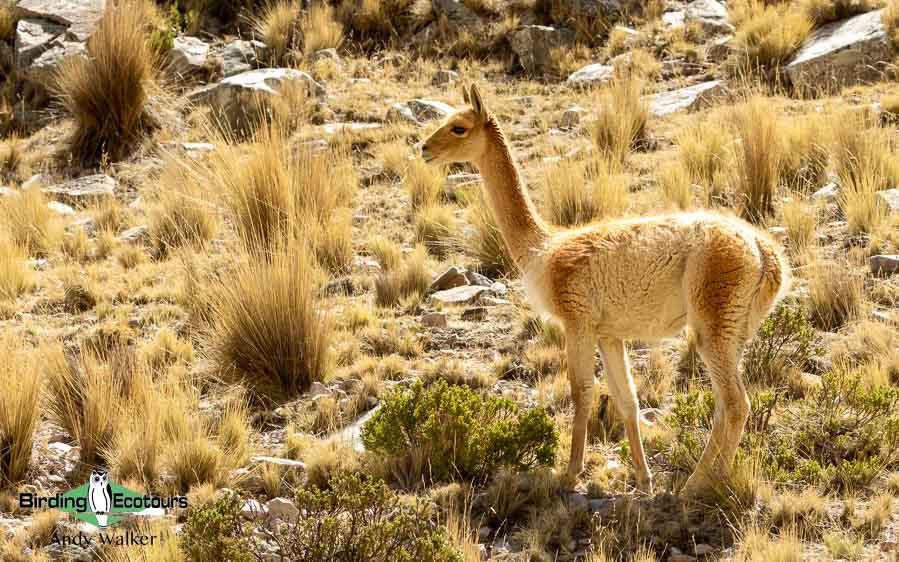
Vicuna was one of a dozen mammal species seen on the tour and found at very high elevations.
This is a sample trip report. Please email us ([email protected]) for more trip reports from this destination.