by Anton Schultz (written 22 April 2026)
Part of what makes birdwatching such a captivating hobby, is the sheer diversity of color and shapes that birds display. Almost daily, I come across a species I never knew existed, and suddenly I’m planning a new dream destination. I’ve even started calling birds “eye-candy”, because what is life, if not a collection of colors and experiences?
Although it may feel like it, this kaleidoscope wasn’t built for our enjoyment. Millions of years of evolution have gone into finely crafting feathers for function, and the toolbox is impressive! From hard-earned pigments to cheap structures of eye trickery and refraction, birds can really do it all.
Let’s start by asking what color actually is, because it’s not as simple as it sounds. In truth, color is a construct of perception. What we experience as color is the brain’s interpretation of a narrow slice of the electromagnetic spectrum, the small range of wavelengths our eyes can detect.
When you see a Scarlet Tanager as red, you are not seeing “red” as an inherent property of the bird. What you’re seeing is red light being reflected off its feathers, while most other wavelengths are absorbed. Your brain then interprets the reflected light as your own version of the color red. As Pink Floyd famously illustrated, white light is a combination of all the colors in the visible spectrum. A white object, therefore, reflects most of those wavelengths rather than absorbing them.
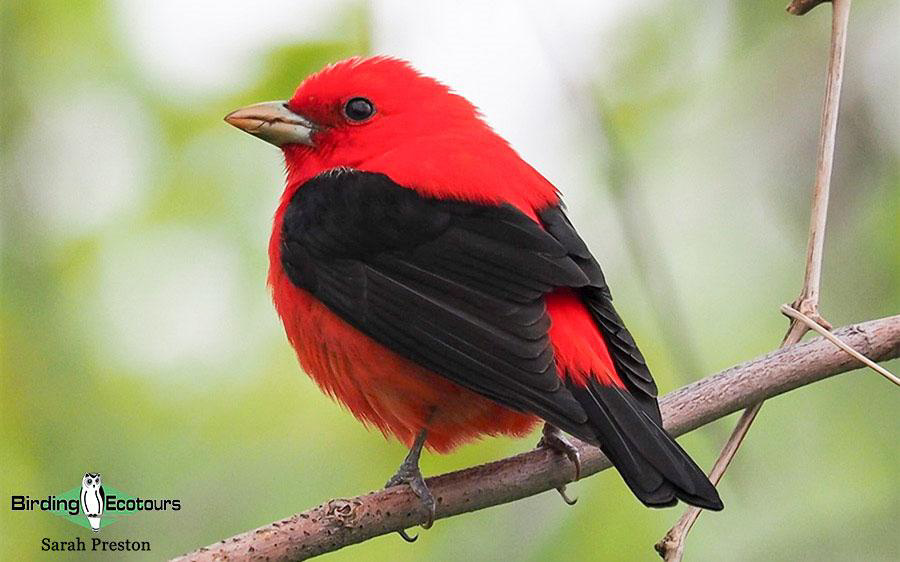
The intense Scarlet Tanager can be seen in the USA during the spring migration in Ohio.
Here’s where things get interesting. Our experience of color represents only a tiny fraction of the electromagnetic spectrum. Beyond what we can see lie microwaves, infrared, and even longer wavelengths like radio waves. There is nothing fundamentally special about the visible range, it is simply what our biology allows us to perceive.
In theory, a being could detect radio waves and experience them as something comparable to color. This isn’t far-fetched of course, because we know that birds are able to access the ultraviolet light spectrum, but more on that later.
So, if color is simply a construct of perception, then pigments are chemical systems that absorb and reflect light, and often at a metabolic cost. There are five main classes of pigments used in bird feathers, each with its own special functions and properties. Let’s break them down.
Melanins
Melanins are the same class of pigments that determine variation in human skin color, and form the foundation of color in most birds. They’re responsible for black and gray feathers, as well as the reddish-brown and buff tones seen in most species.
Melanins are composed from tyrosine, a common amino acid produced endogenously by all birds. While the colors produced by this pigment class could be considered drab, they are incredibly versatile and can produce some stunning dream birds based on the precise spatial control of the cell signaling pathways that determine where a pigment is deposited in a feather. This can be seen in the stunning ocellated feathers of a Great Argus, or the disruptive camouflage of a Tawny Frogmouth for instance.
In addition to the visible versatility of this pigment class, it also possesses another property which makes it highly functional: the biochemicals that create melanins are considered durable and long-lasting compared to other pigment classes.
Ever wondered why the wing tips of many long-distance flyers, such as the Pallid Harrier, are black? No? Ok, neither did I, but it was interesting to learn why. The primaries receive most of the aerodynamic wear and tear, so loading these feathers with melanins can reinforce them, allowing for longer flight times before molting.
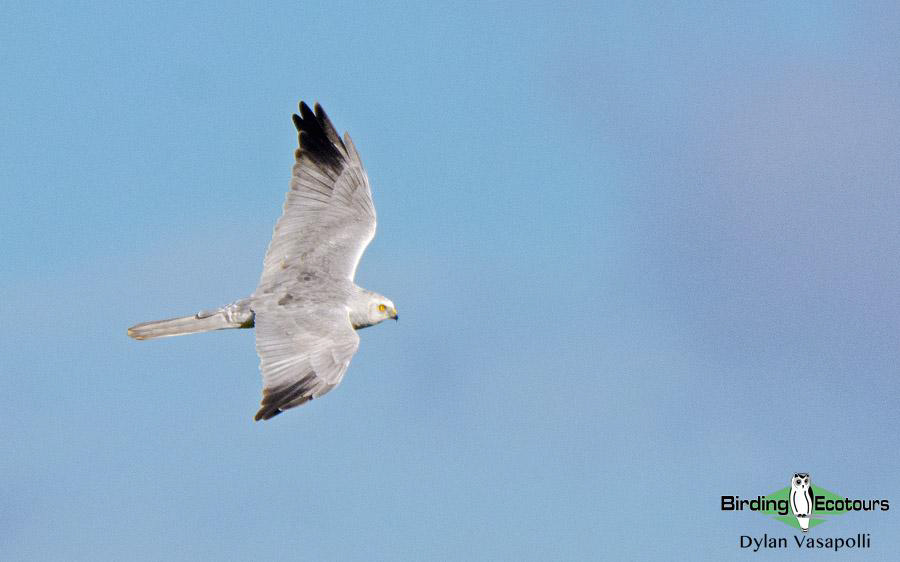
The population of Pallid Harrier has been decreasing globally. While the bird is widespread, a good place to find it is in Georgia in the fall.
Carotenoids
Carotenoids are a class of pigments produced by virtually all plants and some microbes, and are responsible for the yellow, orange, and red colors seen in many bird species. Unlike melanins, carotenoids cannot be synthesized directly by birds and must be obtained through their diet, making them a limited resource. As a result, carotenoid-based colors often act as honest signals of foraging ability, and overall condition.
To give you a better understanding of the pathway of these pigments, let’s take a look at the Crimson-breasted Shrike, which can reliably be found on a day trip out of Johannesburg. This bird obtains its yellow pigment from insects and other small creatures, which in turn obtained them from consuming plants. Then, through the addition of two double-bonded oxygen groups to the yellow pigment, the pigment finally becomes red. As with melanins, carotenoids also serve multiple essential functions in bird metabolism, including antioxidant defense, immune support, and visual enhancement.
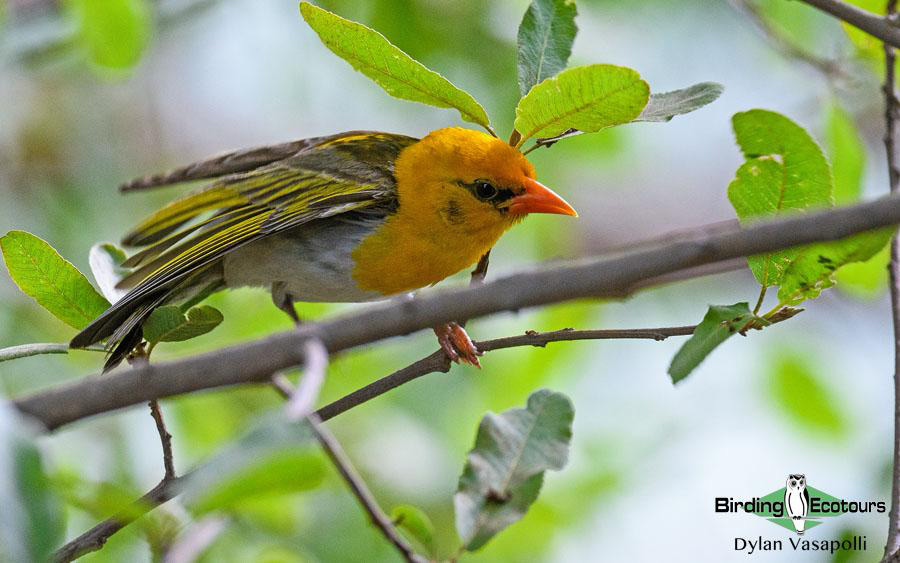
Xanthochromism occurs when a bird lacks the ability to add the two oxygen groups necessary to convert yellow to red. This Red-headed Weaver is a prime example.
Porphyrins
Porphyrins are where bird pigmentation starts to feel a bit more unusual and chemically rare, capable of generating reds, browns, and even rare greens. Unlike other pigments, they are chemically unstable and can degrade under light exposure, meaning their colors may fade over time. This instability may itself carry information, potentially signaling recent molt.
Interestingly, these compounds are found in the feathers of many owl species, and, even more intriguingly, it is only visible to us under ultraviolet light in those species. Human eyes have three types of cone cells, each sensitive to red, green, or blue wavelengths, which together shape our perception of color. Birds extend this system with a fourth type of cell, the UV cone, which is chemically tuned to detect much shorter wavelengths than we are able to perceive.
When we shine a UV torch on the underside of a Northern Saw-whet Owl’s wing, we excite the porphyrins in its feathers, causing them to fluoresce a vivid pink. This is only a secondary effect that we are able to observe, however; the true colors visible to a bird under natural conditions remain beyond our perception.
The true star of the porphyrin class is a pigment called turacoverdin, which as the name suggests, is found only in green birds of the turaco family (musophagiformes) such as Knysna Turaco. This copper-based compound is the only true green pigment found across all birds, all other ‘green’ birds you see are playing a trick on you.
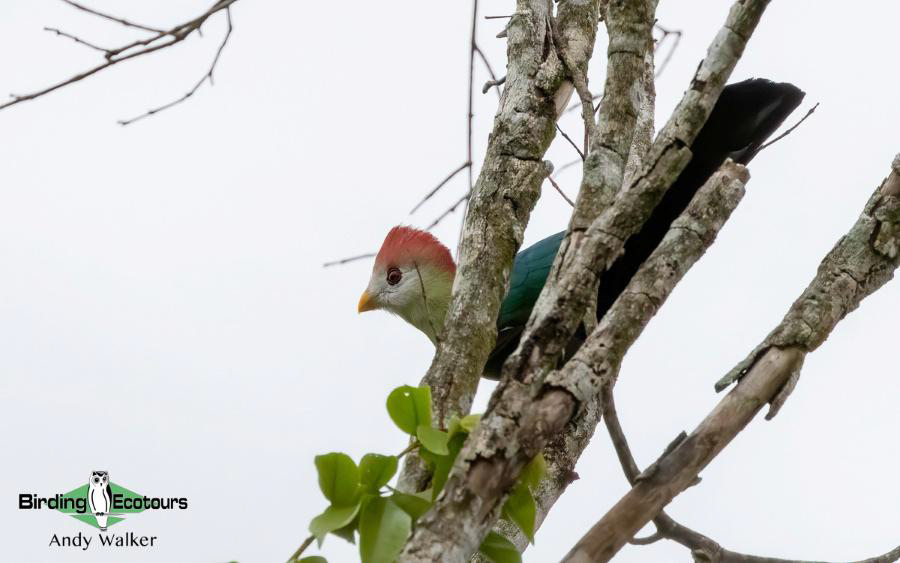
Red-crested Turaco is endemic to Angola, its red crest is also pigmented with a copper based compound called turacin.
Psittacofulvins and Spheniscins
In the interest of brevity, I’ve combined the final two pigment classes into a single section, as both are relatively rare and highly specialized.
Psittacofulvins are found only in parrots and are responsible for the bright reds, oranges, and yellows seen in species such as the Scarlet Macaw. Like porphyrins, they are synthesized directly by the bird rather than obtained from the diet, allowing parrots to produce vibrant colors independent of environmental availability. In addition, psittacofulvins appear to have antibacterial properties, which may be particularly advantageous in the warm, humid environments that many parrots inhabit.
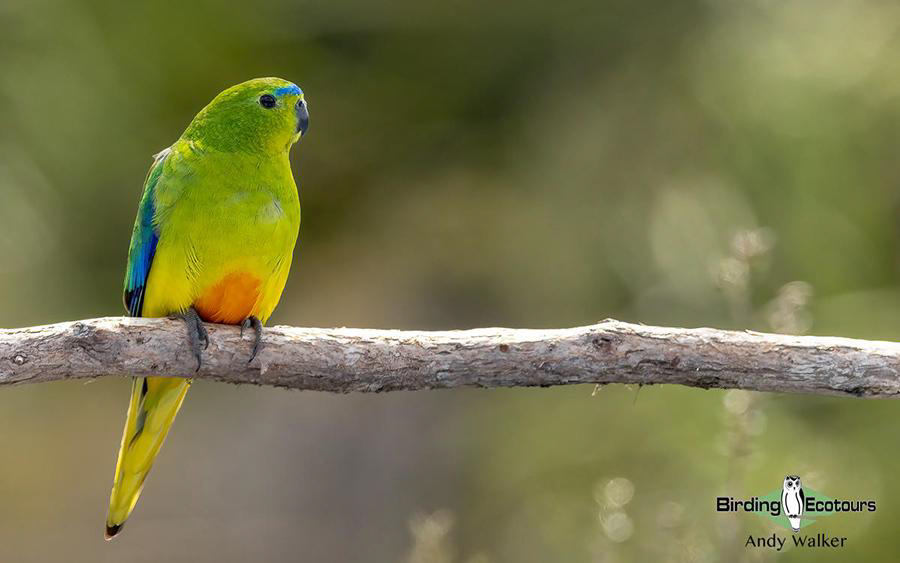
The Orange belly of the critically endangered Orange-bellied Parrot is the product of a psittacofulvin pigment. This bird is best sought in Tasmania.
Spheniscins, on the other hand, are unique to penguins and are responsible for the yellow tones seen in the head and neck patches of the “great penguins”, as well as the yellow ornaments of the crested penguins like the Macaroni Penguin.
These pigments were only identified as distinct in 2013, so there is still much to learn about this class. Although penguins obtain carotenoids from their marine diet, the yellow pigments in their feathers are not typical carotenoids, and the exact biochemical pathway leading to spheniscins remains an area of ongoing research.
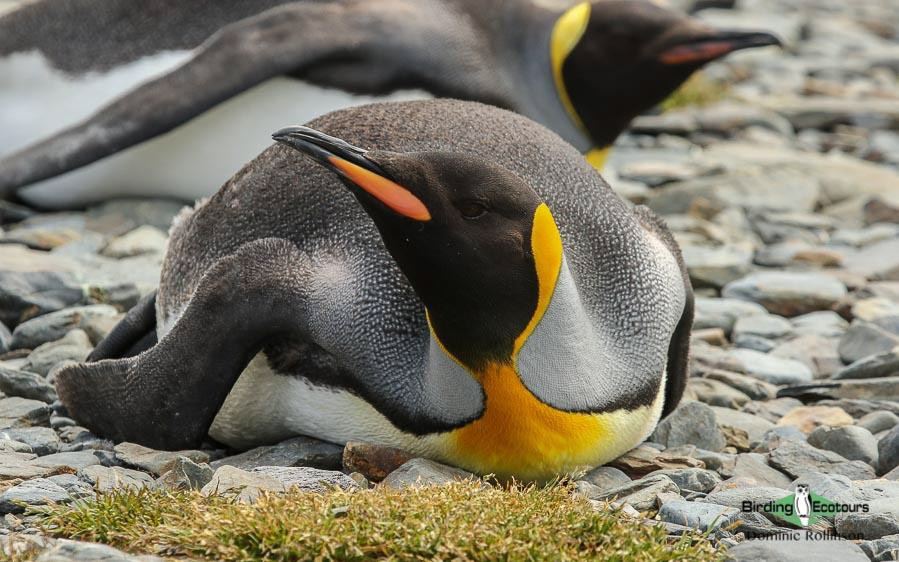
King penguins are best sought on the polar and sub-polar islands surrounding the Antarctic continent. Most people see them on the Falkland islands.
Well that just about wraps things up…but wait… What about Bluebirds?
As you may know, blue is an incredibly rare pigment color in nature and is, in fact, entirely absent from birds. Instead, blue is created by microscopic structures within the keratin itself, which manipulate light in very precise ways.
In glossy, iridescent birds such as the Himalayan Monal, the feather contains tightly ordered layers of keratin and melanin. As light hits these layers, it reflects and interferes with itself, reinforcing certain wavelengths and cancelling others. The result is a shimmering, metallic blue that shifts and flashes as the viewing angle changes.
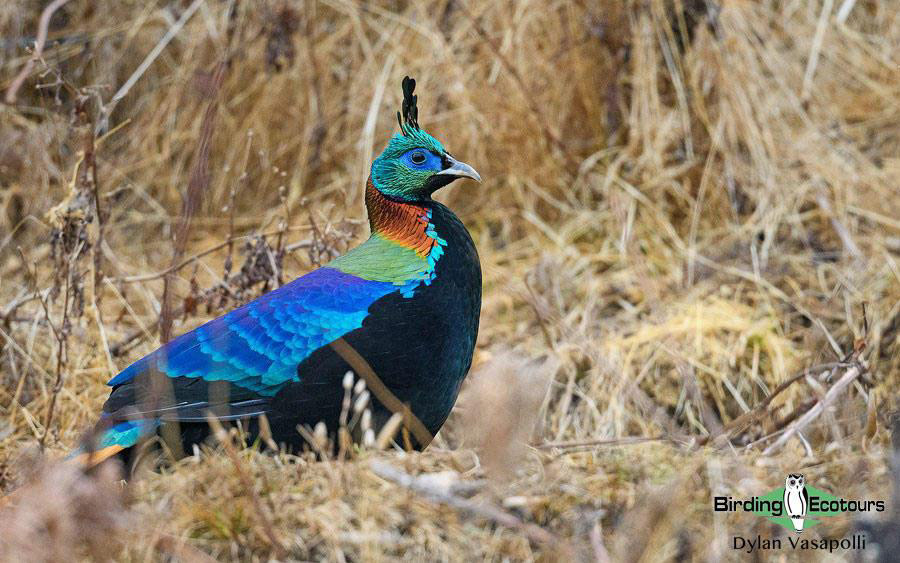
The rare Himalayan Monal is well sought after in Bhutan.
In softer blue species like the Eastern Bluebird, the structure is far less ordered. Here, a fine matrix of keratin and air pockets creates countless tiny boundaries that scatter light, preferentially sending blue wavelengths back to the viewer. This produces a matte, stable blue that does not change with angle. In both cases, a layer of melanin beneath the structure absorbs stray light, sharpening the color. Of course, this is not restricted to melanin class compounds; green birds (that aren’t turacos) have a layer of a yellow carotenoid (or psittacofulvin) combined with an altered structural matrix.
What looks like a simple feather is, in reality, a highly tuned optical system built from nothing more than keratin, air and a painting kit of pigments; all meticulously trial run by natural selection over millions of years, and we are just lucky enough to enjoy the show!
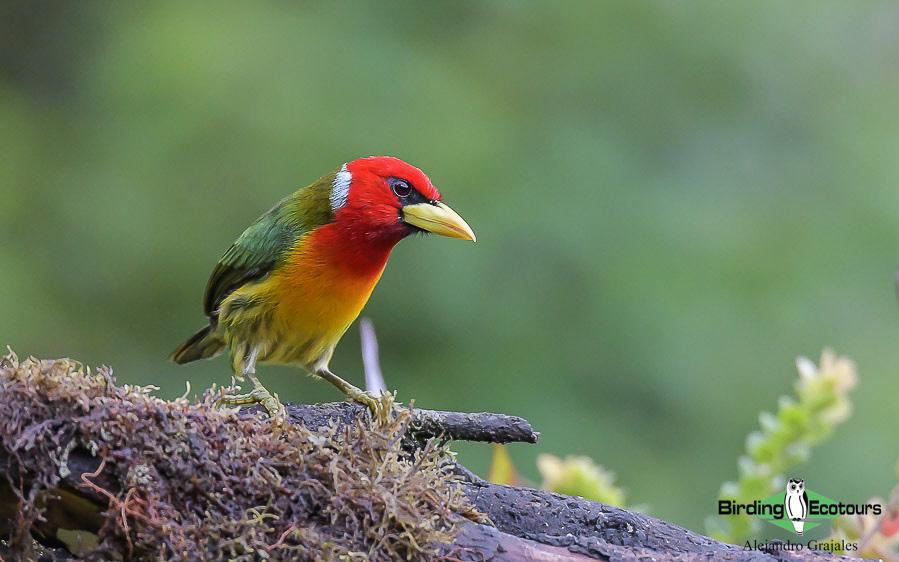
Given what we have learnt, we can now look at any bird and have a fairly decent idea of its pigment make up. Take this Red-headed Barbet found in Colombia. Yellow carotenoids around its belly, which were internally oxidized to become red on its head, a black facial mask composed of melanins, the lack of any pigment on its white hind-neck, and a combination of yellow carotenoids behind a structural augmentation of feathers with interspersed air pockets to create its green back and wings.
If you would like more information or want to secure your place in a tour listed above, feel free to get in touch with us at [email protected].