- Duration:
- 12 days
- Group Size:
- 4–8
- Tour Start:
- Chinggis Khaan International Airport, Ulaanbaatar
- Tour End:
- Chinggis Khaan International Airport, Ulaanbaatar
Birding Tour Mongolia: Steppes and Gobi Desert Birding
Details
2027
11–22 May
Per person sharing
$7,995 USD
£6,293 GBP / €7,326 EUR
Single supplement
$660 USD
£520 GBP / €605 EUR
including domestic flights
2028
23 May–03 June
Per person sharing
$8,875 USD
£6,986 GBP / €8,132 EUR
Single supplement
$735 USD
£579 GBP / €673 EUR
including domestic flights
Itinerary
Download ItineraryBirding Tour Mongolia: Steppes and Gobi Desert Birding
Mongolia is one of the most exciting and remote landlocked birding destinations in Asia and this small-group Mongolian birdwatching tour (without real camping like some operators) will allow you to see a wide variety of birds in spectacular natural landscapes. We will traverse Mongolia, visiting the Siberian taiga forests, the seemingly endless steppe grasslands, a range of fresh and brackish lakes, the Gobi Desert, and impressive mountains. We will stay in local-style comfortable and mostly heated Mongolian yurts (here called gers), offering an incredible and authentic Mongolian travel experience.
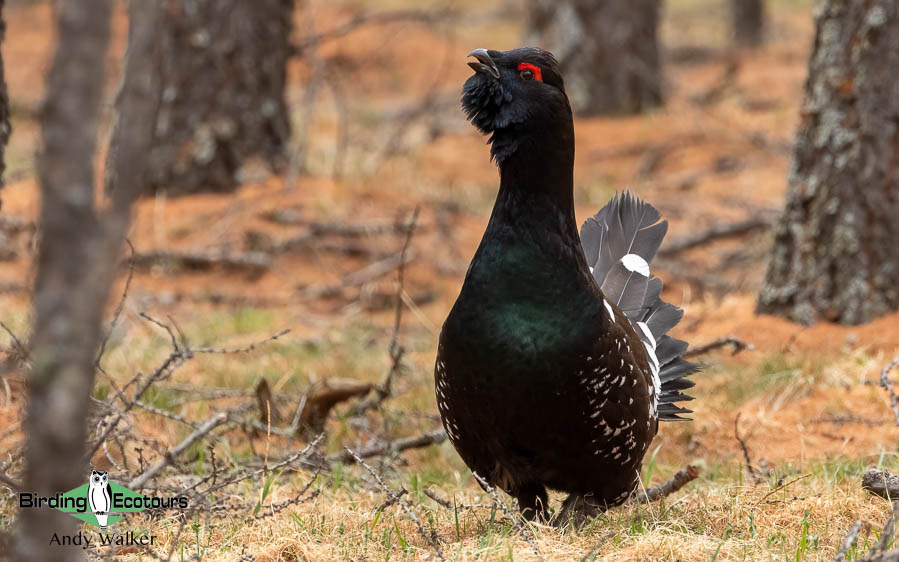
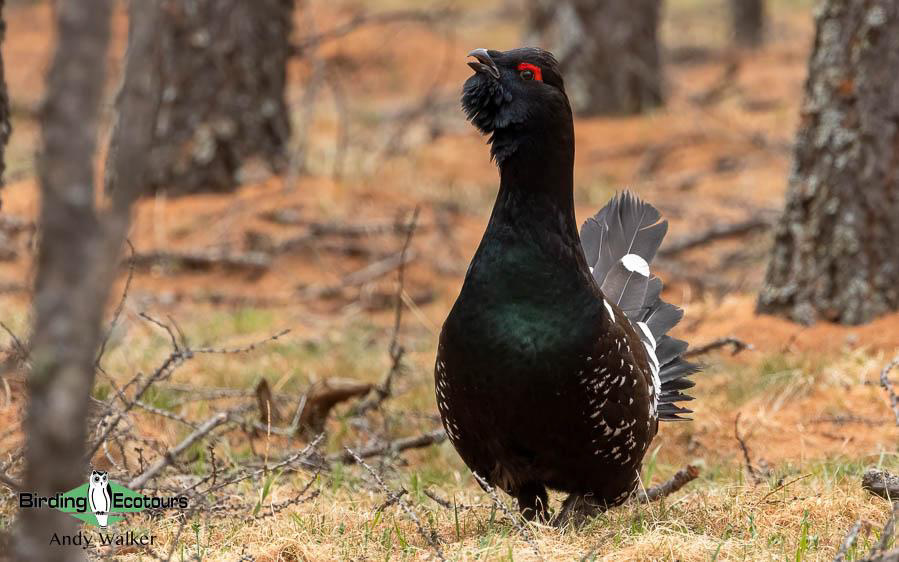 The incredible Black-billed Capercaillie will be a big target on this Mongolia birding tour.
Mongolia has been made famous worldwide by Genghis Khan (Chinggis Khaan) and the Mongol hordes (army), but the draw of some highly sought-after and poorly known bird species has also kept birders and wildlife enthusiasts enthralled in the country, making a Mongolian bird tour an essential destination for serious world birders and folks with a sense of adventure.
This Mongolian birdwatching tour offers the ultimate adventure to find an array of dream birds from the Eastern Palearctic. We will start (and end) our Mongolian birding journey in Ulaanbaatar (also widely known as Ulan Bator). We will visit several different areas and key habitats in the region where we will look for a range of important target species. On arrival in the city some of our target birds should be waiting for us near our carefully selected hotel, such as Bar-headed Goose, Mandarin Duck, a range of shorebirds, Amur Falcon, Common Hoopoe, Azure-winged Magpie, Red-billed Chough, Daurian Jackdaw, Azure Tit, Naumann’s Thrush, Red-throated Thrush, Long-tailed Rosefinch, Citrine Wagtail, and Little Bunting.
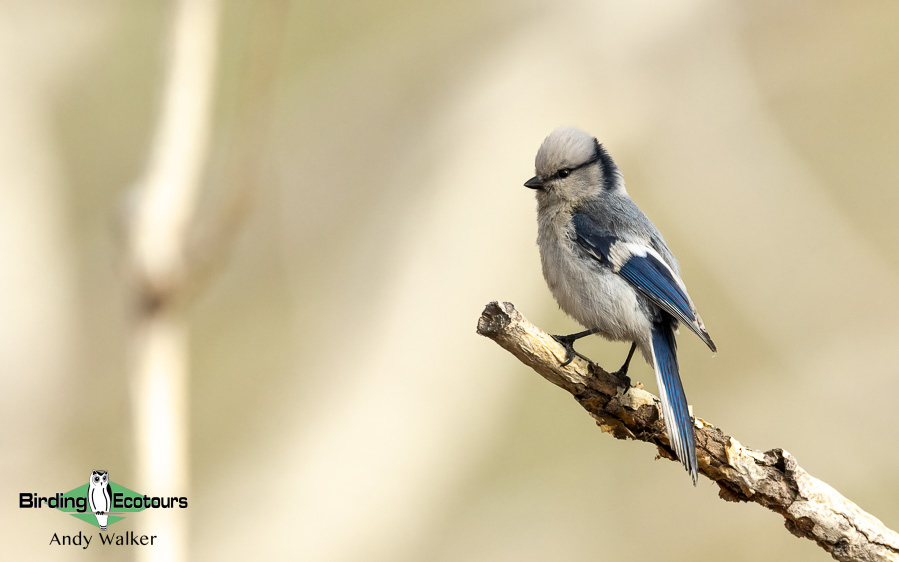
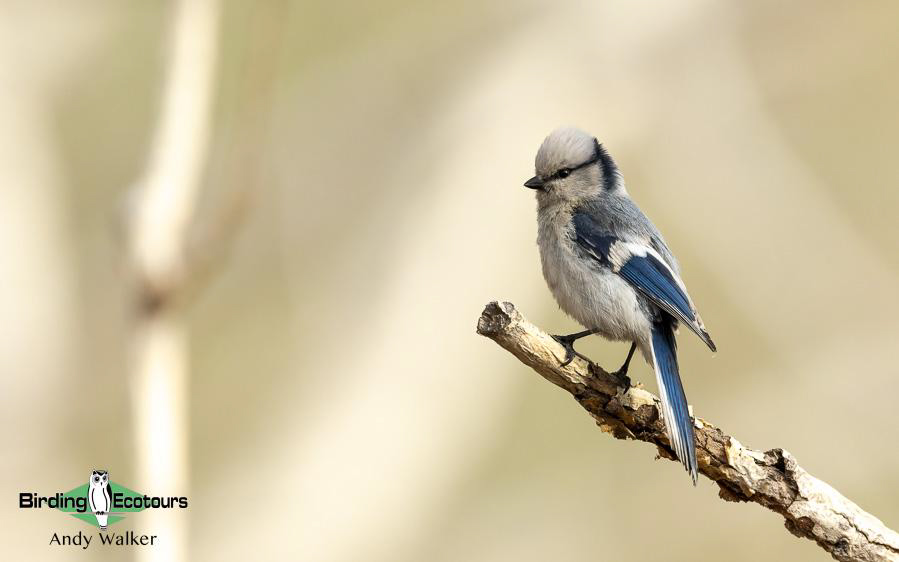 The gorgeous Azure Tit may provide an early tour highlight.
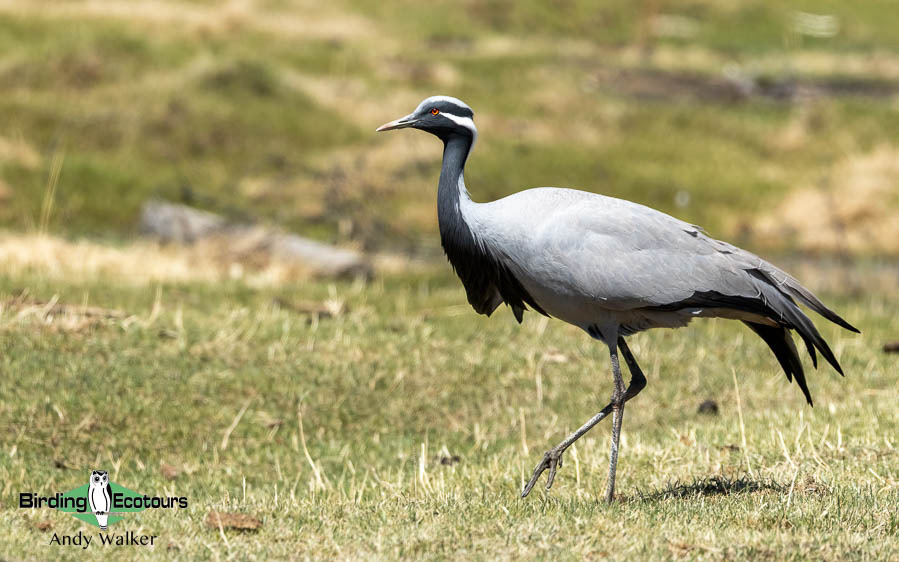
We will first travel to Gun-Galuut Nature Reserve in the steppe grassland habitats. In this park, we will search for Swan Goose, Bar-headed Goose, Stejneger’s Scoter, White-naped Crane, Demoiselle Crane, and with extreme luck we may even encounter the Critically Endangered (IUCN/BirdLife International) Siberian Crane. Other targets here include Black Stork, Asian Dowitcher, Steppe Eagle, Greater Spotted Eagle, Golden Eagle, Bearded Vulture (Lammergeier), Cinereous Vulture, and Saker Falcon. We might also find Lanceolated Warbler, Red-throated Thrush, Pied Wheatear, Citrine Wagtail, Pere David’s Snowfinch, Meadow Bunting, and Pallas’s Reed Bunting, to name a few exciting possibilities.
The next stop on our Mongolian birding tour will take us to some incredible Siberian taiga forest where we will look for the magnificent Black-billed Capercaillie, along with other high-quality birds like Black Grouse, Hazel Grouse, Ural Owl, Great Grey Owl, Black Woodpecker, White-backed Woodpecker, Eurasian Three-toed Woodpecker, Eurasian Jay, Northern Nutcracker, White-crowned Penduline Tit, Chinese Bush Warbler, Siberian Rubythroat, Red-flanked Bluetail, and many more high-latitude forest birds along the way.
Following a flight south, we will bird in the high mountains, where we will look for Mongolia’s near-endemic, Kozlov’s Accentor and Wallcreeper (a monotypic family). Other specials here include Himalayan Vulture, Bearded Vulture (Lammergeier), Golden Eagle, Brown Accentor, Himalayan Beautiful Rosefinch, Mongolian Finch, and White-winged Snowfinch.
After birding the mountains, we will do something totally different, birding the famed Gobi Desert! Here, yet more targets await us, with mouthwatering prospects of breeding-plumaged Oriental Plover and Greater Sand Plover, along with Pallas’s Sandgrouse, Mongolian (Henderson’s) Ground Jay, Asian Desert Warbler, Desert Wheatear, and Saxaul Sparrow to name a few. Once our birding is completed we’ll fly back north to Ulaanbaatar where the tour will conclude.
In addition to these exciting birds, we should also see an assortment of interesting mammals during the tour, such as Tolai Hare, Pallas’s Pika, Tarbagan Marmot, Mongolian Jird, Argali, Siberian Ibex, Mongolian Gazelle, Goitered Gazelle, Onager, Corsac Fox, and more.
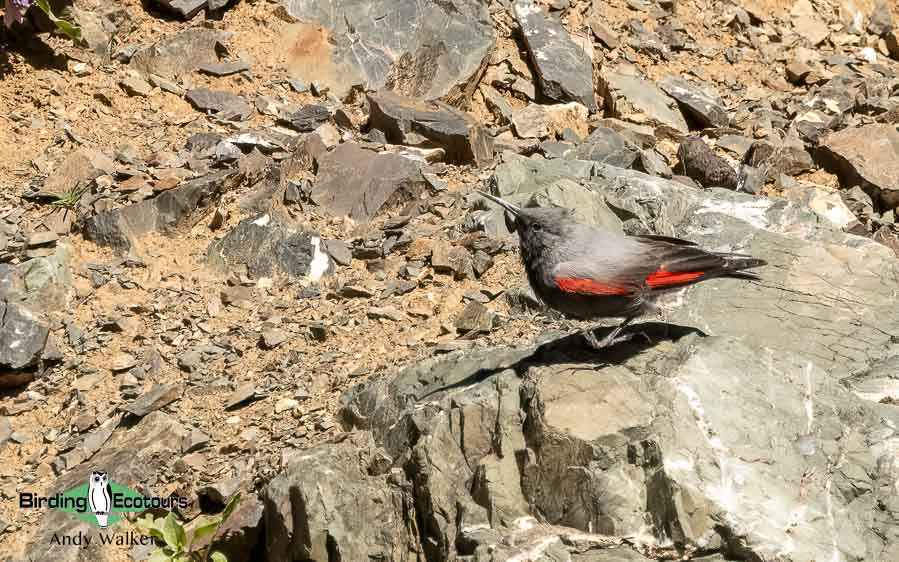
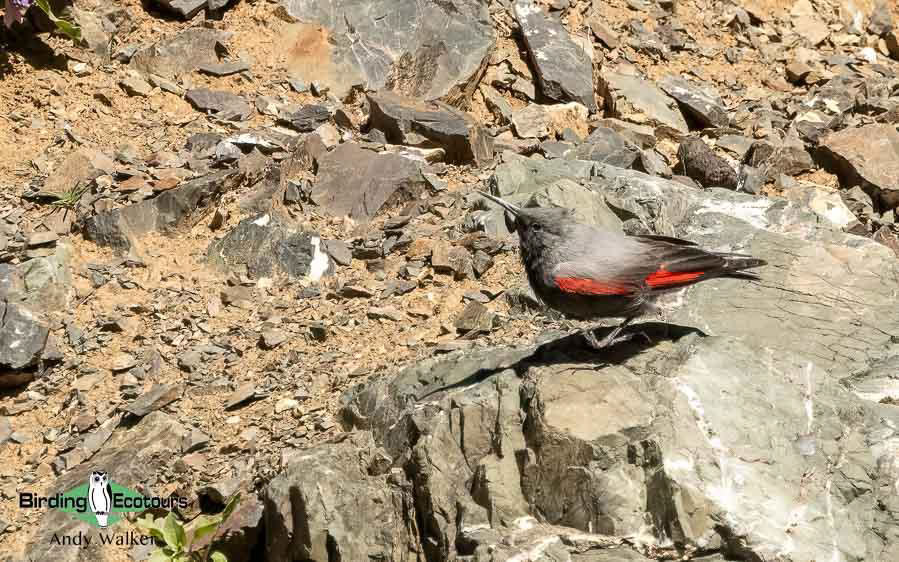 Wallcreeper can be found on the towering cliffs in the southern Gobi Desert.
Itinerary (12 days/11 nights)
Day 1. Tour starts with afternoon birding in Ulaanbaatar
We will have a welcome lunch together and then we will go to some woodland near the Tuul River in the afternoon, where we will look for Amur Falcon, Azure-winged Magpie, White-crowned Penduline Tit, Azure Tit, Red-throated Thrush, and Long-tailed Rosefinch. We will perhaps also see some wildfowl and shorebirds in the nearby gravel pit ponds, such as Bar-headed Goose and Mandarin Duck for a nice relaxed introduction to our Mongolian birding experience.
Overnight: Ulaanbaatar hotel
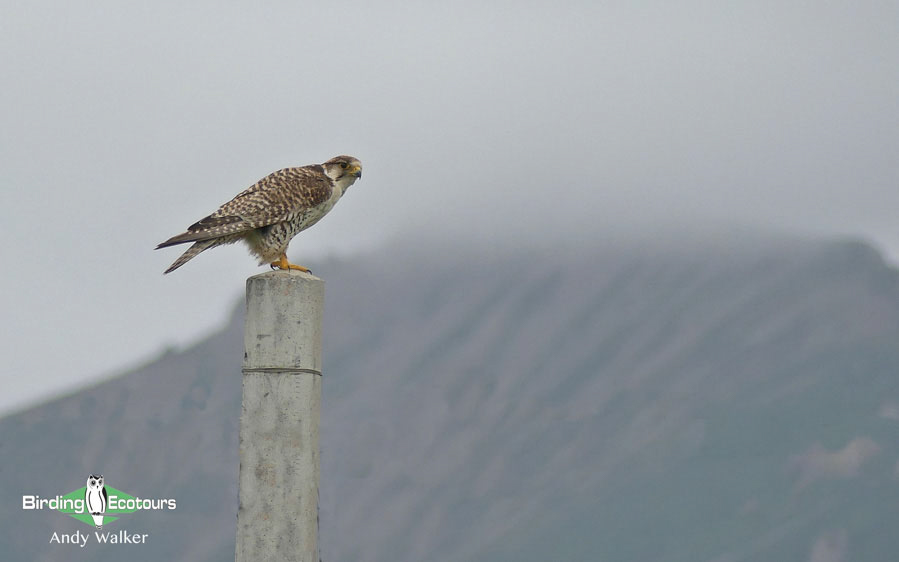
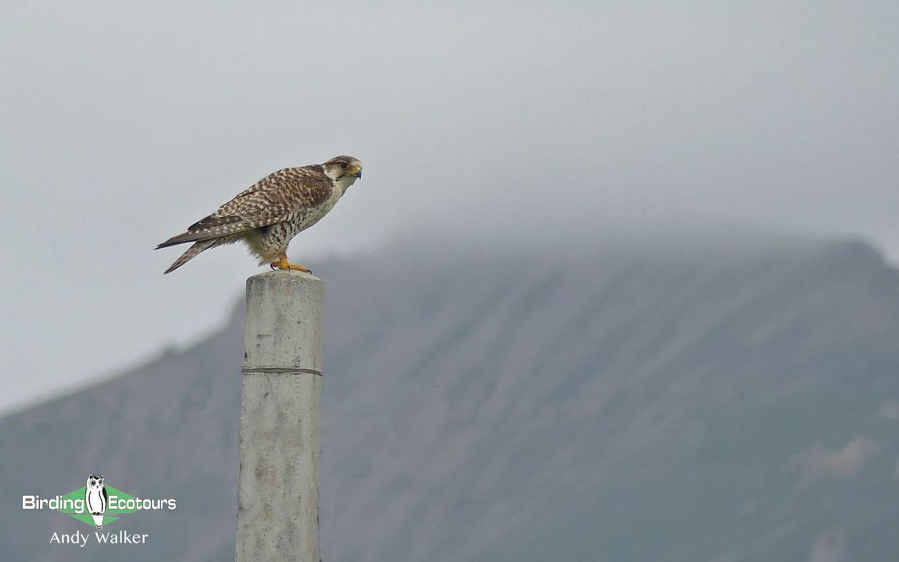
Saker Falcon is a huge falcon and makes its home in the steppes and mountains of Mongolia.
Days 2 – 3. Ulaanbaatar to Gun-Galuut Nature Reserve
We will spend time birding in the picturesque Gun-Galuut Nature Reserve. The reserve was founded in 2003 to protect the endangered wildlife and their habitat along the River Kherlen. The reserve is made up of high mountains and pretty lakes teeming with birds, and surrounded by grassland full of beautiful and colorful wildflowers, all providing important breeding and foraging grounds for many of our regional target bird species.
There are several birds of global significance in this area, and we will spend time trying to find as many of them as possible. One highlight, with extreme luck, would be the Critically Endangered (IUCN/BirdLife International) giant Siberian Crane – these days a very rare visitor. Other crane targets here include White-naped Crane, Demoiselle Crane, and Common Crane. Further species we will look for include Swan Goose, Bar-headed Goose, Whooper Swan, Stejneger’s Scoter, Eastern Spot-billed Duck, Black Stork, Asian Dowitcher, and White-winged Tern. A wide range of impressive raptors can be encountered here too, such as White-tailed Eagle, Eastern Marsh Harrier, Upland Buzzard, Golden Eagle, Steppe Eagle, Bearded Vulture (Lammergeier), Cinereous Vulture, Amur Falcon, and Saker Falcon.
Some of the passerines possible in this area include Red-billed Chough, Asian Short-toed Lark, Mongolian Lark, Lanceolated Warbler, Paddyfield Warbler, Oriental Reed Warbler, Common Rock Thrush, Red-throated Thrush, Northern Wheatear, Pied Wheatear, Isabelline Wheatear, Richard’s Pipit, Citrine Wagtail, Rock Sparrow, Pere David’s Snowfinch, Meadow Bunting, and Pallas’s Reed Bunting. We will spend some time searching for these many great species, as well as the impressive non-passerines of the area.
Overnight (two nights): Tourist ger camp
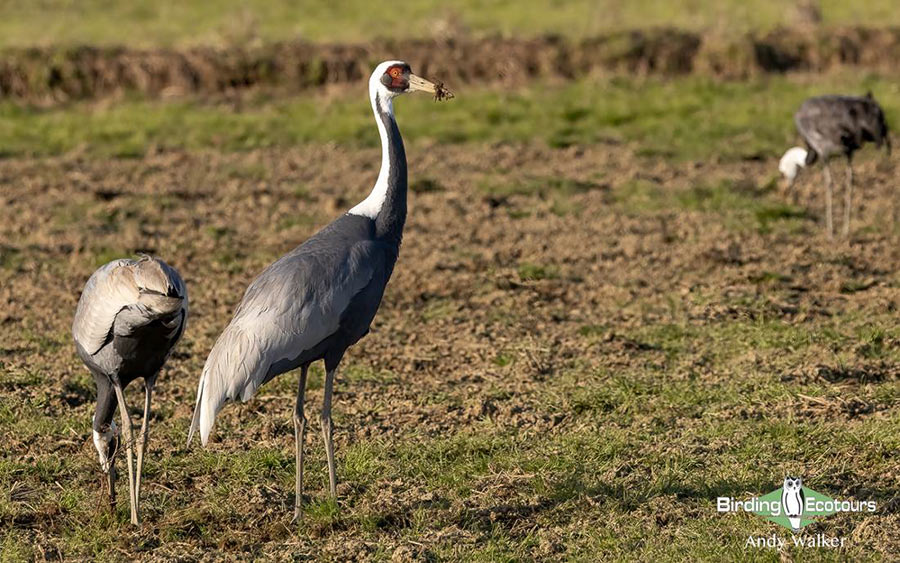
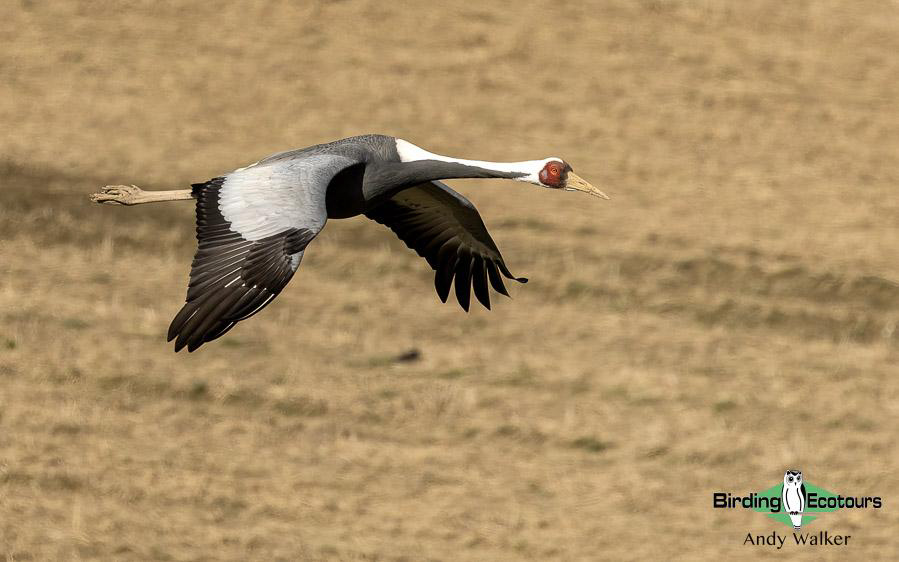 The stately White-naped Crane may be one of several crane species seen on this tour.
Days 4 – 5. Gun-Galuut to Gorkhi Terelj National Park
We will drive to Gorkhi Terelj National Park and check into a tourist ger camp near the birding site for a two-night stay to explore this fascinating area. Here we will look for forest and forest/steppe birds, including the tough and highly sought-after Black-billed Capercaillie (see cover image for the fantastic views we enjoyed on a recent Mongolia birding tour).
Other target birds for our time here include Daurian Partridge, Common Cuckoo, Oriental Cuckoo, Great Grey Owl, Ural Owl, Eurasian Three-toed Woodpecker, White-crowned Penduline Tit, Chinese Bush Warbler, Siberian Rubythroat, Red-flanked Bluetail, Daurian Redstart, Dark-sided Flycatcher, Taiga Flycatcher, Siberian (Stejneger’s) Stonechat, White-cheeked Starling, Olive-backed Pipit, Black-faced Bunting, and Pine Bunting.
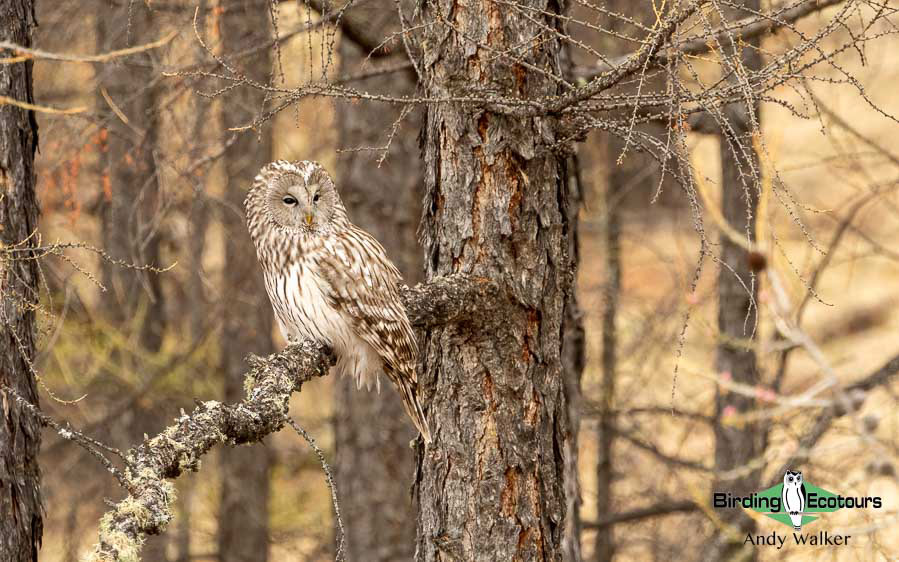
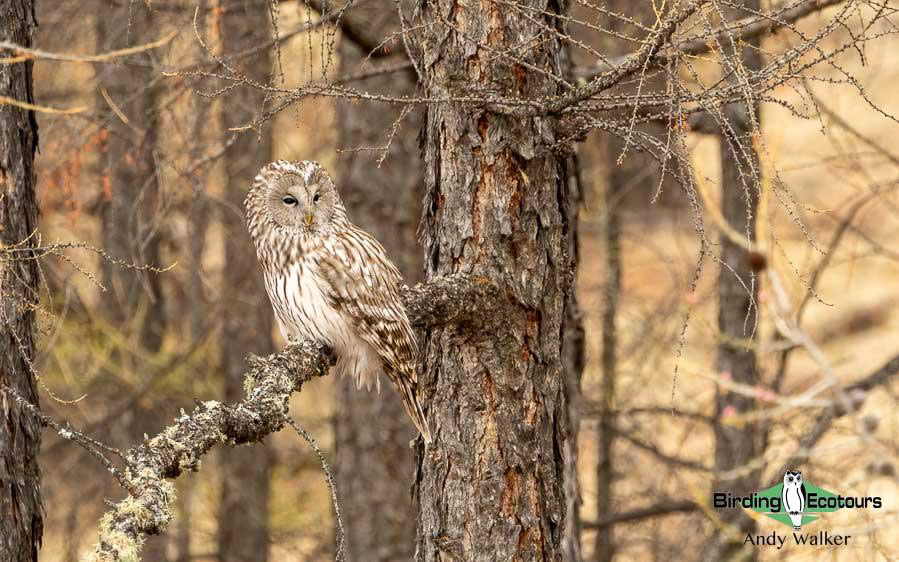 Ural Owl can be found while birding at Gorkhi Terelj National Park.
Birders who have spent time in the non-breeding season in Thailand (e.g. on our Northern Thailand – Spectacular Resident and Migrant Birds tour) or chased rare birds in the UK, US, or continental Europe, will likely be familiar with the challenge (and fun!) of Phylloscopus warbler identification. In Gorkhi Terelj, in late May, we have the opportunity of seeing breeding and singing Arctic Warbler, Greenish Warbler, Two-barred Warbler, Yellow-browed Warbler, Hume’s Leaf Warbler, Pallas’s Leaf Warbler, and Dusky Warbler, which makes identification a little less of a challenge!
Other birds we will look for in the Siberian boreal forest (taiga) include Eurasian Goshawk, Eurasian Sparrowhawk, Common Hoopoe, Black Woodpecker, Grey-headed Woodpecker, White-backed Woodpecker, Northern Nutcracker, Paddyfield Warbler, Oriental Reed Warbler, Lesser Whitethroat, Willow Tit, Common Redstart, and Daurian Redstart.
Overnight (two nights): Tourist ger camp
Day 6. Travel between Gorkhi Terelj National Park and Yolyn Am (via flight between Ulaanbaatar and Dalanzadgad)
Today we will travel to, then take a flight from, Ulaanbaatar to Dalanzadgad. We will then drive the short distance to Yolyn Am. Depending on the flight schedule, we may get time for some extra birding in the Gorkhi Terelj National Park area, where we might have further chances to look for Grey-headed Woodpecker, Eurasian Three-toed Woodpecker, Lesser Spotted Woodpecker, Northern Nutcracker, and Red-flanked Bluetail. Alternatively, if we arrive in Yolyn Am earlier we may get started on some of the birds to be found near our accommodation.
Overnight: Tourist ger camp
Day 7. Birding Yolyn Am
We will drive through yet more beautiful scenery as we head from our accommodation to Yolyn Am, a deep and narrow gorge in the Gurvan Saikhan Mountains in the Gurvan Saikhan National Park. We hope to see Bearded Vulture (Lammergeier) and Himalayan Vulture at close range, along with Wallcreeper (a monotypic family), Sulphur-bellied Warbler, Kozlov’s Accentor (a Mongolian near-endemic bird), and the attractive Himalayan Beautiful Rosefinch.
Other species we will look for will include Chukar Partridge, Cinereous Vulture, Golden Eagle, Eurasian Eagle-Owl, Saker Falcon, Barred Warbler, Eurasian Crag Martin, Common Rock Thrush, Brown Accentor, White-winged Snowfinch, Mongolian Finch, Godlewski’s Bunting, and Grey-necked Bunting. We will also scan the mountain ridges for Siberian Ibex, which can be found here too.
In the afternoon we will take a drive around the open desert plains looking for Oriental Plover.
Overnight: Tourist ger camp
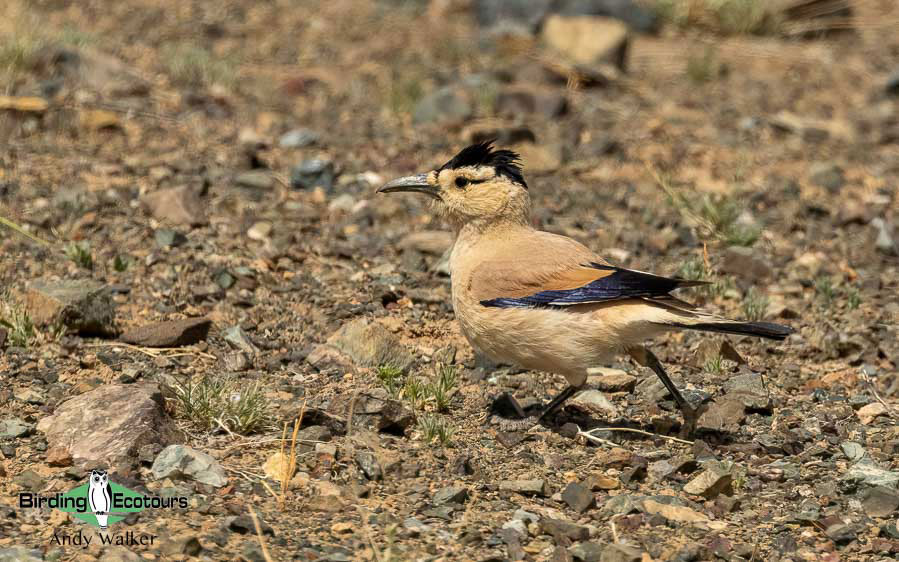
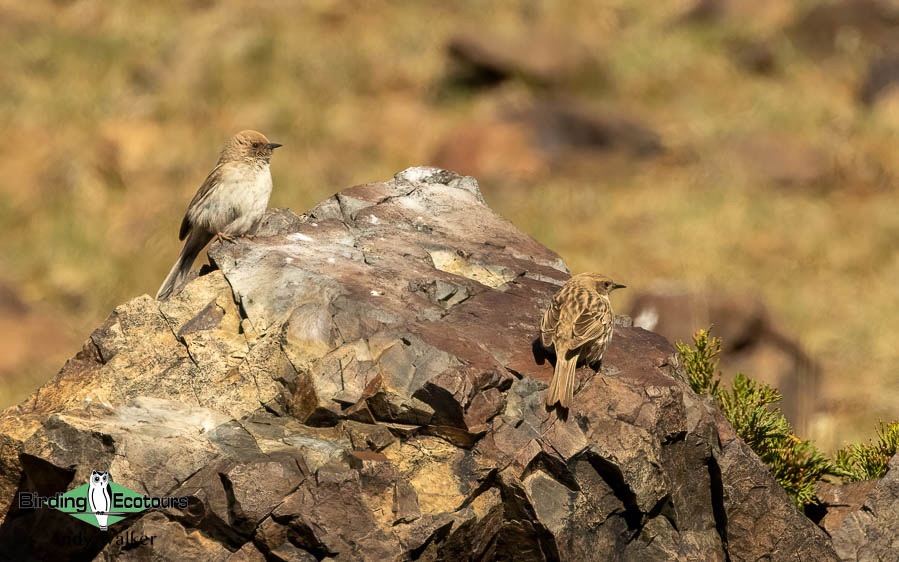
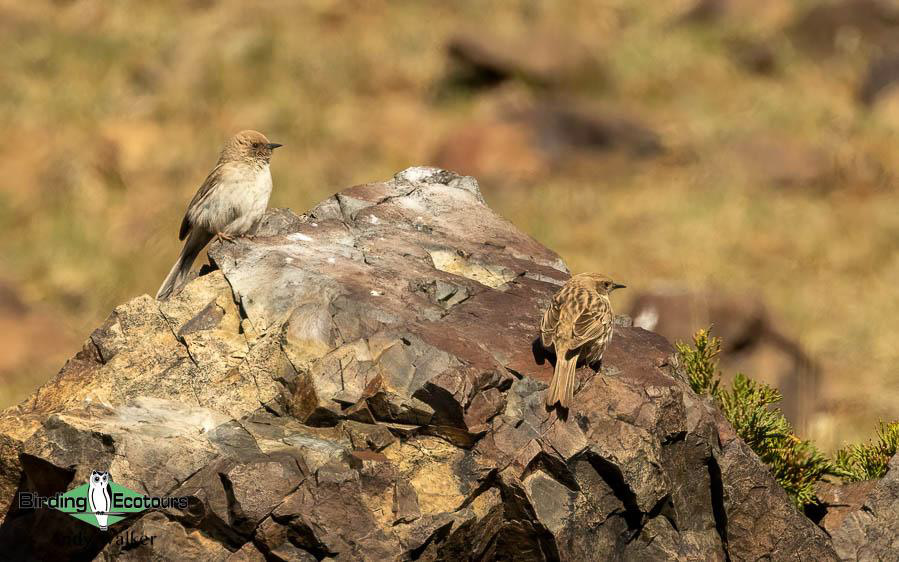 One of the least snazzy birds on the trip, but Kozlov’s Accentor is a near-endemic to Mongolia, so a highly sought after and well camouflaged target species.
Days 8 – 9. Khongoryn Els
We have a long drive ahead as we travel to the ‘Singing Sands’, the famous dunes of Khongoryn Els, located within the Gobi Gurvansaikhan National Park (i.e. the Gobi Desert!). We will make stops along the way for any interesting birds and for the incredible sandstone hills scenery.
Once we arrive at our ger camp, we will be able to relax and unwind with spectacular views of endless desert steppe, with massive sand dunes set against the grandeur of the high mountains behind. We will have to pull ourselves away from these views to find the many Gobi Desert bird specialties, such as Hill Pigeon, Pallas’s Sandgrouse, Long-legged Buzzard, Lesser Kestrel, Mongolian (Henderson’s) Ground Jay, Great (Steppe) Grey Shrike, Desert Wheatear, Asian Desert Warbler, and Saxaul Sparrow.
Overnight (two nights): Tourist ger camp
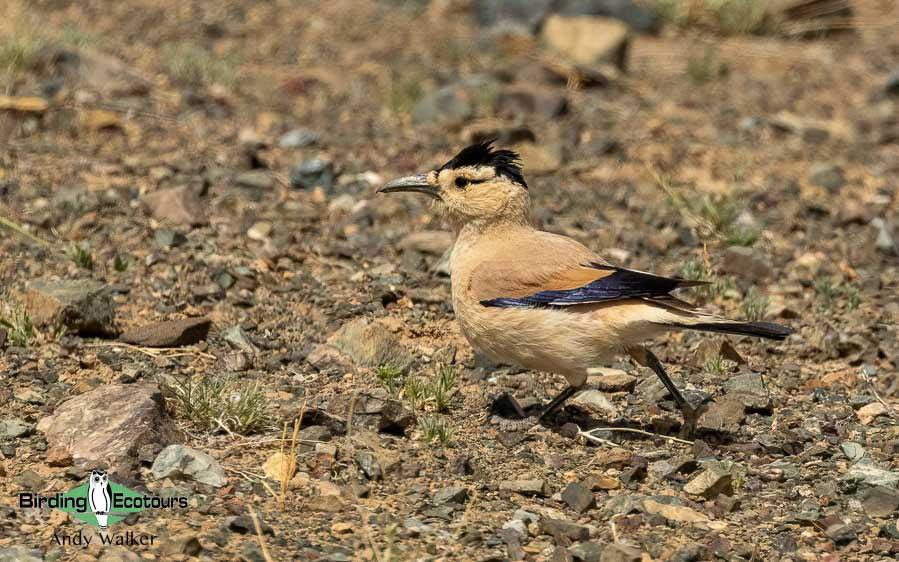 Mongolian Ground Jay is an interesting bird found in desert scrub.
Day 10. Travel between Khongoryn Els and Bayanzag (the “Flaming Cliffs”)
Today we will travel from Khongoryn Els to Bayanzag, also known as the “Flaming Cliffs”, famed for the world’s first discovery of dinosaur eggs in the 20th century.
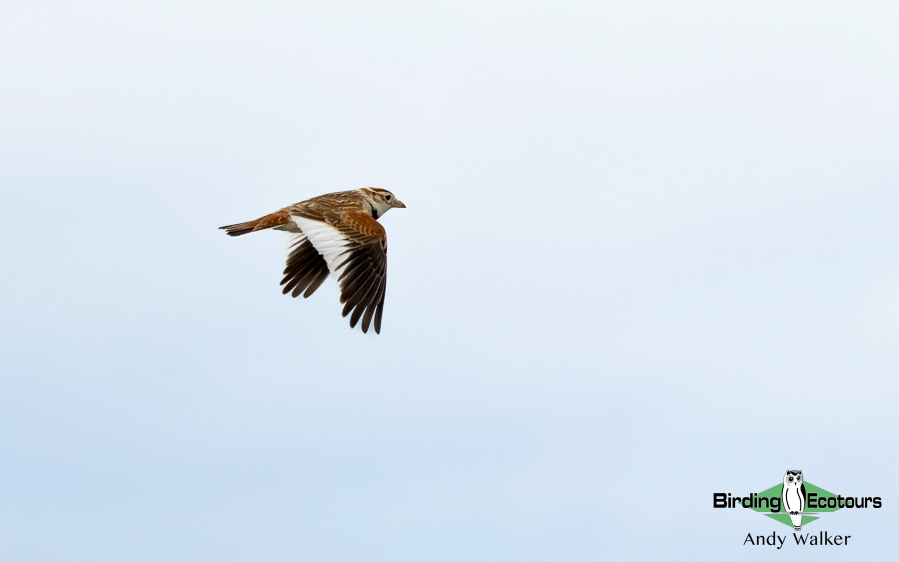
This site is also great for a few prized birds like Pallas’s Sandgrouse, Oriental Plover, Long-legged Buzzard, Great (Steppe) Grey Shrike, Horned Lark, Isabelline Wheatear, and Desert Wheatear. Several mammals are also possible in the area such as Goitered Gazelle, Gobi Jerboa, Great Gerbil, and with luck maybe even some dinosaur bones! The landscape is also rather spectacular (as it is for pretty much everywhere we visit on this tour!).
Overnight: Tourist ger camp
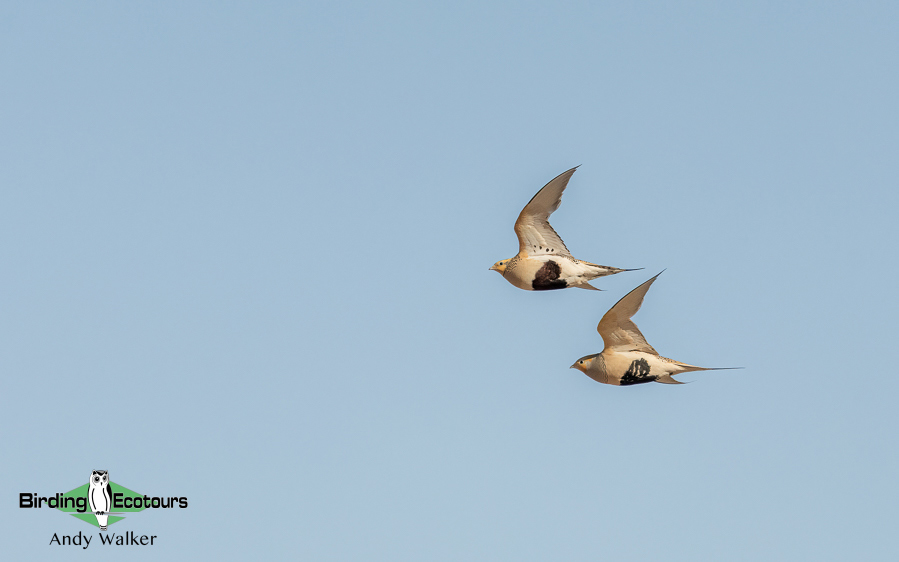
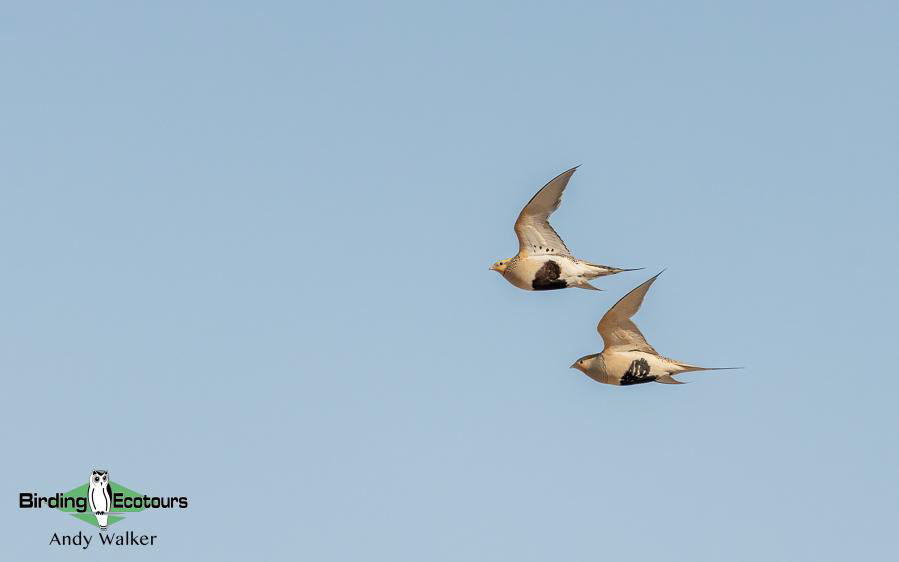 Pallas’s Sandgrouse can be found in the Gobi Desert and we will likely be able to get good flight (and perched) views of birds as they come to desert pools to drink.
Day 11. Travel between Bayanzag and Ulaanbaatar
We will spend the early morning birding at Bayanzag before we drive back to Dalanzadgad and take a flight to Ulaanbaatar. The exact timings will depend on the domestic flight schedule.
Overnight: Ulaanbaatar hotel
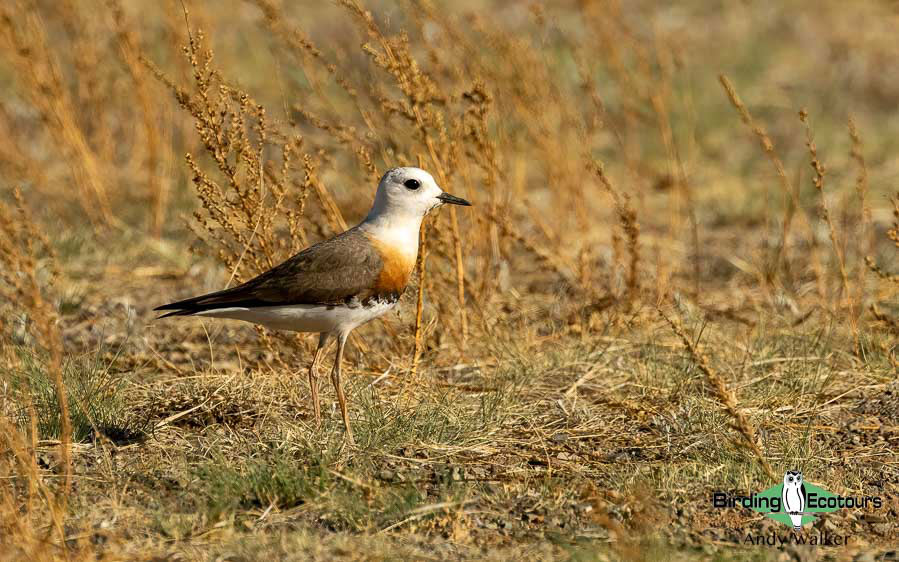
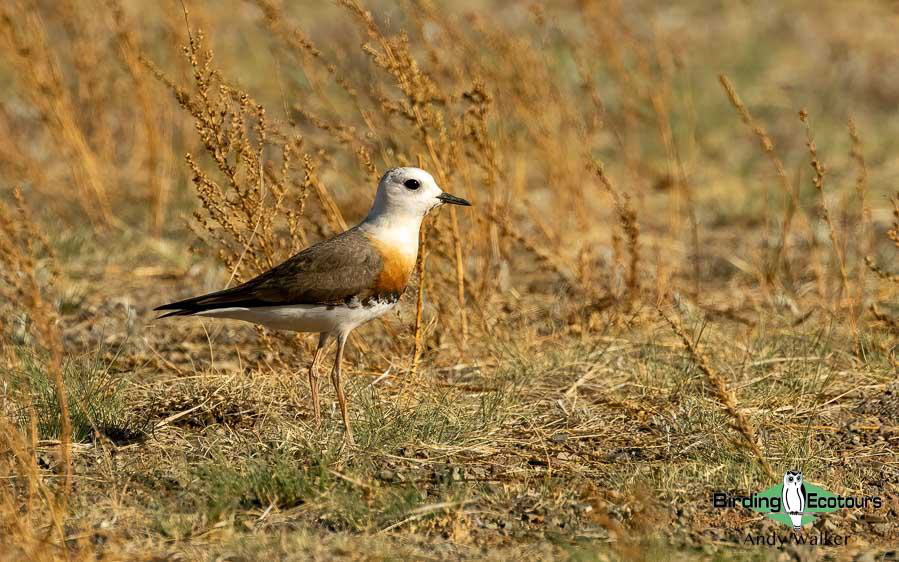 Oriental Plover can be found in the desert grasslands and is one simply stunning bird in breeding plumage.
Day 12. Tour ends in Ulaanbaatar
This is a non-birding day with the tour concluding. Breakfast is the final meal of the tour. Time at leisure before your departure from Ulaanbaatar.
Overnight: Not included
Please note that the itinerary cannot be guaranteed as it is only a rough guide and can be changed (usually slightly) due to factors such as availability of accommodation, updated information on the state of accommodation, roads or birding sites, and the discretion of the guides and other factors. In addition, we sometimes have to use a different guide from the one advertised due to tour scheduling and other factors.
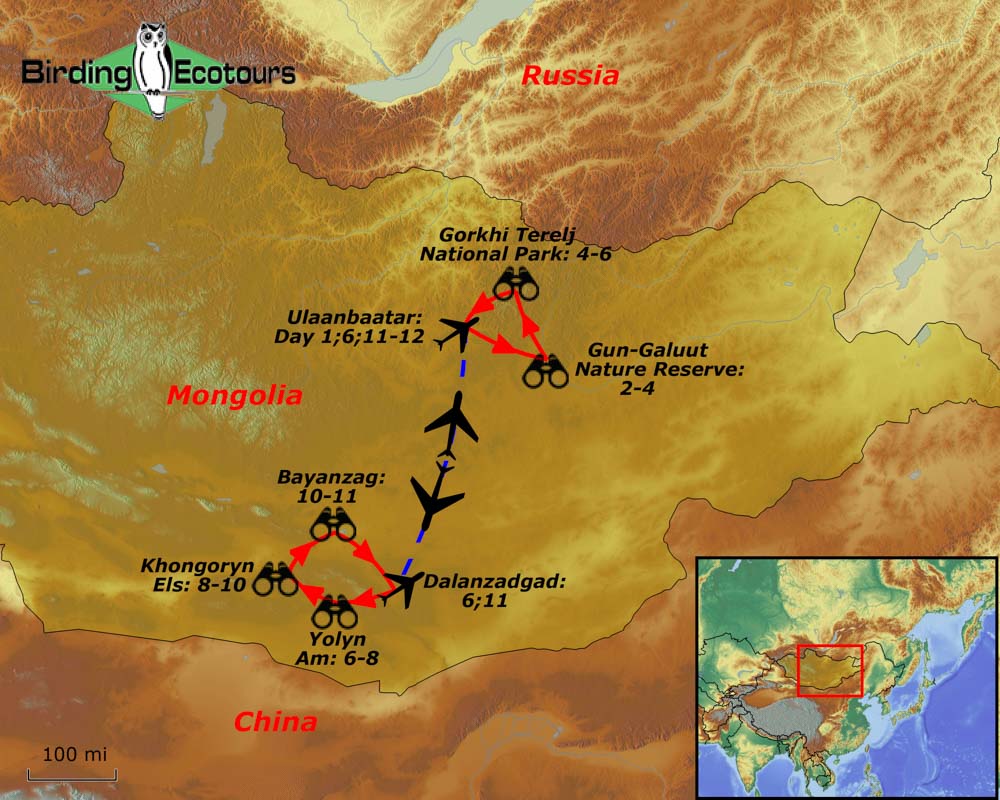
Map
Gallery
General Information
Download General InformationMONGOLIA: GENERAL INFORMATION
TOUR OUTLINE
This Mongolian birdwatching tour visits one of the most remote places on the planet. We will bird our way around the central northern part of the country and central southern regions, including birding in the vast Gobi Desert. The tour starts and ends in Ulaanbaatar, Mongolia’s capital and most populous city. You will fly in and out of the Chinggis Khaan International Airport, situated about an hour’s drive from Ulaanbaatar, for this tour. This is a birding-focused tour.
We will spend time birding in Ulaanbaatar, Gun-Galuut Nature Reserve, Gorkhi Terelj National Park, the ‘Flaming Cliffs’ of Bayanzag, the famous sand dunes of Khongoryn Els, located within the Gobi Gurvansaikhan National Park (i.e. the Gobi Desert!), and to Yolyn Am, a deep and narrow gorge in the Gurvan Saikhan Mountains in the Gurvan Saikhan National Park. The tour will target a range of highly sought-after species, including Black-billed Capercaillie, Pallas’s Sandgrouse, White-naped Crane, Demoiselle Crane, Siberian Crane, Oriental Plover, Amur Falcon, Mongolian (Henderson’s) Ground Jay, Wallcreeper, Kozlov’s Accentor, and Saxaul Sparrow.
DAILY ACTIVITIES, PHYSICAL REQUIREMENTS, AND TOUR PACE
We will be covering large distances during the tour, making use of comfortable 4×4 vehicles (such as Toyota Landcruiser’s and similar such vehicles) for the overland elements of this journey and two domestic flights (as we move between the north and south of the country, flying between Ulaanbaatar and Dalanzadgad and back to Ulaanbaatar). There are multiple nights at most places we stay, but there are a couple of one-night stays required for logistical reasons. Please note the tour route is subject to change due to potential flight schedule changes beyond our control even at the last minute, though we will do our best to ensure all of the places mentioned in the itinerary are visited and birded.
The tour will go at a moderate birding pace. Birding time is expected to be concentrated on the early morning and late afternoon periods when bird activity is likely to be higher and more noticeable, though some sites will remain birdy throughout the day. We will likely spend time during the middle of the day traveling between birding/overnight sites. Mealtimes are likely to be variable and may require packed lunches/breakfasts on some occasions.
We may walk at birding pace for an hour or two at a time, depending on our targets and the terrain, which is not expected to be too tough for walking. At times we may walk over grassy/boggy, and/or rocky ground, without trails to speak of. Most of the walks are fairly easy and short over good ground and this tour does not require high levels of fitness or stamina. Some of the forest birding we will undertake will be in hilly terrain (and we will visit several mountain sites), though we will be taking all walking at a slow, birding pace.
This is a spring Mongolian birding tour, and the weather in Mongolia in May can be variable (see the “Weather/Climate” section, below). Please be prepared for changeable weather conditions.
ITINERARY AND SPECIES RECORDING (BIRD LISTS AND ANIMAL LISTS)
In advance of our Mongolian birdwatching tours, we will email you a detailed daily itinerary (along with your arrival instructions). We will provide you with a printed version of your itinerary at the beginning of the tour. We will also provide you with a bird list and lists of other animals possible on the tour (or a blank sheet to write down any interesting wildlife sightings if that’s more appropriate for the tour). At Birding Ecotours, we now use the latest AviList global bird taxonomy. For all other wildlife recorded, we follow the International Union for Conservation of Nature (IUCN) taxonomy, so all our itineraries and checklists follow these lists.
In addition to the AviList checklists, we will also complete eBird checklists for all birdwatching time during the tour. If you would like us to share eBird checklists with you, please provide your eBird user details to us at the beginning of the tour so we are able to do this.
Each evening, after we’ve finished our birding for the day, we will go through the daily bird and animal list, noting all the species recorded. The list session is totally optional, not everyone is interested in the “bird listing” side of things, and that’s fine, but we also know that many of you are very much interested in that aspect of the tour. The lists are usually completed once we’ve ordered our meal as we wait for our food to be prepared. Each evening, we will go through the plans for the following day by providing you with information on what clothes and equipment will be needed, when we will be having breakfast, departure time from the hotel, and key target species we will be looking for, among other pertinent points.
Once the tour is completed, we will email you a PDF copy of an illustrated trip report. This will include a complete checklist of all wildlife recorded during the tour, and if we are able to get any interesting bird, animal, or landscape photographs, these will be included in the trip report. We will also complete an eBird trip report for the tour, where you are welcome to add your photos.
PASSPORT, VISA, AND LOCAL LAWS
To enter Mongolia, your passport must have an ‘expiry date’ at least 6 months after the date you arrive. You will be denied entry if you do not have a valid travel document or try to use a passport that has been reported lost or stolen. You can visit Mongolia for tourism purposes for up to 30 days without a visa until the 31st of December 2026 (UK passport holders) and 90 days without a visa (US passport holders). We recommend checking with your own government advice as things can change and the information in the document might become out of date without our knowledge. Make sure the border control officer puts a stamp in your passport or you could face issues when leaving the country.
Your hotel or landlord will register you using an app. If you are travelling independently or staying with friends ahead of the tour, you must register yourself with the Mongolian Immigration Agency. You do not need to go in person. The agency will issue you with a digital residence permit that shows your passport number, address, photograph and fingerprints. Always carry it when you are in Mongolia. All foreign nationals, no matter their duration of stay, must register with the Immigration Agency of Mongolia within 48 hours of their arrival in country. The individual or their housing provider (e.g. hotel) can do this (you should double check it has been done). Registration can be done online through the Immigration Agency of Mongolia’s website. If you don’t register, you may face fines upon departure. You may not leave until you pay the fine to the Mongolian Immigration Agency.
There are strict rules about goods you can take into or out of Mongolia. You must declare anything that may be prohibited or subject to tax or duty. If you become involved in a commercial dispute or a criminal investigation about a customs matter, you may be held in Mongolia until it is resolved.
Always carry your passport with you. If the police ask you for identification, they will not accept a copy and you could be fined. Keep copies of the photo page and the page with your Mongolian entry stamp in a separate place.
Show respect in Buddhist monasteries. Always ask for permission to take photographs and do not touch sacred images or objects.
It is illegal to photograph or video police, police escorts, or military personnel. You could be arrested and fined. The court decides the fine based on the considered degree of social danger of the crime and the income of the defendant.
Although not illegal, same-sex relationships are not generally accepted socially. Read more advice for LGBT+ travelers, here.
It is illegal to buy, sell, kill, or capture any protected species of wild animal or trade its parts without a license. You could get a fine and a prison sentence. Note the removal of dinosaur bones/fossils etc. is also illegal.
ACCOMMODATION
We will spend two nights in comfortable hotels of good standard (in Ulaanbaatar, at the beginning and end of the tour) – where there are great birds right on our doorstep, including Mandarin Duck, Azure Tit, and Long-tailed Rosefinch! But for the majority (11 nights) of the tour, accommodation will be spent in comfortable tourist ger camps (gers are the local name for yurts). The gers will be booked on a private basis (e.g. for individuals, couples, or people traveling together), with all equipment provided, such as beds, bedding, bath towels, etc.
This tour does not include any “proper camping”, such as you may do at home, and we do not stay in small portable tents on this tour like some operators will put you in. We believe you can see the birds and amazing country yet still remain clean and comfortable at the same time. We have selected good quality gers close to our main birding sites. It’s worth noting that nighttime temperatures can drop to 32oF (0oC) during the tour, so small portable tents are likely to be cold and uncomfortable in these conditions.
Our selected ger camps are the highest of local standards. The camps provide gers for accommodation; each ger usually has 1 – 4 beds (note the mattress firmness can vary between camps), a stove (can be used for heating the room overnight – please just ask us to get it going if needed), chairs, a table, and drawers inside. Some gers provide electric heaters. One or two of the tourist camps do not provide heaters, but we can usually muster up extra blankets, or these might be in the south, where overnight temperatures are slightly warmer and so heating is less of a requirement.
The gers do not have private bathrooms. Bathrooms are located in shared, same-sex units (e.g. separate facilities for males and females) and include western toilet and shower blocks. We will try to book the gers closest to the bathrooms for convenience.
At most places we stay, electricity is provided 24 hours a day. But note that in some camps there is only electricity in a communal ger. Most gers that do have electricity, usually only have one plug socket. We therefore recommend bringing an extension cable with multiple plug sockets so you can charge more than one item at once.
Meals are served in a restaurant, usually an immense ger or a one-story building. Please note that due to our remoteness on this trip, power cuts do occur due to very windy conditions (mainly in the south) and water services may be paused due to freezing overnight temperatures (mainly in the north).
VEHICLES
We will use comfortable 4×4 vehicles, such as the Toyota Landcruiser, to travel around Mongolia rather than the older and uncomfortable Russian tour buses that some operators use. Given the vastness of the country, the distance between birding sites, and the sparseness of suitable accommodation, you should expect lengthy daily drives in the vicinity of 3–5 hours, so comfort will be appreciated. We recommend packing as lightly as possible for more comfort in the vehicles. The number of vehicles required will depend on the final group size. We will drive on some sealed roads, but we will mostly be driving on dirt/rocky steppe roads or desert tracks. The quality of these roads will vary and at times might be uncomfortable and potentially dusty, but our vehicles will make the journey more pleasant.
TRAVEL INSURANCE
As stated in our standard Terms & Conditions, we strongly recommend that you purchase comprehensive trip cancellation insurance to protect against unexpected events that might cause delays and interruptions to travel. Your insurance should also cover illness, medical issues, accidents, repatriation, loss of luggage or valuable items, flight delays/cancellations, etc. Failure to purchase adequate insurance could be costly if something unexpected occurs.
If you are injured or become ill in a remote part of Mongolia, it may be a long journey to the nearest medical facility. Outside Ulaanbaatar, the standard of healthcare is limited, and doctors may not speak English. At hospitals, you will have to pay 80% of the treatment cost in advance. Make sure you have access to funds and that your insurance covers full medical expenses, an air ambulance, in case you need to be flown home, bringing a body home in the event of a death, and bringing your family home, if one of you is seriously ill or injured.
CRIME AND SAFETY
Mongolia is one of the most sparsely populated countries in the world and crime rates are low. However, given the current global political situation, the threat of terrorism against westerners is likely increased, so additional care and attention to surroundings, especially in public places should be considered. The US travel advisory website here, is a good starting point for keeping on top of the current situation in Mongolia.
Occasionally large groups of people, including children and teenagers, harass pedestrians for money as they get into vehicles or walk into pubs or restaurants. Keep your mobile phone, passport and money in a secured bag on your person, and leave valuables in a hotel safe if possible. Violent incidents are rare, but foreigners have been assaulted and robbed in Ulaanbaatar. Avoid being out alone at night, and ask hotels or restaurants to order a car for you. If hailing a ride, use only licensed taxis such as VIP Taxis. Alternatively use the taxi app UBCab, which is trackable.
The Mongolian government has asked foreigners to report crimes so they can investigate and keep records. You do not need to have any further involvement and will be free to leave once you’ve made your report. In an emergency, call the police on 102 or +976 102 from an international cell phone. There should be someone available on this number who can speak to you in English.
Driving conditions in Mongolia are generally considered poor due to low driving standards, speeding vehicles, poorly maintained vehicles, difficult terrain, and dangerous road conditions. In Ulaanbaatar driving is hazardous as roads are heavily congested. Outside the capital, Mongolia does not have an extensive road network and only about 10% of the country’s roads are paved and signposting is minimal.
Extreme weather should also be considered, see the “Weather/Climate” section, below.
HEALTH AND PESTS
Please consult your local travel clinic or doctor regarding vaccine requirements before your Mongolian bird tour. We recommend doing this around two months prior to the tour start date so that any vaccine courses can be completed in time.
Everyone visiting Mongolia should be up to date with routine vaccinations and boosters recommended in the UK and US, like Measles-Mumps-Rubella (MMR), Diphtheria-Tetanus-Polio, and Covid. There are no certificate requirements for Mongolia under International Health Regulations. Most people should be vaccinated for Hepatitis A, Tetanus, and Typhoid, and some people should be vaccinated for Hepatitis B, Rabies (Bat Lyssavirus), Tick-borne Encephalitis, and Tuberculosis.
There is no risk of yellow fever transmission in Mongolia, and vaccination is not required for entry. Proof of vaccination is only required if traveling from a country with endemic yellow fever. Yellow fever vaccination is generally not recommended for travel to Mongolia, as it is not a risk area. Please refer to the World Health Organization’s list of countries where Yellow Fever transmission is possible, here.
In case of a medical emergency, call 103 and ask for an ambulance. If you require medical treatment, contact your insurance company quickly. It is best to bring prescription medication and a first aid kit with you. Medical products in pharmacies are mainly from China and Russia, so you may not easily recognize what you need.
The high levels of air pollution in Ulaanbaatar, especially in winter, may aggravate bronchial, sinus or asthma conditions. Children, the elderly and those with pre-existing medical conditions may be especially affected. You can check the levels for Ulaanbaatar on the Real-time Air Quality Index. Dusty storms are a frequent occurrence anywhere along our tour route (especially if the wind is from the south), these can make breathing conditions difficult.
Please refer to the CDC (Centers for Disease Control and Prevention) website here, for further information on vaccines and how to stay healthy in Mongolia. Another great source of data is the “Travel Health Pro” website, which provides information on Mongolia here. Both these linked web pages are worth studying ahead of joining the tour.
Insect- (or tick-) borne bites can lead to Crimean-Congo haemorrhagic fever, Leishmaniasis, and scrub typhus (e.g. from chiggers). Prevention of insect bites is the best way to avoid these issues. Insect repellent with a high DEET content is recommended for most of the areas we visit in Mongolia (DEET usually works against both ticks and mosquitoes). Biting insects are expected to be at low levels in May, however ticks are likely to be present and commonly encountered in some of our birding areas (e.g. at Yolyn Am), so being aware of them is important (as will be having a tick removal tool).
Sunscreen (rated SPF 30+) should be used frequently, and a sunhat should be worn to protect from the sun’s powerful rays, with sunglasses used to help prevent glare. A plentiful intake of water is also essential to maintain hydration, though please remember tap water is not safe to drink, drink only bottled water.
We are not expecting to spend any time over 8,200 feet (2,500 meters) elevation, so the risk of altitude sickness on this tour is considered to be very low. However, if you wish to be more aware of altitude sickness symptoms, please check this link. The maximum elevation we expect to reach during our Mongolian birding tours is 6,560 feet (2,000 meters).
MEDICAL CONDITIONS
Please ensure you are suitably covered with comprehensive medical insurance in the instance of any emergency situation while on our Mongolian bird tours. Without insurance, the cost of medical care will likely be very high (and you will need to pay in advance for any treatment required, before you will be treated). As detailed in Birding Ecotours’ general Terms & Conditions, we require you to notify us of any medical conditions we should be aware of when signing up for this tour. The sort of things we should know about include, but are not limited to, any walking/mobility issues, diabetes, epilepsy, food and medicinal allergies, heart conditions, long-term illnesses, etc.
Many of the places we go to during our Mongolia birding tours are very remote and without many medical facilities. If medical treatment is required, this might necessitate flying to a different part of the country or a neighboring country with better medical facilities. The costs of this sort of situation can be extremely expensive (requiring extra flights, etc.) and so you must be suitably covered for any eventuality.
WEATHER/CLIMATE
Mongolia is a huge, landlocked country, with varying weather conditions from 95oF (+35°C) in summer to -40oF (-40°C) in winter and during the nights. Weather conditions often change without warning so it is necessary to be prepared for a range of changeable situations. There are frequent weather warnings all year round for flooding, dust storms, heavy snow and blizzards, strong winds, and heatwaves.
The most extreme weather conditions occur in and around the Gobi Desert and the steppes. Check the World Meteorological Organization weather forecasts for Mongolia, here.
May in Mongolia brings warm, sunny days and chilly nights as spring turns to summer, with average daytime temperatures across the country ranging from 57 – 70oF (14 – 21oC) and nights dropping near to, or below, freezing, especially early in the month. It is generally dry with occasional windy, dusty, or snowy days, offering 12+ hours of sunshine daily. Rainfall is expected to be low during May and June.
In Ulaanbaatar and the central region, in May/June we can expect pleasant days with temperatures around 57 – 63oF (14 – 17oC), dropping to 34 – 39oF (1 – 4oC) at night. While in the Gobi Desert, we can expect daytime temperatures in the region of 64 – 70oF (18 – 21oC), nighttime temperatures might drop to 39 – 46oF (4 – 8oC). As we will likely be birding in the early morning and late afternoon when temperatures will be low, suitable clothing will be required (as will suitable clothing for the night); see the “What to Bring: Clothing” section, below.
DANGEROUS ANIMALS
There are not as many dangerous animals to deal with as we might bump into on an Australian or South African tour, for example, but we do need to be mindful of venomous snakes, particularly Halys Pit Viper and Common Adder which occur in rocky areas and can be stepped on accidentally. Similarly, scorpions occur in the Gobi Desert and should be considered. Wolves and bears are rare and shouldn’t be of too much concern, however dogs (such as guard dogs in rural herding communities) should be treated with caution. Rabies does occur in Mongolia.
Please check your boots before putting them on and check your bedding before getting into it when camping. Be careful of where you are putting your feet and hands in rocky areas and avoid guard dogs. Essentially just stay vigilant at all times.
Ticks should be considered during the tour, you might benefit from bringing a tick removal tool.
FOOD AND DRINK, INCLUDING WATER
Tap water in Mongolia is not considered safe to drink directly from the tap, especially in Ulaanbaatar, where aging pipes and poor quality water pose health risks. Travelers should consume bottled, boiled, or filtered water to avoid illness. In rural areas, water from natural sources may be contaminated by livestock. It is safest to just drink bottled water throughout your time in Mongolia.
Traditional Mongolian food is defined by a nomadic, high-protein diet focusing on mutton, beef, and dairy, designed for a harsh climate. Key staples include Buuz (steamed dumplings), Khuushuur (fried meat pies), Tsuivan (noodle stew), and Khorkhog (hot stone barbecue), usually paired with fermented mare’s milk (Airag), milk tea (Suutei Tsai), and yogurt. An interesting blog article on Mongolian food, here.
Mealtimes are likely to be somewhat flexible depending on our birding or travel plans for the day. So, if you need to eat food at a specific time of day (e.g., to accompany any medication you are on), we recommend that you bring snacks to supplement the meals, such as cereal bars/protein bars, dried fruit, etc. It is important to note rules on what you can/can’t bring into the country. Please consult us if you have a certain or restrictive diet or food allergies and we will let you know if the tour will be suitable for you.
CURRENCY AND MONEY
The Mongolian tögrög, also spelt tugrug or tugrik, is the official currency of Mongolia and has the code MNT and ₮ symbol. It was historically subdivided into 100 möngö. Currently, the lowest denomination in regular use is the 10 tögrög note, and the highest is the 20,000 tögrög note. Banknotes frequently used are: ₮100, ₮500, ₮1,000, ₮5,000, ₮10,000, ₮20,000. Rarely used banknotes are: ₮1, ₮5, ₮10, ₮20, ₮50, ₮100,000. Coins are of the following denominations: ₮20, ₮50, ₮100, ₮200, ₮500.
You can use a Visa card in Mongolia, particularly in Ulaanbaatar, where they are widely accepted at hotels, large supermarkets, and major restaurants. While Visa is preferred, MasterCard is also used. However, cash is essential for the countryside, taxis, and smaller shops, making it necessary to carry Mongolian Tögrög. You may need to notify your card supplier about your trip so you do not find a block on your card preventing its use. Several ATMs can be found in Ulaanbaatar airport, allowing for local currency withdrawals (if they are working). However, it should also be noted that not all ATM machines will work with foreign cards (and the currency exchange office at the airport might not be open when you pass through), so it would be best to bring some local currency with you from home.
You can take into the country up to 15 million Mongolian tögrögs. Declare cash or travelers cheques if the value is USD $10,000 or more. You will get a certified declaration to show you brought it with you. If you do not, your money could be seized when you leave.
ELECTRICITY
In Mongolia, power plugs and sockets (outlets) of Type C and Type E are used. The standard voltage is 220 volts (V) at a frequency of 50 hertz (Hz). Further details (and photos) can be found here.
Adaptors are likely to be needed for some visitors from overseas; you may also need a voltage converter and should be careful with certain appliances that utilize different frequencies. The link provided here will tell you what you need (e.g. adapter and / or voltage converter) based on your home location.
Most of the tourist camps we will be staying at have electricity connected 24 hours a day, though there is usually only one plug socket per ger. However, some camps only have electricity in a communal ger (usually the restaurant) rather than in the individual accommodation gers. Power cuts can occur at any time due to dust storms/strong wind etc. We recommend bringing a powerbank for additional power supply to keep cell phones and camera batteries fully charged in case of a long power outage. Loss of power may also impact water supply for showers/toilet flushing etc.
DOMESTIC/INTERNAL FLIGHTS
We usually have two short (less than two hours) domestic flights on the tour. We will confirm the baggage allowance when we book the domestic tickets (we prefer to book these to ensure everyone is on the same flight). You should expect a baggage allowance on domestic scheduled flights of 33 pounds (lb) / 15 kilograms (kg), with hand luggage of 11 lb (5 kg). Extra weight can usually be added for around USD $2 per 2.2 lb (1 kg). You will be responsible for loading your own bags onto and off baggage carousels and into and out of vehicles.
WHAT TO BRING: CLOTHING
We recommend packing as lightly as possible, especially noting the weight allowances on the domestic flight. That said, the weather can be extremely variable on this tour (especially when considering daytime and nighttime temperature fluctuations), so bringing clothing layers is essential, including a windproof/waterproof jacket (and trousers), a fleece, hoodie, sweater, and warm clothing for the nights. Woolen hats, gloves, a scarf, and layers of thermal undergarments to help you stay warm will be required in May and June, especially if you are not used to cold weather.
Loose, lightweight field clothing with green, brown, or dark colors works best while we are birding in the forest. Sand and khaki-type colors are fine for birding desert areas. Please avoid bright colors for birding time; for example, no pale colors in forests and no white, red, orange, etc. anywhere during birding time. Easily washable clothes are most convenient, as you may not have much time to use laundry services. Zip-off lightweight travel trousers would be ideal for most days, and it is better to have layers of trousers to keep you warm. Pajamas/tights help you to stay warm at night. Warm hiking socks are a must too.
Casual and informal dress is appropriate for the hotels/accommodation we use on these tours. Sunglasses, sunhat, lip balm, and sunscreen (rated SPF 30 or higher) are essential.
Lightweight walking boots are recommended for our Mongolian tour as they give extra ankle support while walking (necessary given some of the terrain we will be birding in) and added protection against animal stings/bites (e.g., potential snake issues). A pair of sandals (flip-flops) or trainers (tennis shoes) can be useful when in vehicles and walking between your room and restaurant in the gers/hotels/towns.
WHAT TO BRING: OTHER ITEMS
Do not forget: Binoculars, camera, field guide (see “Books” section below), flashlight (torch – e.g., headtorch – essential for nighttime when no electricity), spare batteries, power bank, converter plugs, plug adaptors, chargers, prescription drugs (please bring the generic names for these drugs with you), toiletries, prescription glasses (and a spare pair), insect repellent, sunscreen, lip balm, sunglasses, alarm clock, money pouch, personal medical kit, tick removal tool, water bottle (we can fill personal water bottles from a larger communal water bottle to reduce plastic waste), and daypacks.
Some pills for common symptoms you may have while traveling. Pill recommendations are travel sickness pills, allergy pills (there is a vast expanse of grasslands), Pepto-Bismol for any upset stomach issues, and antibiotic cream for cuts, scratches, and insect bites. Please carry any medication in the original package and clearly labeled container in your handbag. Dry tissues, wet wipes, and hand sanitizer will be useful when having picnic meals in the countryside and if you need to use a bush toilet.
Our tour leader will have a communal telescope for use during the tour. The communal scope will allow everyone opportunities to look at birds briefly on a rotation basis. If you like to take “digiscope/phone-scope” photographs through a scope, or you would like to take prolonged scope views of the birds, please bring your own scope to do so. The communal scope will be for everyone to look at the birds but not for photography.
Some additional items to remember to bring include important travel documents, passport, cash (or ATM/credit cards to draw money), and your travel or health insurance cards – photocopies of all can be carried by the tour leader in case of emergency. Don’t forget you must carry your passport with you at all times, so you will want it in a zip-lock bag or in something to prevent it (and other items like cash) from getting wet, sandy, and dusty etc.
Bringing a couple of different colored pens along with a 12-inch (30-centimeter) ruler can make the checklist session easier to follow on the longer tours.
LANGUAGE AND COMMUNICATION
The official language of Mongolia is Mongolian, which is spoken by roughly 90 – 95% of the population. The predominant dialect is Khalkha Mongolian, written primarily in the Cyrillic script. While Mongolian is the official language, Kazakh, and other minority languages are spoken in certain regions, and English is widely used as a second language.
Most international phone networks operate in the cities and Wi-Fi is widely available in hotels, restaurants, and bars in Ulaanbaatar. You can buy local SIM cards for cell phones but an eSIM is likely to be easier/quicker to set up. There are several options for eSIM providers, such as aloSIM and several networks are available. In rural Mongolia there are large areas that do not have network coverage at all, so it would be advisable to let family and friends know you might be “off the grid” for periods during the tour. Many of the tourist camps we stay at have Wi-Fi. Some of these networks reach the accommodation gers, whereas at some other locations the Wi-Fi is more restricted to communal areas. As with the electricity supply, Wi-Fi signal might not work as well in poor weather situations.
BOOKS
Helm Field Guide: Birds of Mongolia – Sundev Gombobaatar and Christopher W. Leahy (2019), Helm Field Guides, Helm.
Other specific interest books include:
A Field Guide to the Birds of Mongolia – Dorj Ganbold and Chris Smith (2019), John Beaufoy Publishing.
A Field Guide to the Mammals of Mongolia (2nd Edition) – N. Batsaikhan, R. Samiya, S. Shar, D. Lkhagvasuren, and S.R.B. King (2014), Zoological Society of London.
The Butterflies of Mongolia – V. Tshikolovets, R. Yakovlev, and Z. Balint (2009), “The Butterflies of Palearctic Asia Series”, Vol 8. Tshikolovets Publications.
Rare Animals of Mongolia (Vertebrata) – V. Sokolov (1996), International Scholars Publications.
The Age of Dinosaurs in Russia and Mongolia – (Ed.), M. J. Benton, E.N. Kurochkin, M.A. Shishkin, and D.M. Unwin (2003), Cambridge University Press.
SOUND RECORDING, WEBSITE RESOURCES, AND APPS
A wide range of bird songs and calls from Mongolia can be downloaded from the excellent xeno-canto website. Many species recordings can now also be found on eBird species pages, where video clips can also be viewed.
eBird and Merlin – loads of information that is easy to gather on your cell phone or other devices such as tablet and computer. Sound, photo, and video galleries exist for almost every species found in Mongolia, via the Cornell Lab of Ornithology’s Macaulay Library with offline access possible if you download the “Mongolia” pack.