- Duration:
- 8 days
- Group Size:
- 4–6
- Tour Start:
- Cape Town
- Tour End:
- Cape Town
Birding Tour South Africa: Best of Cape Town and Beyond — Endemics, seabirds and more
Details
2026
07–14 October
Per person sharing
R52,625 ZAR
$3,397 USD / £2,536 GBP / €2,959 EUR
Single supplement
R10,625 ZAR
$686 USD / £512 GBP / €597 EUR
This trip is full, waitlist only, or please consider booking early for 2027.
2027
07–14 October
Per person sharing
R59,700 ZAR
$3,852 USD / £2,876 GBP / €3,357 EUR
Single supplement
R10,800 ZAR
$697 USD / £521 GBP / €607 EUR
2028
07–14 October
Per person sharing
R64,500 ZAR
$4,162 USD / £3,108 GBP / €3,627 EUR
Single supplement
R10,900 ZAR
$704 USD / £525 GBP / €613 EUR
2029
07–14 October
Per person sharing
R69,500 ZAR
$4,486 USD / £3,348 GBP / €3,907 EUR
Single supplement
R11,100 ZAR
$716 USD / £534 GBP / €624 EUR
Itinerary
Download ItineraryBest of Cape Town and Beyond — Endemics, seabirds and more
South Africa must surely rank as one of the best value destinations on the entire African continent. The combination of superb accommodation, excellent infrastructure, great food, wonderful South African hospitality, impressive and varied scenery, and the presence of Africa’s big and small mammals makes it one of the most popular countries in the world to bird in. The tour begins in one of the world’s most beautiful cities, Cape Town, where we will search for a host of avian endemics found nowhere else but in the fynbos of the Cape Floral Kingdom (the richest place on earth for plants). While in Cape Town we will also do a pelagic trip, enjoying the great numbers and diversity of seabirds which visit the southern tip of Africa. After a few days birding around Cape Town we then head northward up the west coast and finally head inland through rugged mountain ranges into the Tankwa Karoo, another of Africa’s great endemic hotspots.
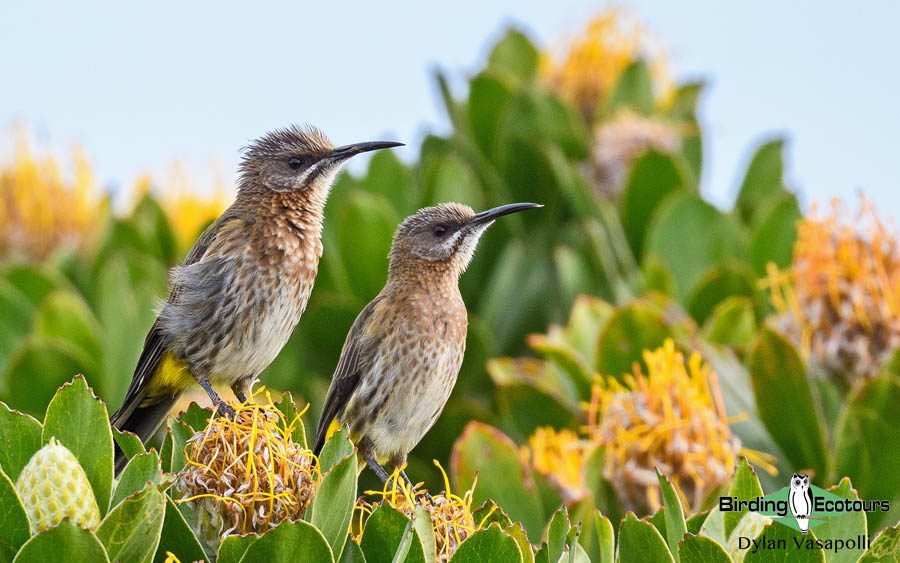 The endemic Cape Sugarbird is one of our targets on this trip.
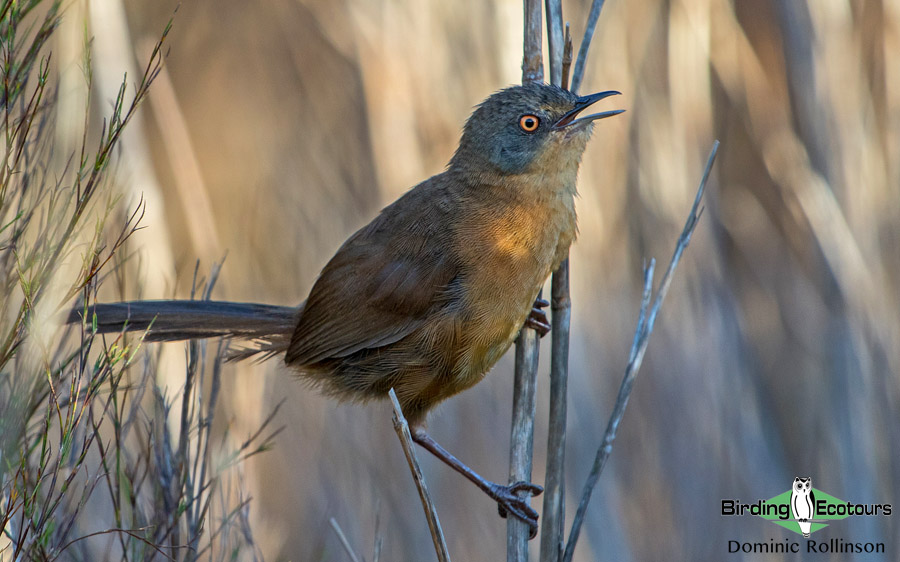
We begin this tour with a private Cape pelagic trip, where we invariably find four albatross species and always hope for an additional rarer one like Wandering Albatross. Then we hope to encounter some very enigmatic birds: Watch a weird little warbler, a desert bird that skulks, disappear into a rock crevice, namely Cinnamon-breasted Warbler, one of the Cape’s strangest endemics and one of the toughest of the many Karoo endemics to see well. Cape Rockjumper has a beautiful call, striking colors, a boisterous personality and a terribly limited distribution around Cape Town. A terrestrial woodpecker, Ground Woodpecker, and African Penguin are also found on the spectacular Cape Peninsula. What more can you possibly ask for of a Cape birding tour?
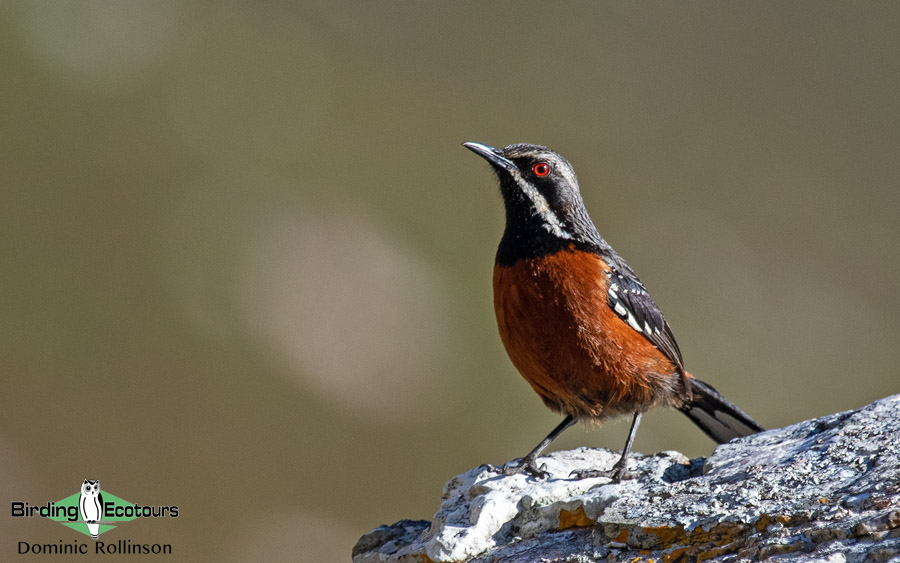 Cape Rockjumper is one of the two species making up the rockjumper family; we normally encounter it on this tour.
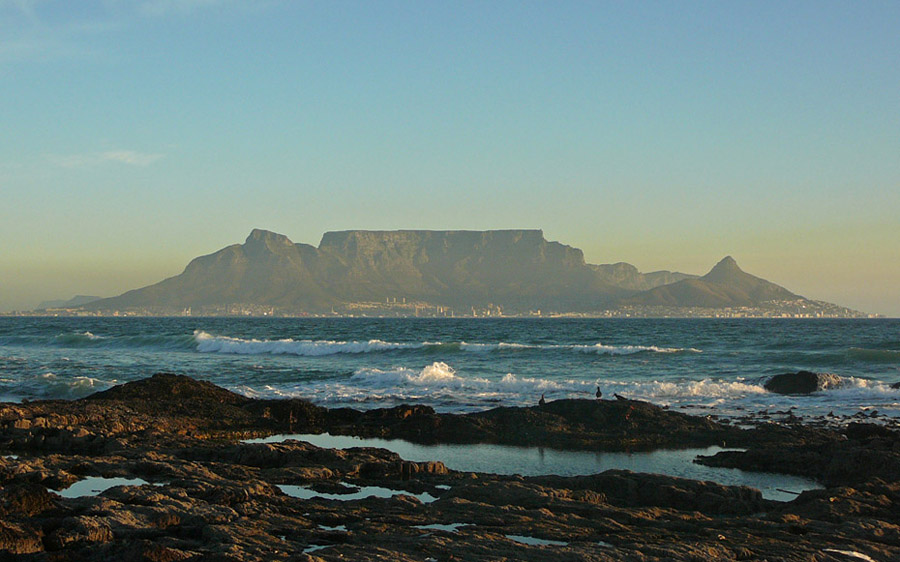
But this trip is not only full of localized avian endemics but also of spectacularly famous scenery, such as the Cape of Good Hope, Cape Point, and Table Mountain. All in all, our eight-day Cape tour is full of localized endemics, spectacular scenery, and so much more. This is where Birding Ecotours started as a company in 2002, and nowhere else do we have as much experience as in the Cape.
The Western Cape is the most important endemic bird area on the entire African continent. It is a truly essential area for any serious birder because of its sheer number of endemics. Pelagic trips off Cape Town also rank as among the finest in the world (with at least four albatross species, Cape Petrel (seasonal), and many more on the rich trawling grounds near where two oceans meet). The Cape is also a spectacularly scenic area, with the rugged Cape Fold Mountains that come right down to the sea, white sand beaches, sea cliffs on the Cape Peninsula, and beautiful vineyards. Close inshore Southern Right Whales (seasonal) plus a lot of other mammals, spectacular carpets of flowers (seasonal), and the most plant-diverse biome on earth (even richer than the Amazon!) are major attractions that are easily seen incidentally, while not jeopardizing our chances of finding all the birds. We recommend at least a week in the Western Cape. The aim of our standard (set departure) eight-day tour (but we can custom-make a trip of any length) is to find a majority of the endemics of this province, with many other species as an unavoidable byproduct (plus, as always, an amazing overall experience), and of course a lot of pelagic and other seabirds. To find the endemics we budget adequate time in each strategic ecosystem – the fynbos, Langebaan Lagoon, and the Karoo.
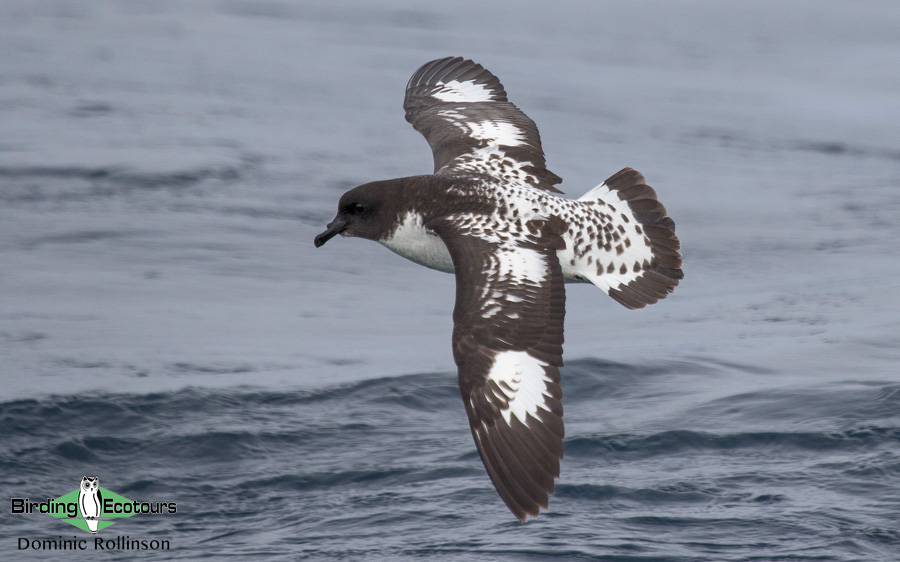 Cape Petrel is usually seen on our pelagic trip on our eight-day Cape tour.
The October departures can be combined with our preceding Kruger National Park and Escarpment Birding Safari and then with our following Subtropical South Africa Birding Tour: Comprehensive Eastern South Africa for a 38-day South African adventure, and, following that, with our Namibia, Okavango and Victoria Falls 18-day Birding Adventure for a stunning 46-day Southern African mega tour.
Itinerary (8 days/7 nights)
Day 1. Arrival in Cape Town
This is the day you need to arrive in Cape Town – any time during the day at your leisure. You will be met at Cape Town International Airport and transferred to our comfortable guesthouse in the leafy Cape Town suburbs. We should hopefully have some time to start with some local birding this afternoon – probably birding one of the many impressive wetlands nearby, or perhaps the forests on the slopes of Table Mountain. Species to look for include Great White Pelican, Greater and Lesser Flamingo, Cape Teal, Cape Shoveler, Southern Pochard, and Maccoa Duck among many other waterfowl species. Some of the more elusive species we will search for are Little Bittern, African Snipe, African Marsh Harrier, Malachite Kingfisher, four species of reed-associated warblers, and other waterbirds. The forested areas host species such as African Olive Pigeon, Cape Batis, Southern Boubou, Olive Thrush and African Dusky Flycatcher. In the neighboring fynbos we should come across the first of many South African specials, such as Cape Bulbul, Karoo Prinia, Southern Double-collared Sunbird and Cape White-eye.
Overnight: Greater Cape Town area
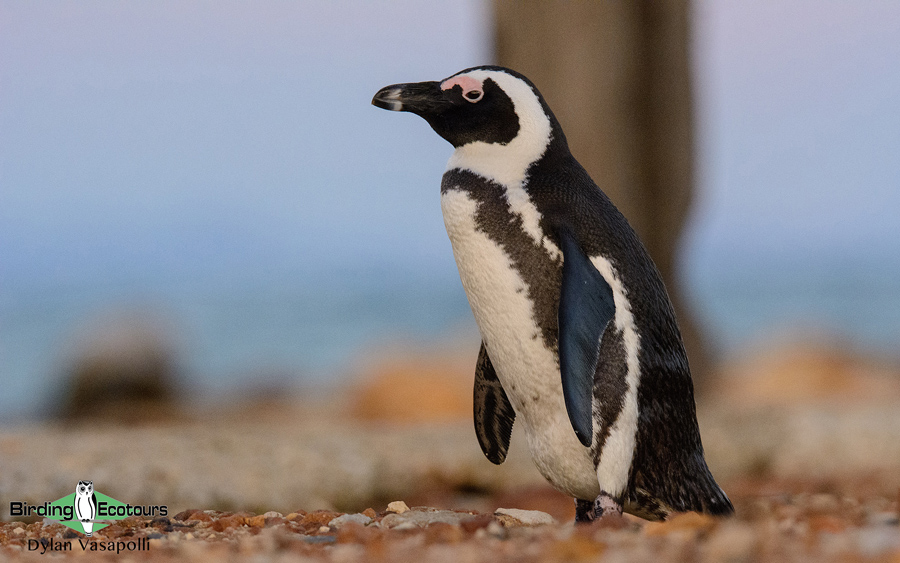 The comical African Penguin is always a highlight in any Cape birding trip!
Day 2. Cape Town Pelagic trip (or Cape Peninsula and False Bay birding)
Today is an early start as we embark on a Cape pelagic trip (weather-permitting, otherwise we will spend the day around the Cape Peninsula and False Bay). Soon after leaving the harbor we normally come across large flocks of Cape Cormorants and Cape Gannets heading out to sea to fish for the day, along with the occasional African Penguin. The coastline is incredibly rugged, yet eerily beautiful, with the sharp mountains rising right from the shore. Once we start transiting away from land the serious pelagic birding soon begins as we start seeing good numbers of Sooty, Great, and Cory’s Shearwaters, White-chinned Petrels, and the odd Storm Petrel (Wilson’s and European being most common). As we head farther out we will be on the lookout for trawlers, which attract huge numbers of seabirds. If we do find a trawler it normally has a cloud of seabirds behind it, particularly when the nets are being hauled in. Here we can expect to find Shy, Black-browed, Indian Yellow-nosed and Atlantic Yellow-nosed Albatrosses, Northern and Southern Giant Petrels, Cape Petrel, Brown Skua, and occasionally Great-winged Petrel. We will always be on the lookout for Spectacled Petrel, Northern and Southern Royal Albatrosses, and Wandering Albatross which, although considered rare, are seen with some frequency off the Cape.
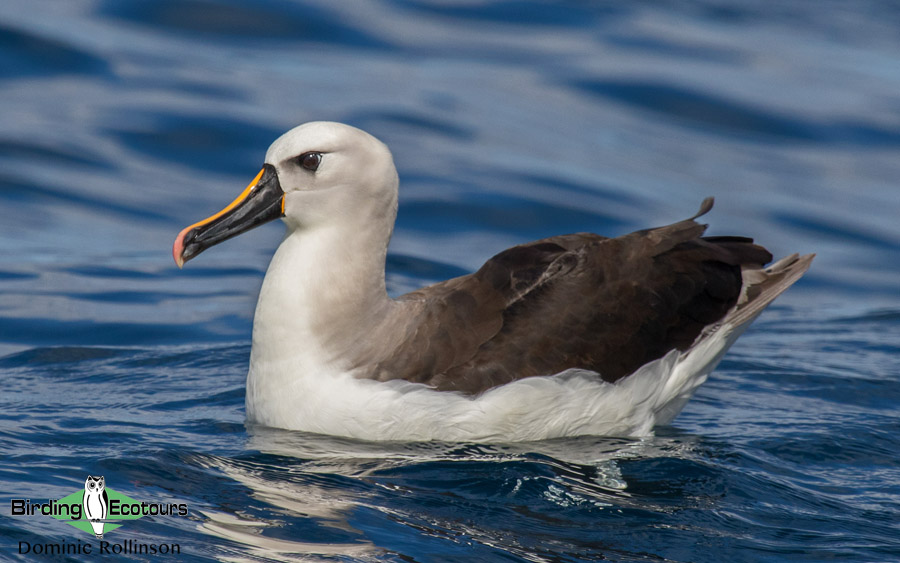 Albatrosses such as this Atlantic Yellow-nosed Albatross are usually seen on our Cape pelagic.
Other marine life to search for include Humpback and Bryde’s Whales as well as Long-beaked Common Dolphin and, if we are extremely lucky, Killer Whale! If possible/already decided, please let us know if you do not want to join the pelagic.
Overnight: Greater Cape Town area
Day 3. Birding the Cape Peninsula and False Bay (or Cape pelagic trip)
Today we plan to visit excellent sites such as the beautiful Hottentot Holland mountain range and Strandfontein Bird Sanctuary, one of Cape Town’s best waterbird sites. We start the day with an early departure (we’ll take breakfast packs along to enjoy later) heading east toward the Hottentot Holland mountains and particularly the small village of Rooi Els. To get to this picturesque village we have to traverse one of the most scenic drives in South Africa along the False Bay coast. First, we drive parallel to an extremely long white beach bordering the Cape Flats that separate the mountainous Cape Peninsula from the inland Cape Fold mountain ranges. Then we reach an area where impressive mountains meet the sea to begin a truly stunning marine drive. Our primary target for the day is Cape Rockjumper, which only occurs in the Cape Fold Mountains. Rooi Els is perhaps the easiest and most accessible spot to see the rockjumper, and our success rates are high. Other species to find here and nearby include Ground Woodpecker, Cape Rock Thrush, Victorin’s Warbler, Cape Siskin, Cape Grassbird, Cape Sugarbird, and many others. We may be lucky with a flyover of the pair of Verreaux’s Eagles that breeds in the area.
We then head to the small town of Betty’s Bay, where we visit the picturesque Harold Porter National Botanical Garden and enjoy lunch after a walk around the gardens. In the gardens we should find African Dusky and African Paradise Flycatchers, Black Saw-wing, Swee Waxbill, Yellow Bishop, and Brimstone and Cape Canaries.
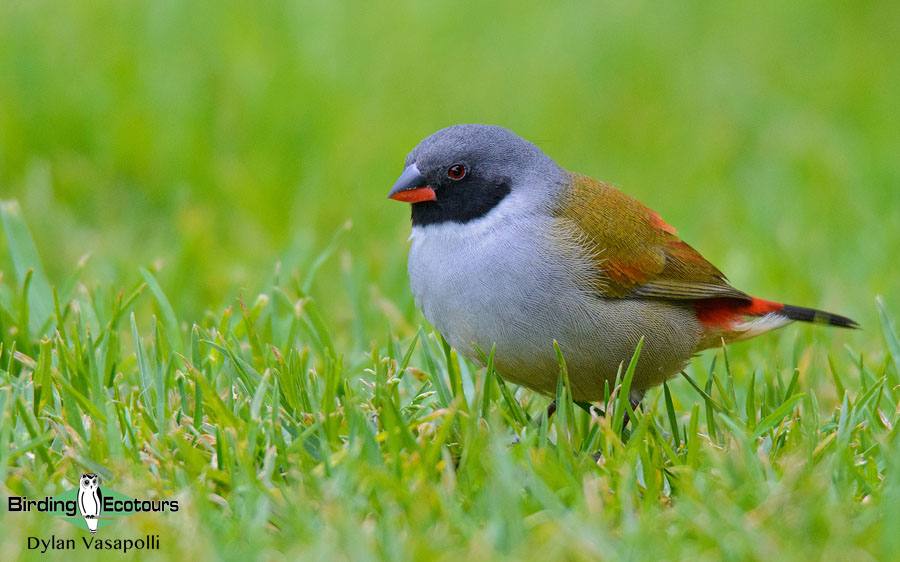 The cute and beautiful Swee Waxbill.
We will also be sure to include a visit to the nearby Stony Point African Penguin colony. In addition to the penguins, Stony Point also has numbers of breeding Cape, Crowned, and Bank Cormorants – all offering excellent and close-up views!
On our way back to Cape Town we may visit Strandfontein Bird Sanctuary, which offers Cape Town’s best wetland birding. Species to look for here include South African Shelduck, Blue-billed, Red-billed, and Cape Teals, Maccoa Duck, Cape Shoveler, Great Crested and Black-necked Grebes, African Swamphen, and a number of other waterbird species.
Overnight: Greater Cape Town area
Day 4. West Coast Birding
Today we head north of Cape Town and travel along the west coast. The strandveld vegetation is subtly different and, with the habitat change, results in a different mix of bird species. We will stop off in some farmlands en route to look for Blue Crane, Pied Starling, Cape Clapper Lark, Capped Wheatear, Cape Longclaw, Pearl-breasted Swallow, and the endemic Cape subspecies of Cloud Cisticola. Birding the strandveld habitat around the West Coast National Park and its surrounding areas will hopefully produce Cape Penduline Tit, Grey Tit, White-backed Mousebird, Bokmakierie, Karoo Scrub Robin, Yellow and White-throated Canaries, Grey-winged Francolin, Southern Black Korhaan, and the striking Black Harrier. We will also spend time at a few of the strategically positioned bird hides along Langebaan Lagoon, one of Africa’s most important shorebird stopover sites. Here we hope to find an assortment of Palearctic shorebirds as well as resident shorebirds, such as Chestnut-banded, White-fronted, and Kittlitz’s Plovers, with the possibility of Osprey and African Fish Eagle overhead. We may have time to look for Langebaan’s resident pair of Verreaux’s Eagles this afternoon; if we run out of time, we will look for them tomorrow morning.
Overnight: Le Mahi Guest House, Langebaan
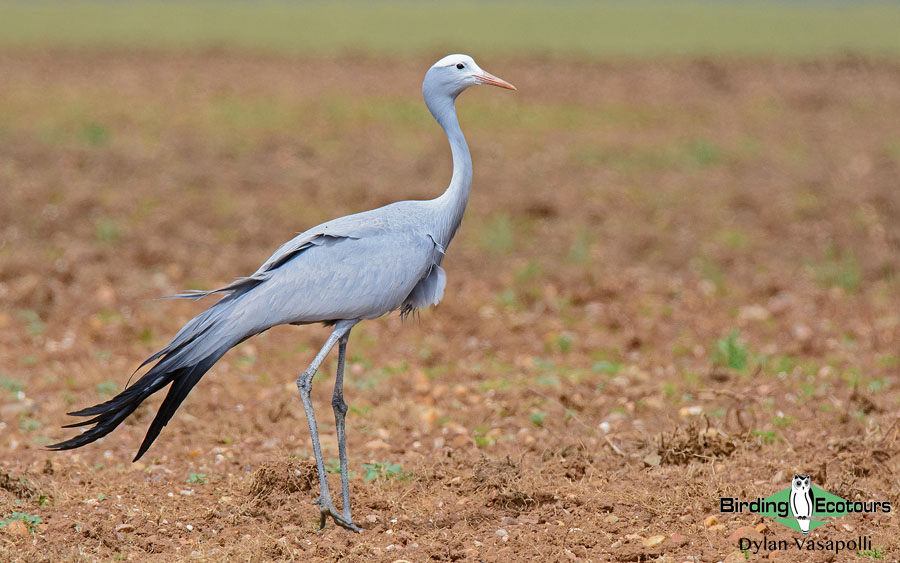 The majestic Blue Crane is commonly encountered on this tour.
Day 5. Transfer to the Karoo
We often start this day by birding some of the farmlands north of Langebaan for a few more endemics that are unlikely to be found elsewhere on the trip. Our primary targets this morning will be Cape Long-billed Lark and Sickle-winged Chat; however, we should also find Large-billed Lark, Grey-backed Sparrow-Lark, Blue Crane, Ant-eating Chat, and perhaps Namaqua Sandgrouse. After our early-morning birding we head inland through some spectacular mountain scenery. But we have to get to the eastern (rain-shadow) side of the mountains to get to the famed (among birders) Karoo. The Karoo exhibits an amazing level of endemism, as the species need to adapt to the incredibly harsh conditions. This makes for spectacularly exciting birding for any serious birder who has never visited this particular semi-desert.
Overnight: Tankwa Karoo/similar
Day 6. Birding the Karoo
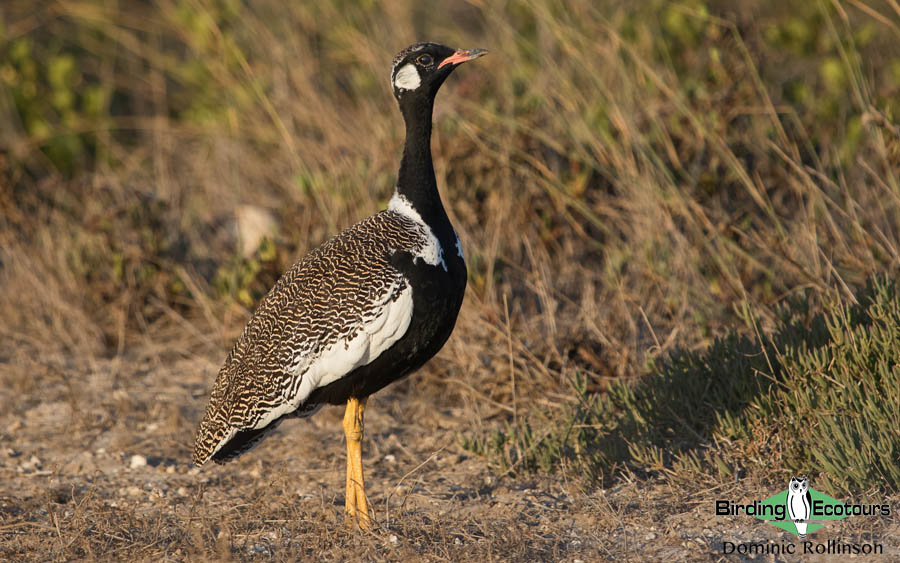
Today we will have a full day of Karoo birding. Dry, rocky gorges will be explored for Cinnamon-breasted Warbler (a truly bizarre rock crevice skulker) as well as Layard’s Warbler, Grey Tit, Fairy Flycatcher, and Booted Eagle overhead. In the riverbed vegetation we will look for another special, Namaqua Warbler. The dry plains will be birded extensively for a range of exciting species such as Rufous-eared Warbler, Black-headed Canary, White-throated Canary, Karoo and Tractrac Chats, Karoo, Spike-heeled, and Large-billed Larks, Karoo Eremomela, Pririt Batis, Ludwig’s Bustard, Karoo Korhaan, Pale Chanting Goshawk, Namaqua Sandgrouse, Namaqua Dove, and many others. The erratic Burchell’s Courser is seen from time to time however sightings of this desert nomad are unfortunately rare and unpredictable. Similarly, depending on unpredictable Karoo rains, Black-eared Sparrow-Lark may sometimes occur in large numbers, however it is only during exceptional years that we see this erratic species, here at its southern extent. We may then head out this evening to search for Freckled and Rufous-cheeked Nightjars and any other exciting nightlife we may encounter.
Overnight: Tankwa Karoo/similar
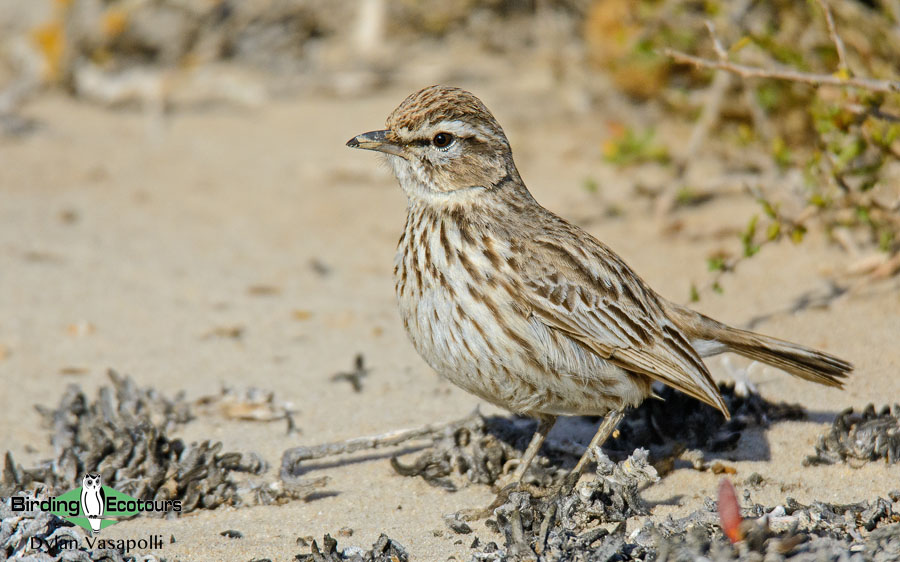 Many species occur here that have ‘Karoo’ in their names – such as this Karoo Lark.
Day 7. Transfer to Cape Town
After some early-morning Karoo birding, searching for anything we have missed over the last couple of days, we head out of the Karoo and back toward Cape Town. On our way back we will stop on a beautiful mountain pass to search for Protea Canary and Victorin’s Warbler and may get lucky with a flyover Verreaux’s Eagle.
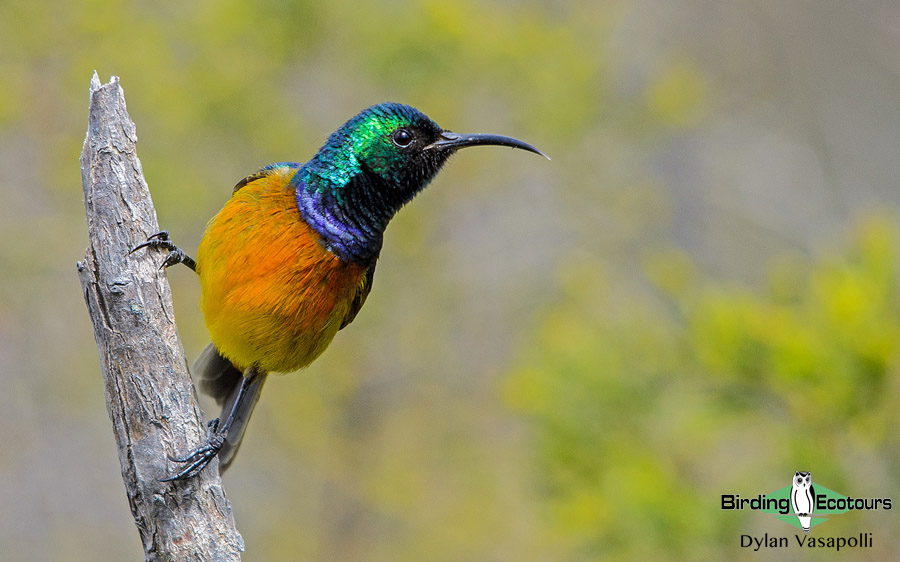
Once back in Cape Town we will have part of the afternoon to bird at Kirstenbosch National Botanical Garden. The gardens here are incredibly beautiful, complete with Table Mountain as a backdrop. In the beautifully maintained gardens we will look for Orange-breasted Sunbird and Cape Sugarbird feeding on Protea flowers, while Cape Spurfowl, African Olive Pigeon, Olive Thrush, African Dusky Flycatcher, Cape Batis, Southern Boubou, Cape Canary, Brimstone Canary, Swee Waxbill and Lemon Dove should all be seen while walking around the gardens.
Overnight: Greater Cape Town area
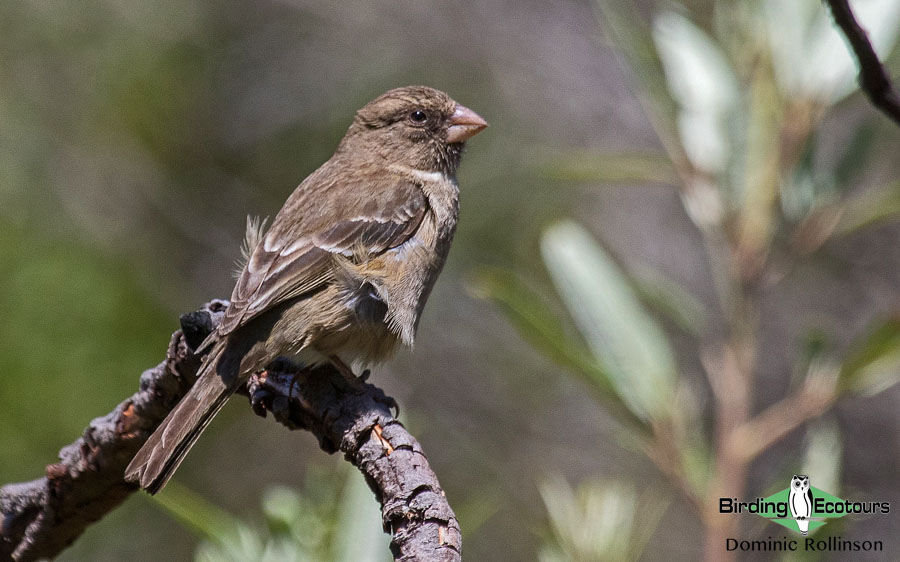 Protea Canary — a Cape endemic
Day 8. Departure
This is the departure day and the tour ends after breakfast, without any further Cape Town birding planned. This tour links up with our Subtropical South Africa birding tour for which we usually catch mid-morning flights to Durban. If you are not joining the Subtropical South Africa tour, you can depart Cape Town at your leisure.
For those joining both these Cape and Subtropical birding trips, the Birding Ecotours office will book the one-way flight from Cape Town to Durban, with everybody on the same flight (this flight cost is excluded from tour prices and usually costs around R2,000-R3,000).
Please note that the itinerary cannot be guaranteed as it is only a rough guide and can be changed (usually slightly) due to factors such as availability of accommodation, updated information on the state of accommodation, roads, or birding sites, the discretion of the guides and other factors. In addition, we sometimes have to use a different international guide from the one advertised due to tour scheduling.
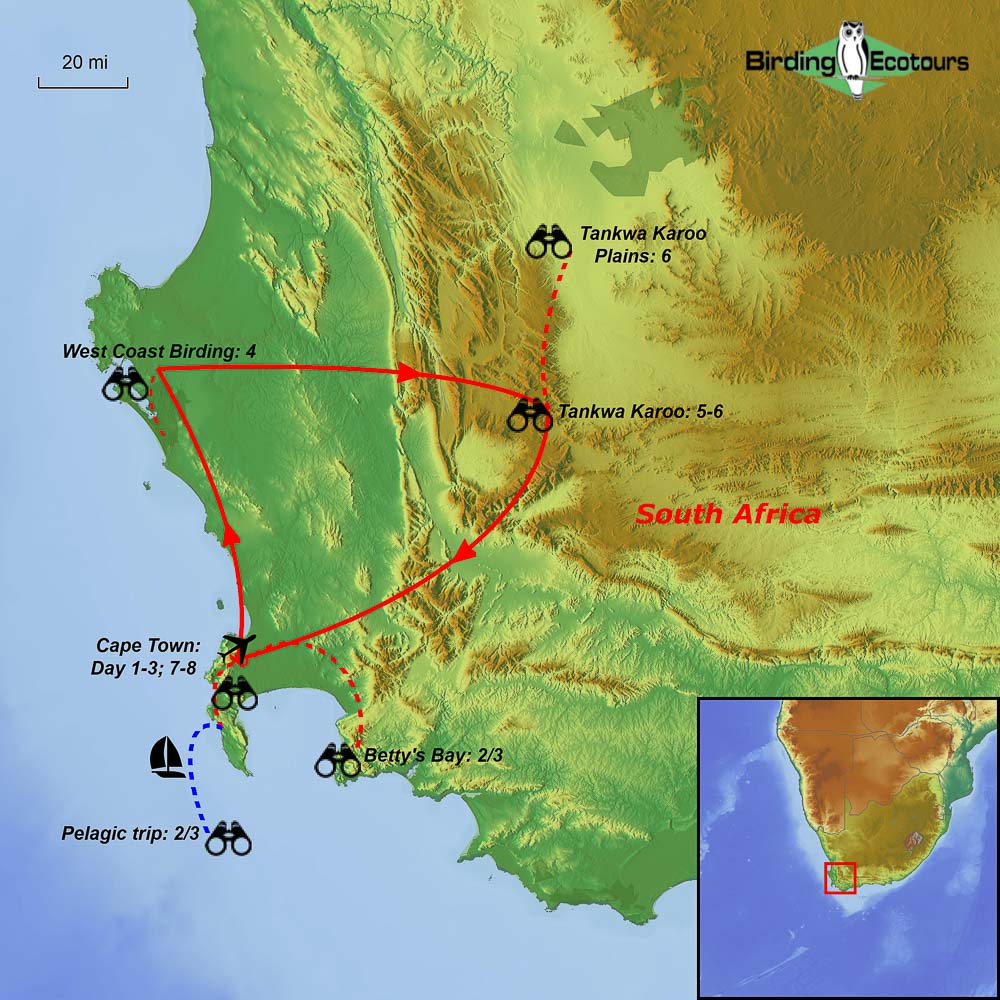
Map
Testimonials
Gallery
General Information
SOUTH AFRICA BIRDING TOUR: BEST OF CAPE TOWN AND BEYOND
TOUR-SPECIFIC INFORMATION
GENERAL INFORMATION ABOUT SOUTH AFRICA CAN BE READ HERE
TOUR OUTLINE
This short Cape birding tour is designed to give you a good introduction to the Cape and to give you a realistic chance of seeing most of the Cape’s endemic bird species (excluding Fynbos Buttonquail, although please contact us if you would like to organize a pre-trip/extension to look for this cryptic endemic). Excitingly, we will embark on a single-day Cape Town pelagic to look for a memorable suite of seabirds (weather dependent).
The tour starts with a few days birding in the greater Cape Town area, before we head up the west coast and then further east into the Tankwa Karoo plains where we spend a full day seeking dry-country endemics and near-endemics. The tour then ends with a single night back in Cape Town so you can catch your flights home (or onwards to your next birding tour) the following morning (such as our set-departure subtropical South Africa birding tour which immediately follows this tour).
PACE OF TOUR
Although this is a short tour, we pack in a lot and as such it can mean some quite long days out birding, with limited down-time. On most of the days we will leave our accommodation early and only return late in the afternoon although on a couple of days we will ensure some down-time for you to take it easy. This is a fast-paced, short tour.
To ensure we take advantage of the early morning peak in bird activity, we will often leave the accommodation armed with fairly simple (but adequate) breakfast packs however we will still likely enjoy a few delicious sit-down breakfasts on this tour. Similarly, lunches will often involve lunch packs, or simpler sandwiches/wraps, which we eat while out birding (usually enjoying a picnic lunch) rather than a large sit-down meal, so that we do not waste large amounts of time during the day. A range of snacks are usually available to participants. Although these meals may be simpler, we will always ensure you are well fed so that you do not go hungry. Dinners will, of course, be a sit-down meal and are generally of a very good standard in the Cape, where we eat out at restaurants for most nights on the tour (though eating at our lodge in the Tankwa Karoo).
It is possible to opt out of some activities, such as various morning and afternoon excursions, and the pelagic trip. On some days, however, this won’t be possible (please do ask your tour leader for specifics).
The guide discusses the daily plan with the group in detail each evening. Note that we do retain a sense of flexibility, within reason, to allow for us to better maximize your birding experience.
WALKING AND STYLE OF BIRDING
The tour is generally considered ‘easy’ in terms of physical exertion. It does not involve a great deal of walking, and any walks that we do are generally less than a mile (1.6 kilometers), and under ~3 hours.
- The walks are never very strenuous although we might have to walk on uneven terrain when looking for rockjumpers near Betty’s Bay.
- While birding in West Coast National Park and in the Tankwa Karoo we generally bird from the vehicle, although we can get out the vehicle and go for short walks strategically and opportunistically, to see the birds.
- The vegetation in the Tankwa Karoo is very spiky and so long trousers are recommended to protect your legs from cuts and scrapes.
LENGTH OF DRIVES
This trip does not involve many long-distance transfers between accommodations, however, we do spend quite a lot of time in the vehicle, with many birding stops in between.
On our first couple of days, we will take day trips out from Cape Town, with a travel time of around 1.5 hours each way (much less for our pelagic day), with the transfer up the west coast also taking around 1.5 hours, with many birding stops en route.
The longest transfer of the trip, when we go from the west coast into the Tankwa Karoo, takes around 3.5 hours of driving, which excludes any birding stops along the way (of which there are a few). The transfer from the Tankwa Karoo back to Cape Town normally takes around three hours.
PELAGIC TRIP PREPARATION
This Cape birding tour includes an exciting Cape Town pelagic trip, where we head out to sea for most of the day in search of albatrosses, petrels and other seabirds. Our pelagic trip will depart from the specified port around sunrise and venture out into the ocean for usually a maximum distance of 30 nautical miles (55 kilometers) from land. Off southern Africa this is usually the ‘drop zone’, where deep water is present and many fishing vessels operate. On a pelagic trip we strive to try and find a fishing vessel, whether it be a trawler or a longliner, as they attract huge masses of birds. The ride out can be quite rough and uncomfortable at times but it will be well worth the effort, should we find a fishing trawler which is packed with seabirds. We then have a similar-length ride back to the harbour after a few hours in the trawling grounds. We spend quite a large part of the day out at sea (depending on weather and sea conditions) and return to our port of departure in the afternoon (usually any time between 2:00 and 4:00 p.m.). We provide a light lunch on board with various snacks, eats, and drinks, although if you should want anything specific, we recommend that you bring it yourself.
Whether our pelagic goes out or not on this tour, is entirely at the mercy of the weather, as sometimes bad weather and winds roll in and we simply cannot go out to sea, as the swells are too large and dangerous. A pelagic trip is booked over two consecutive days (usually a weekend), despite this, there is probably around a 50:50 chance of the pelagic going ahead at this time of the year. The first day is used as the primary day, with the second day available should weather prove more favorable then. However, it is possible that the trip may not go ahead at all due to adverse conditions over the entire two-day period. This is, unfortunately, not something we can predict and reliably confirm far in advance, and we are at the mercy of the weather/sea conditions and the word from our very experienced skippers, who ultimately give the final approval. Your safety on board the vessel is of paramount importance to us, and should the conditions of the sea prove to be too dangerous, the vessel will not go out. The pelagic trip is confirmed by the skipper, either way, a few days before it is due to depart. We will keep you informed about the decision. Should our pelagic trip be canceled entirely, we will likely spend the morning at Cape Point (perhaps enjoying some land-based seawatching), however, the itinerary for this day will be at the tour leader’s discretion. In the event of cancelation of the pelagic, we will issue R3,000 vouchers to each tour participant which can be used for any future Birding Ecotours tours.
What you will require:
- Most important is a waterproof layer of clothing. There is often wind out at sea, and it blowing off the swells creates some spray. It is very easy to get wet on board, especially while heading out to the trawling grounds and returning back to port.
- Layered and warm clothing. No matter the conditions predicted, whether it be sun or cloud, it can get cold out at sea, and bringing warm clothing is advised. It is also recommended to bring layered clothing, so that you can remove/add on as the conditions change. Sometimes it gets hot, so one needs to be prepared for this too (hence the need for layers).
- Applying sun lotion or anti-sunburn cream is recommended, no matter the conditions. It is very easy to get badly burnt out at sea, whether it be a sunny or cloudy day.
- It is recommended to bring a hat that can be fastened to your head to prevent it from being blown away. Sunglasses are also strongly recommended, as the glare from the ocean can be very bad at times, but note that it is very easy to lose a pair of sunglasses, and they will invariably pick up some spray from the ocean.
- Due to the nature of the pelagic trip, water/spray invariably gets on board the vessel, and it is very easy to get your feet completely wet. Either waterproof hiking boots, or sturdy Teva-type sandals that can be fastened to your feet are recommended.
- Anti-seasickness medication. Not everyone is affected by seasickness, but it is a very unpleasant experience should you get seasick. Various tablets, such as Stugeron, are recommended. Should you be prone to seasickness, it might be worth consulting your local pharmacist for stronger medication. Some seasickness pills make one very drowsy, so do consult a doctor and ask her/him as many questions as possible, before deciding.
- Binoculars and cameras are recommended (as in any birding excursion), but again please note that they can very easily get wet and could get damaged as a result. A covering over your camera is advised.
Further information on pelagic birding can be found here.
SAFETY
Although this tour spends a lot of time in the greater Cape Town area (where safety is an issue in certain areas), we stay in safe suburbs where you generally do not need to worry about your personal safety. While out birding, we may visit some areas which are less safe than others, however, we will be mostly vehicle-based in these areas and you again do not need to worry about your personal safety. We suggest rather not leaving personal items of value in the vehicle while it is unattended, if you’re ever in doubt, please just check with the tour leader.
HEALTH, PESTS AND DANGEROUS ANIMALS
There is no risk of malaria on this tour, as it is absent from this part of the country, however, there may still be mosquitoes around which are more of an annoyance than a health concern. In some areas that we may walk, there could be ticks around, and so it is mostly recommended to wear long trousers and check yourself for ticks after a day out in the field. There is no risk of Lyme Disease in South Africa, however, African tick bite fever is possible but is generally much less severe than other tick-borne diseases.
*Note that dangerous and venomous snakes and scorpions, are possible, and this point is discussed in greater detail under the “South Africa General Information” document.
TRANSPORTATION
Depending on the final group size, we will likely use a 14-seater minibus on this Cape birding tour, ensuring everybody has a window seat for every day of the tour. Air-conditioning is available in our tour vehicles. We will follow a seat-rotation policy every day to ensure fair viewing opportunities to everyone throughout the tour (your guide will explain further at the start of the tour).
We will provide airport transfers to participants on the first and final days of tour, which are included in the tour cost. Should you arrive in South Africa earlier than that or prolong your stay in South Africa after the tour, those transfers would be at your own expense. We will, however, help arrange transfers wherever they may be needed.
DOMESTIC FLIGHTS
There are no domestic flights on this Cape birding tour, although you would need to catch a domestic flight, should you be joining our subtropical South Africa birding tour which immediately follows this tour.
ACCOMMODATION
The accommodation on this tour (as with all our South African tours) is of good to excellent quality. It is worth noting that buildings in South Africa are often not heated like they are in North America and Europe, etc., and so for colder evenings it may be worth packing warmer sleeping clothes.
Our accommodation in the Tankwa Karoo is rustic, and more basic (than elsewhere on the tour) but is still of a good standard, with its own charm, and is certainly very comfortable. The accommodation is much more spread out, as we stay on a guest farm, which means that Wi-Fi may not be possible in your rooms but it will be possible in the dining area. Some of the rooms do not have a shower, but do have perfectly good baths – all rooms have hot water. By using this accommodation, we are basing ourselves right in the Tankwa Karoo with some great birding on our doorstep, which means we cut down significantly on travel times, compared to staying in the nearest town (around 50 miles/80 kilometers away). Additionally, with our nearest neighbors many miles away, it means there is almost no light pollution and the stargazing is simply spectacular.
It is possible to get laundry washed at most of the establishments used on this tour (generally, any of the establishments we stay at for two nights, or longer), provided they have a minimum of one-day lead time.
ELECTRICITY
Lighting in rooms tends to be low wattage (especially in the Tankwa Karoo), so you might like to bring a good quality torch/flashlight if you like to read in bed!
It is good practice to bring international adapters, as many establishments are changing their plug outlets to better align with international clients, and this is an aspect we do not have direct control over.
WEATHER
Many people are surprised how cold the Cape can be, even though this tour takes place in the spring months. It is possible that a cold front could pass through during our tour which might mean a few days of cold (and wet) weather. The wind can also be very strong at times which can make things unpleasant. We would thus recommend bringing ample cold weather clothing for this Cape birding tour. Conversely the weather can also be wonderful at this time of the year, although most conditions normally require long pants and a light jersey, as opposed to shorts and t-shirts.
Please note that on our 2018 tour we had at least one Canadian person finding it colder than expected in the Cape (in October, so spring) – there was late “winter-type” weather during that year. Accommodations are often not heated like they are in North America, Europe, etc. Kindly be prepared for all kinds of weather, from cold to hot.
The Tankwa Karoo will likely be the hottest destination we will visit on this tour, with daytime temperatures averaging 77-84oF (25-29oC). The average daytime temperature in Cape Town in October is 67-70oF (19-21oC) while the average nighttime temperature is 52-56oF (11-13oC).
Despite the generally cooler temperatures on this tour, the sun in the Cape can be intense and so we recommend the frequent application of sunscreen, particularly when out in the Tankwa Karoo.
The Tankwa Karoo is very dusty, and we recommend, if it is windy, that you wear a scarf or neck buff to cover your face and protect you from the dust.
WHAT TO BRING
Please see our blog on ‘What to bring on a birding tour’ which will help you pack for this Cape birding tour. In addition to what is suggested in this blog we recommend packing a buff to help protect you from dust while birding in the dry plains of the Tankwa Karoo.