by Adam Cruickshank (written 1 September 2026)
It’s easy to see why hummingbirds are one of the most sought-after bird families on earth. Many of the species that excite birders hold very little appeal for non-birders, but hummingbirds are an exception. Their tiny size, bright iridescent plumage, opportunities to see them up close at feeders, and photographic appeal make this a group of birds that captivates far more than just birders.
In this article, we will look at some of the best places in the world to see hummingbirds. As you will see, these extraordinary birds can take you to some of the most beautiful places you could ever hope to visit.
Hummingbirds belong to the family Trochilidae, which comprises approximately 363 species and 112 genera. While hummingbirds are native to the Americas, around 95% of species occur primarily south of the United States. They occur in a wide variety of habitats, including arid deserts, tropical rainforests and high Andean scrub near glaciers and snowfields. Their distribution extends from southern Alaska to the tip of Tierra del Fuego in Chile.
Four of the five countries featured in this article, Brazil, Colombia, Ecuador and Peru, are among the world’s 17 megadiverse countries. That gives some indication of the remarkable range of habitats and wildlife found in the places where hummingbird diversity is at its greatest.
Hummingbirds are famous for their rapid wingbeats and extreme manoeuvrability. When hovering, their wings can beat an incredible 720 to 5,400 times per minute! Their bodies are also built for flight, with around 25 to 35% of their body weight made up of flight muscles, compared with an average of around 15% in other birds.
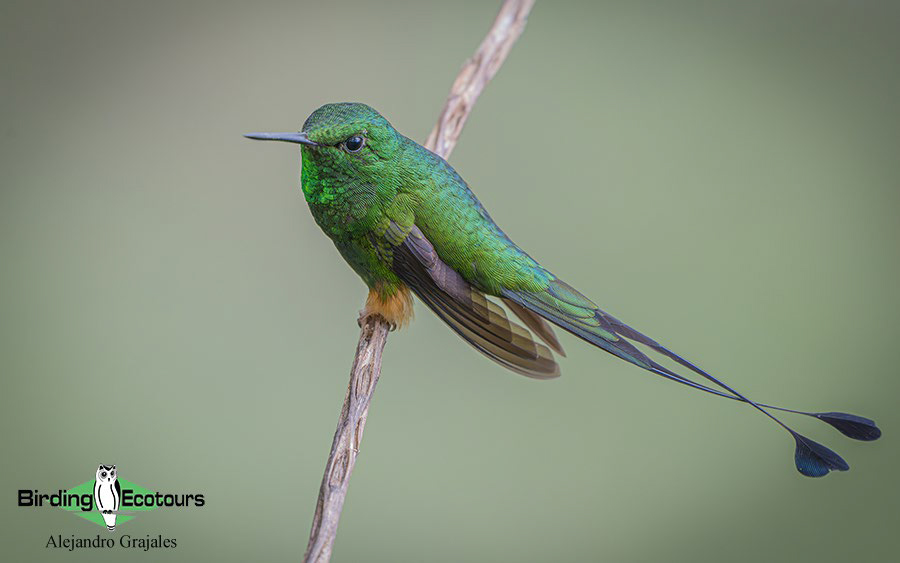
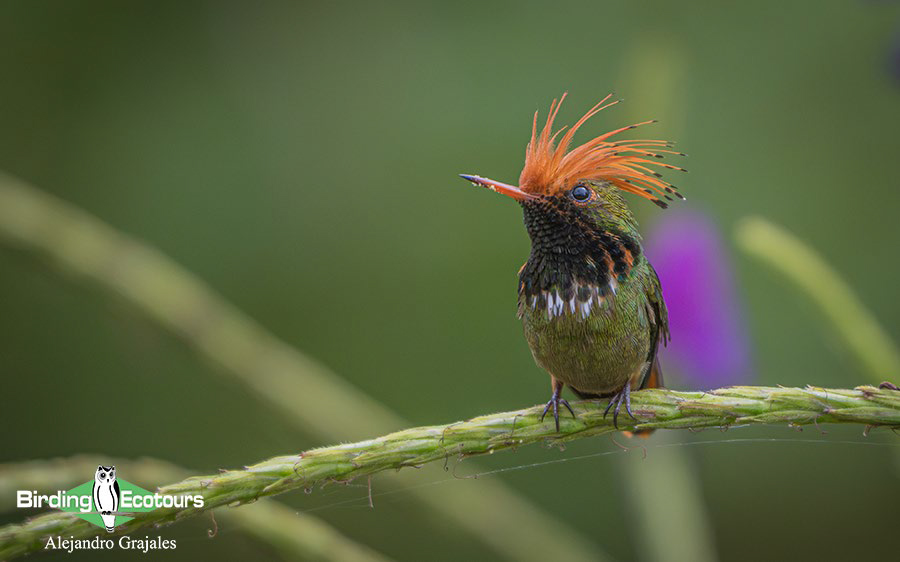
Rufous-booted Racket-tail, one of the many spectacular forms found within the hummingbird family, with the male’s long racket-tipped tail making it instantly distinctive. Hummingbirds are nectar specialists, and different species are often closely linked to the flowers on which they feed. What is fascinating is how their biology is adapted to these flowers. Bill length, bill curvature and even body size can correspond closely with features of the plants they feed from. This close relationship benefits both hummingbirds and the plants they pollinate.
Hummingbirds can consume remarkable amounts of food relative to their body size. They also have a specially adapted long tongue that is forked at the end. These forked tips open as the tongue reaches the nectar, while a fringe of tiny filaments uncurls along the edges, helping the tongue collect nectar. They can extend and retract their tongues around 20 times a second.
This family provides the perfect excuse to plan a birding trip, not only to add new species to your life list, but also to experience them up close and, if you are lucky enough, capture at least some of their extraordinary beauty in a photograph.
You may notice that I have not put these five countries in any specific order. That is deliberate, because deciding which country is “best” for hummingbirds will depend on what you are looking for. A world lister may be drawn to the countries with the greatest number of species, while another birder may be searching for one particular hummingbird. For others, the experience itself, whether watching dozens of hummingbirds around feeders, exploring high Andean páramo or searching for localized endemics, may be just as important as the number of species.
That is why I have tried to look beyond the numbers and give you a feel for both the hummingbirds and the experience each destination offers. If you are unsure which country would suit you best, email us at [email protected] and our team will be happy to help you choose the right destination.
So, where should you go if hummingbirds are high on your wish list? Here are five of the best places in the world to see them.
Costa Rica
Costa Rica is the perfect introduction to Neotropical birding. Although the country is small, it boasts an incredible 936 bird species. What makes Costa Rica such a fantastic destination for both birders and nature lovers is its incredible biodiversity.
The country is also a pioneer of ecotourism, with around 25% of its land formally protected. It is easily accessible for international visitors, with a good road network and excellent accommodation options. For North American birders, relatively short flights from the USA and Canada make it an ideal destination for experiencing Neotropical hummingbirds for the first time.
Around 54 hummingbird species occur in the country, and most are resident rather than migratory. Within a relatively small area, birders can move from Caribbean lowland rainforest to foothill forest, cloud forest, high mountain habitats, Pacific forest and mangroves, encountering different hummingbird communities along the way.
Among the species that make Costa Rica such an exciting hummingbird destination are two found nowhere else on Earth. Coppery-headed Emerald is endemic to Costa Rica and occurs in wetter middle and higher elevation forests. Mangrove Hummingbird is also endemic and is restricted to mangrove habitats along Costa Rica’s Pacific coast, where it is closely associated with tea mangrove. Another of the country’s most sought-after hummingbirds is the Snowcap, a cute species whose stunning purple plumage and white crown make the male one of the most distinctive hummingbirds in Central America.
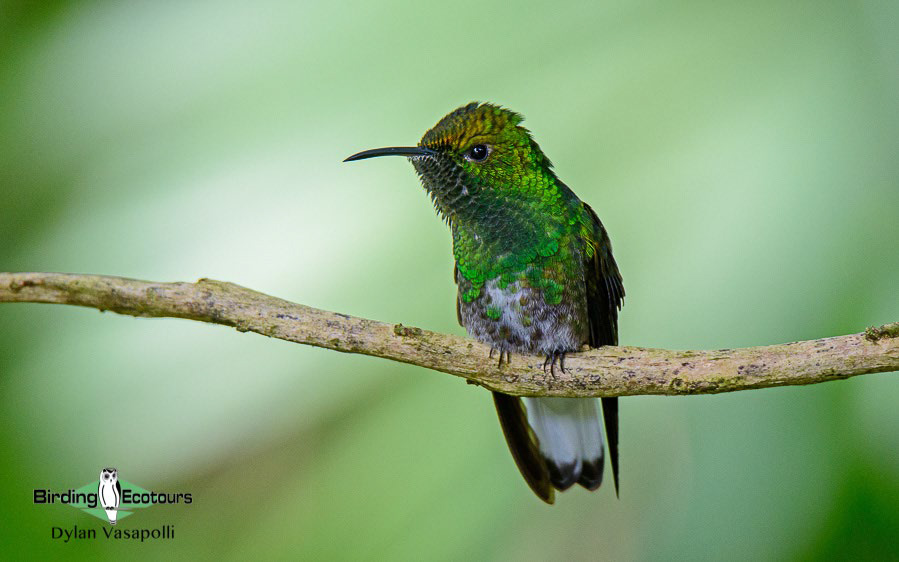
Coppery-headed Emerald, one of only two hummingbird species endemic to Costa Rica. This beautiful species is found mainly in wetter middle and higher elevation forests
One of Costa Rica’s great strengths is the dramatic change in elevation over short distances. On our Costa Rica Escape tour, we move from the Caribbean lowlands, where species such as White-necked Jacobin, Green-breasted Mango and Long-billed Hermit can be seen, through middle elevation forest around La Paz and Cinchona, where birds such as Violet Sabrewing, Green Thorntail and Green Hermit become more prominent, before reaching the highlands around Savegre and Los Quetzales. Here, Fiery-throated Hummingbird is always a highlight, especially when its otherwise dark plumage catches the light and reveals the stunning colors on its throat. Other sought-after highland species include Talamanca Hummingbird, Volcano Hummingbird, Scintillant Hummingbird and several mountaingems.
Costa Rica also offers exceptional opportunities to watch hummingbirds at close range. Well-established feeder stations and flowering gardens at places such as La Paz Waterfall Gardens, Cinchona, Cope Wildlife Reserve, La Selva Biological Station and Paraiso Los Quetzales can bring hummingbirds within only a few yards. Sites like these allow birders to spend time studying behavior and identification features while also providing excellent photographic opportunities.
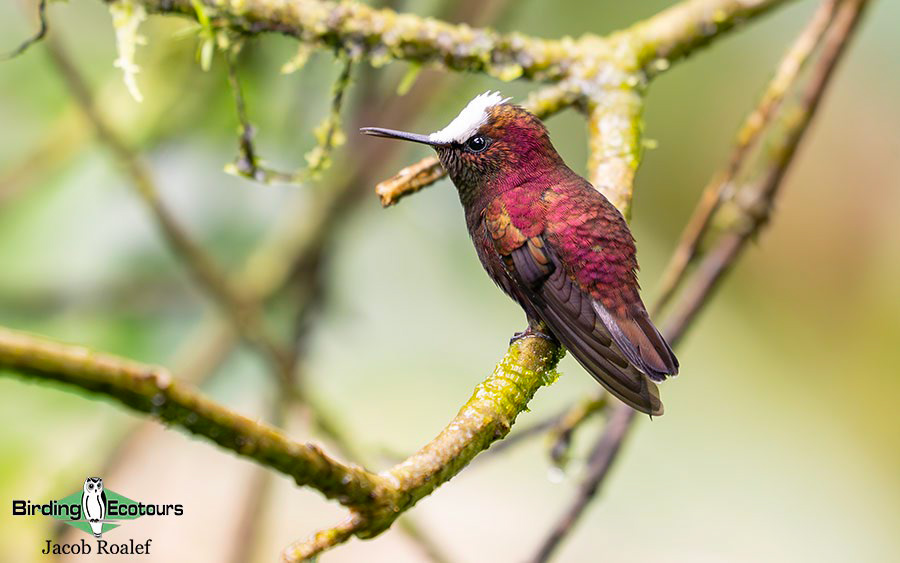
Snowcap, one of Costa Rica’s most sought-after hummingbirds, with the male instantly recognizable by its rich purple plumage and brilliant white crown.Some of Costa Rica’s best hummingbird encounters take place away from feeding stations.
On our Costa Rica Escape Part II tour, Black-crested Coquette, Violet-headed Hummingbird, Blue-throated Goldentail and Green Hermit were seen feeding naturally around flowers at Tapir Valley. Green-fronted Lancebill was found beside a forest river, while Coppery-headed Emerald was seen moving through forest in a mixed flock. On the Pacific side, searching mangrove habitat for Mangrove Hummingbird offers yet another very different experience.
Recent tour results give a good indication of what is possible. On our nine-day Costa Rica Escape tour in January 2026, the group recorded 25 hummingbird species. A separate nine-day Costa Rica Escape Part II tour in February 2025 recorded 19 species along a different route. Across those two tours, 33 different hummingbird species were recorded. Birders wanting to make the most of their time in Costa Rica could therefore consider combining the two itineraries.
Costa Rica may not have the sheer hummingbird numbers of countries such as Colombia or Ecuador, but its strength lies elsewhere. Few places allow birders to experience tropical lowland rainforest, cloud forest, high mountain habitats and Pacific mangroves so easily within a relatively short trip, while also enjoying excellent lodges, established birding sites and superb close-range hummingbird viewing.
Ecuador
Around 132 hummingbird species occur in Ecuador, giving this relatively small country the second-highest hummingbird diversity in the world after Colombia. From the Chocó forests on the western slopes of the Andes to high-altitude páramo, eastern cloud forest and the Amazonian foothills, birders can encounter dramatically different hummingbird communities over relatively short distances.
Ecuador has a bird list of 1,705 species, with 13 endemic to the mainland and 31 to the Galápagos Islands. To illustrate just how biologically rich the country is, more than 16,000 species of plants are found there.
The Andes are at the heart of Ecuador’s hummingbird diversity. On our Northern Ecuador Birding Paradise tour, we move from the high western Andes through cloud forest and Chocó foothills, climb above 12,000 feet (4,000 meters) into high Andean páramo, and then descend the eastern slopes towards the Amazonian foothills. Each change in elevation brings a new set of habitats and hummingbirds.
Ecuador holds some remarkable members of the hummingbird family. Sword-billed Hummingbird is one of the highlights, with an exceptionally long bill that is longer than the rest of its body. Ecuador is also home to the Giant Hummingbird, along with spectacular species such as Violet-tailed Sylph, Long-tailed Sylph, Velvet-purple Coronet, White-booted Racket-tail, Wire-crested Thorntail, Great Sapphirewing, Golden-breasted Puffleg and Rainbow Starfrontlet.
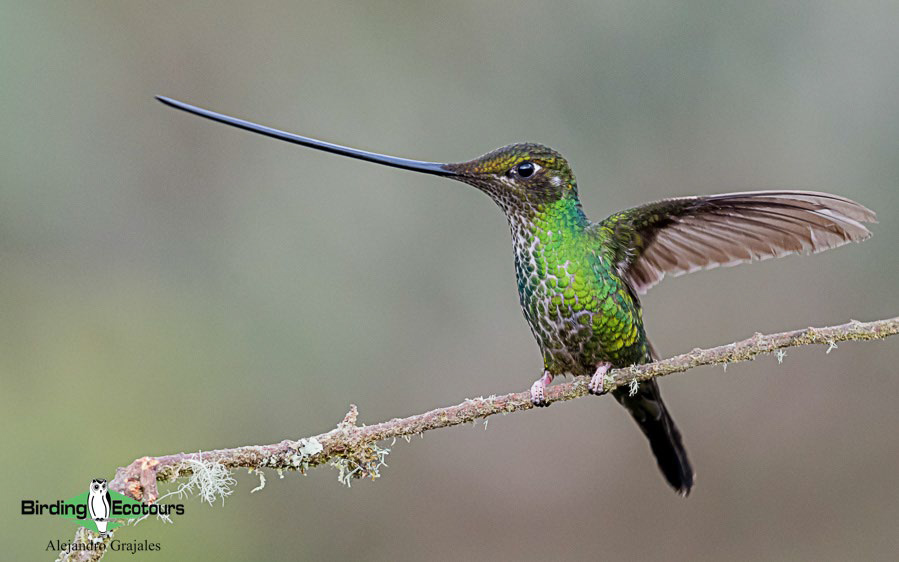
Sword-billed Hummingbird, is one of the most extraordinary members of the hummingbird family. Its remarkable bill is longer than the rest of its body and is perfectly adapted for feeding from long, tubular flowers.
There are also several highly localized species. One of the most exciting is Blue-throated Hillstar, which is restricted to a very small area of southern Ecuador and was only discovered in 2017. On our Southern Ecuador tour, we specifically visit Cerro de Arcos to search for it. During our March 2024 tour, the group enjoyed prolonged views of both male and female Blue-throated Hillstars. Other southern specialties include Violet-throated Metaltail, Flame-throated Sunangel and Spangled Coquette.
Several hummingbirds are endemic to Ecuador, including Black-breasted Puffleg, Violet-throated Metaltail and Esmeraldas Woodstar. Some have extremely restricted ranges, making them especially sought-after by international birders.
One of Ecuador’s biggest strengths for hummingbird watching is its network of lodges, reserves and feeder stations. In northern Ecuador, sites such as Yanacocha, Bellavista, Sachatamia, Alambi, Guango and Wildsumaco provide opportunities to watch large numbers of hummingbirds at close range. At some of these sites, several species can be feeding around you at the same time. For many birders, simply sitting and watching this activity is one of the great experiences of Neotropical birding.
The species can change dramatically from one site to the next. At high-elevation Yanacocha, hummingbirds such as Sword-billed Hummingbird, Great Sapphirewing, Buff-winged Starfrontlet, Shining Sunbeam and several pufflegs can be seen. Lower down on the western slopes, Violet-tailed Sylph, Velvet-purple Coronet, White-booted Racket-tail and Green Thorntail become more prominent. Cross to the eastern slopes and another group appears, including Long-tailed Sylph, Tourmaline Sunangel, Napo Sabrewing, Wire-crested Thorntail and Golden-tailed Sapphire.
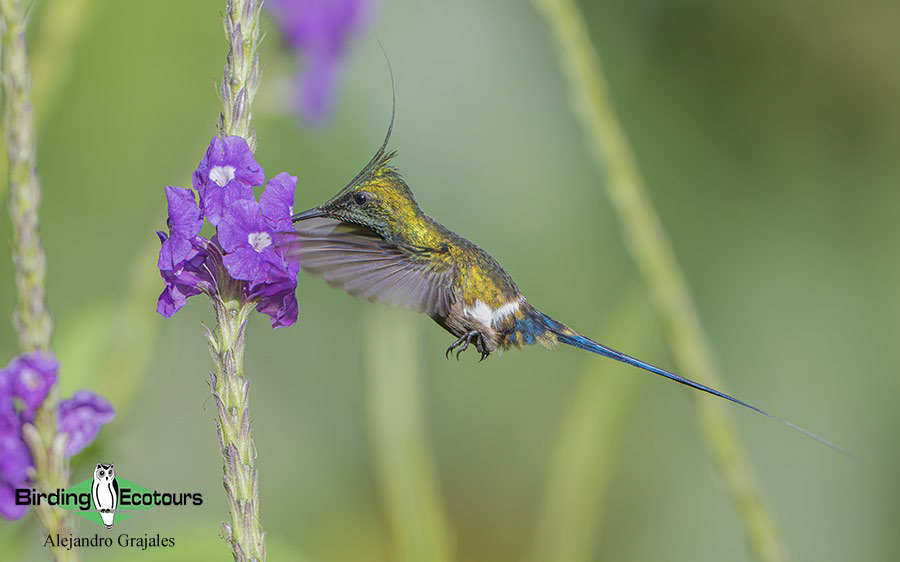
Wire-crested Thorntail, a tiny hummingbird of the Andean foothills. Males are instantly recognizable by their long, wiry crest and elongated tail, and are often seen feeding around flowering plants.
Southern Ecuador provides a different experience again. A stop at a small patch of verbena flowers on our Southern Ecuador tour produced Spangled Coquette, Little Woodstar, Wire-crested Thorntail, Blue-tailed Emerald and several other species feeding naturally around the flowers. Higher in the Andes, birds such as Ecuadorian Hillstar and Blue-mantled Thornbill occupy open páramo and other high-elevation vegetation.
Recent tour results show just how much hummingbird diversity can be encountered in Ecuador. On our 17-day Northern Ecuador Birding Paradise tour in November 2022, the group recorded 49 hummingbird species, more than a third of all those found in the country. Our March 2024 Southern Ecuador tour confirmed at least 30 hummingbird species in the day-by-day report, including Blue-throated Hillstar, Spangled Coquette, Violet-throated Metaltail, Wire-crested Thorntail and Ecuadorian Hillstar.
With extraordinary diversity, dramatic elevation changes, excellent birding infrastructure and some of the finest hummingbird feeder experiences anywhere in the world, Ecuador deserves to be near the very top of any hummingbird enthusiast’s list.
Peru
Peru is one of the world’s great birding destinations. From the dry Pacific coast and fog-fed lomas to high Andean puna, cloud forest, Amazonian foothills and lowland rainforest, it offers hummingbirds in an extraordinary variety of settings.
The country has an extensive network of protected areas and an impressive bird list of 1,890 species, of which 113 are endemic.
Around 124 hummingbird species are found in Peru. On our South Peru tour, for example, we bird from the Amazon lowlands at less than 600 feet (200 meters) above sea level before eventually reaching the high Andes at close to 12,000 feet (4,000 meters). Along the famous Manu Road alone, birders can move from high Andean habitats through elfin forest and cloud forest into humid foothills, encountering a changing selection of hummingbirds along the way.
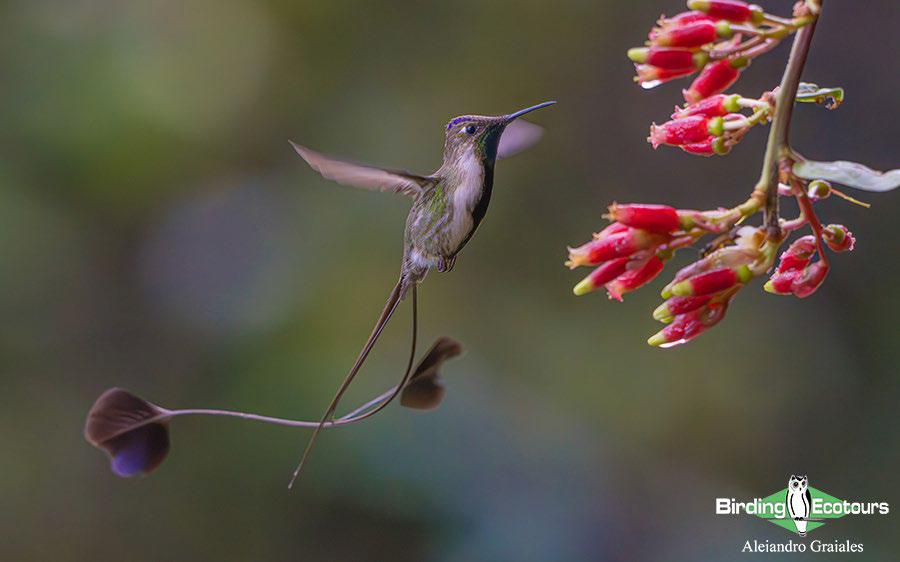
Marvelous Spatuletail, one of Peru’s most sought-after hummingbirds and a species found nowhere else on Earth. The male’s extraordinary outer tail feathers end in large blue violet spatules, making it one of the most distinctive hummingbirds in the world. Photo by Uwe Spek.
Peru is home to one of the most sought-after hummingbirds of all, the Marvelous Spatuletail. This extraordinary species, with exceptionally long outer tail feathers ending in large spatules, is endemic to northern Peru. Other highlights include Rufous-crested Coquette, Wire-crested Thorntail, Royal Sunangel, Sword-billed Hummingbird, Giant Hummingbird, Rainbow Starfrontlet and Emerald-bellied Puffleg.
Endemism is one of Peru’s biggest strengths. In addition to Marvelous Spatuletail, the country is home to species such as Koepcke’s Hermit, Spot-throated Hummingbird, Grey-bellied Comet, Black Metaltail, Bearded Mountaineer and Green-and-white Hummingbird. Some have extremely restricted ranges. On our May 2024 Comprehensive Northern Peru tour, for example, we enjoyed excellent views of three male and one female Grey-bellied Comets near Cajamarca.
Northern Peru is particularly rewarding. A network of feeder stations between Tarapoto, Moyobamba, Abra Patricia and Pomacochas gives birders access to a remarkable range of species. Sites such as Waqanki, Arena Blanca, Owlet Lodge and Huembo each have their own highlights. At Huembo, the main attraction is Marvelous Spatuletail, while Waqanki can produce Rufous-crested Coquette, Golden-tailed Sapphire, Black-throated Mango and several hermits. At Aconavit, endemic Koepcke’s Hermit regularly visits the feeders.
Golden-tailed Sapphire, a brilliantly colored hummingbird of the Andean foothills, with a shimmering green body and rich violet-blue head.
Away from the feeders, the experience becomes even more varied. In the dry Marañón region, birders search for localized Spot-throated Hummingbird, while Grey-bellied Comet occurs in high Andean habitat near Cajamarca. Central Peru adds species such as Black-breasted Hillstar at extreme elevations, Bronze-tailed Comet in dry Andean valleys, and Oasis Hummingbird and Peruvian Sheartail in the fog-fed vegetation of the Pacific coastal lomas.
Southern Peru has a different set of targets again. Around Ollantaytambo and the Sacred Valley, birders can search for endemic Bearded Mountaineer, while the Machu Picchu area offers a chance to see endemic Green-and-white Hummingbird. Farther along the Manu Road, feeder stations and lodge gardens can produce Rufous-booted Racket-tail, Peruvian Piedtail, Rufous-crested Coquette, Sword-billed Hummingbird, Great Sapphirewing and Giant Hummingbird.
Recent tours show just how productive Peru can be. Our May 2024 Comprehensive Northern Peru tour recorded 56 hummingbird species, while our July 2025 South Peru tour recorded 43 species in 13 full days of birding. With around 124 species occurring nationally, the Northern Peru tour recorded close to half of the country’s hummingbird diversity on a single trip.
What makes Peru stand out is the combination of hummingbird diversity, high endemism and extraordinary geography. Few places allow birders to search for localized hummingbirds in dry valleys, high Andes, cloud forest and Amazonian foothills while also visiting world-famous destinations such as Machu Picchu. That combination makes Peru one of the most rewarding hummingbird destinations in the world.
Colombia
With an incredible country bird list of 1,987 species, the highest bird list of any country on Earth, Colombia could arguably be described as the birding capital of the world!
Colombia also has high endemism, with an impressive 84 endemic bird species. Historically, parts of the country were affected by internal conflict and drug trafficking, which kept many travelers away. Today, however, many of Colombia’s most important birding regions are far more accessible, and the country has become one of the most exciting birding destinations in the world. Its famous tourism slogan, “Colombia, the only risk is wanting to stay,” seems particularly appropriate for birders.
Colombia’s complex geography helps explain its incredible number of species. The Andes divide into three separate cordilleras, with the Magdalena and Cauca valleys running between them. Each mountain chain and slope supports different habitats and bird communities. Add the Chocó rainforest, Caribbean coast, Amazonian foothills, Llanos and isolated mountain systems such as the Sierra Nevada de Santa Marta, and the result is extraordinary bird diversity.
Around 168 hummingbird species occur in Colombia, giving it the highest hummingbird diversity of any country in the world. Sword-billed Hummingbird, Velvet-purple Coronet, Violet-tailed Sylph, White-booted Racket-tail, Empress Brilliant, Great Sapphirewing and Rainbow-bearded Thornbill are just a few of the species that may be encountered. Climb into the high páramo and species such as Buffy Helmetcrest and Green-bearded Helmetcrest are adapted to the cold, open conditions above the treeline. Drop back into cloud forest or the Chocó and a completely different hummingbird community awaits.
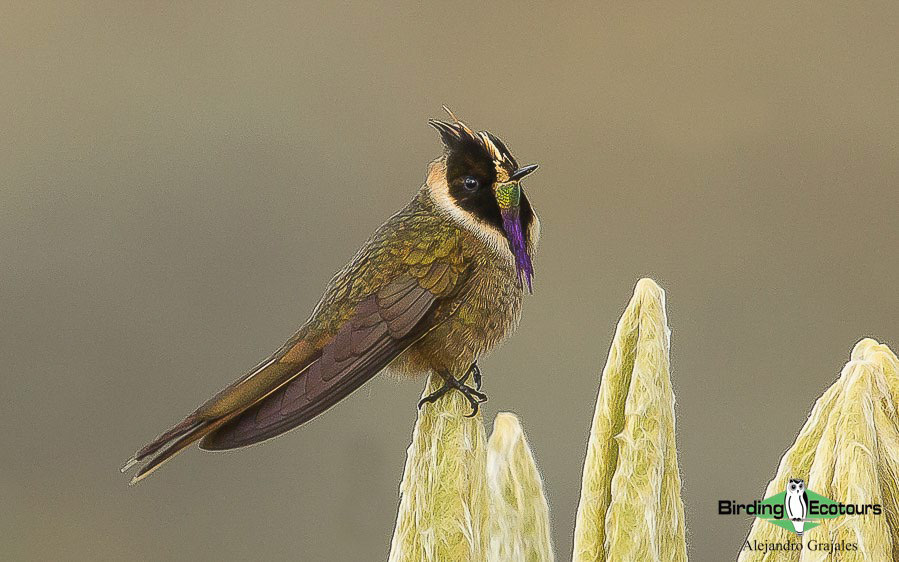
Buffy Helmetcrest, a Colombian endemic restricted to high Andean páramo, where it is adapted to cold, exposed conditions above the treeline
Colombia also has many hummingbirds with restricted ranges. Buffy Helmetcrest, Green-bearded Helmetcrest, Tolima Blossomcrown, Indigo-capped Hummingbird and Golden-bellied Starfrontlet are all Colombian endemics. Then there is the isolated Sierra Nevada de Santa Marta, where birders can search for species such as Santa Marta Blossomcrown and Santa Marta Woodstar. For international listers, these localized species are a major part of Colombia’s appeal.
The country also has an excellent network of reserves, lodges and feeding stations. Around Cali, feeders can attract Long-tailed Sylph, White-booted Racket-tail, Bronzy Inca, Greenish Puffleg and Fawn-breasted Brilliant. Travel into the Chocó and western Andes and the cast changes again, with birds such as Violet-tailed Sylph, Velvet-purple Coronet and Empress Brilliant appearing. A Colombia itinerary can take you through a succession of productive sites, each offering its own selection of hummingbirds.
The high Andes offer another experience entirely. At Los Nevados, birders can search the open páramo for endemic Buffy Helmetcrest at elevations above 12,000 feet (4,000 meters). Nearby feeder stations can attract Great Sapphirewing, Buff-winged Starfrontlet, Mountain Velvetbreast, Golden-breasted Puffleg, Shining Sunbeam and Rainbow-bearded Thornbill. At Hacienda El Bosque, Sword-billed Hummingbird is another major target and can often be watched at close range.
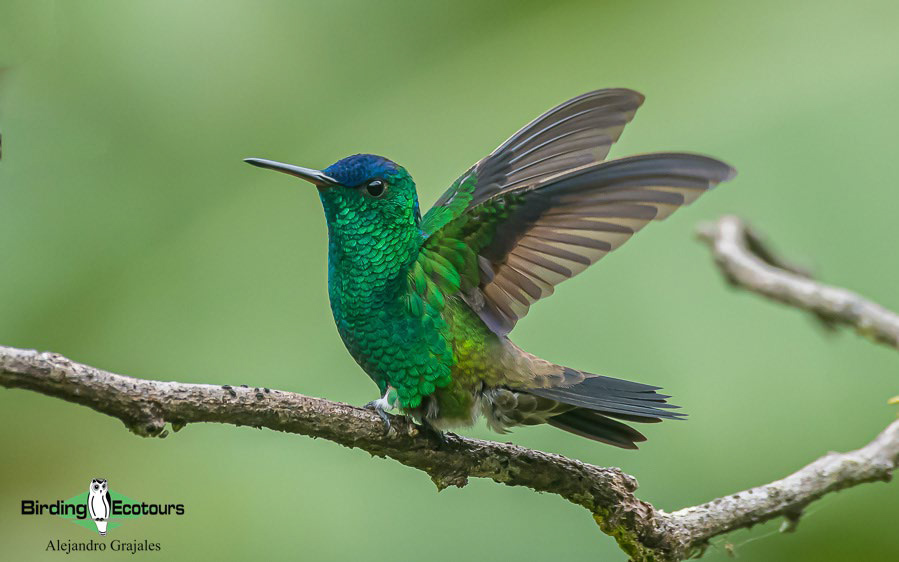
Indigo-capped Hummingbird, a Colombian endemic with a blue crown and brilliant green plumage
Near La Cocha, Sword-billed Hummingbird can be seen around flowering vegetation in the cool Andean highlands. Descend towards the Amazonian foothills and birds such as Wire-crested Thorntail, Golden-tailed Sapphire and Butterfly Coquette begin to appear in warmer, more humid forest. White-bearded Hermit has even been watched feeding from Heliconia flowers in this lower elevation habitat.
On our 14-day Very Best of Colombia tour in November 2025, we recorded 47 hummingbird species, while our 17-day Colombia Uncovered tour in February 2026 produced 42. Because the two itineraries explore very different parts of the country, these results show just how widely Colombia’s hummingbird diversity is spread.
What perhaps stays with you most is how quickly the hummingbird experience changes from one region to the next. One day may be spent watching helmetcrests in cold páramo, another with sylphs and coronets in cloud forest, and another with coquettes and thorntails in the warmer Amazonian foothills. With the greatest hummingbird diversity of any country on Earth, high endemism and three separate Andean cordilleras, Colombia is a destination that is very difficult to beat.
Brazil
Covering an enormous 3.3 million square miles (8.6 million square kilometers), Brazil is the fifth-largest country in the world and one of the great birding destinations on earth. Its bird list stands at an impressive 1,884 species, including a mouth-watering 243 endemic bird species. This diversity is spread across a remarkable range of habitats, from the Amazon rainforest and Atlantic Forest to the vast Cerrado, dry Caatinga and the Pantanal, the world’s largest tropical wetland.
Around 81 hummingbird species are found in Brazil. While that number does not match the extraordinary totals found in Colombia, Ecuador and Peru, Brazil’s appeal lies in the number of endemic and highly localized species spread across very different landscapes.
The Atlantic Forest is one of the best places to start. Running along much of Brazil’s eastern coast and ranging from sea level to around 9,000 feet (3,000 meters), this incredibly rich biome supports species such as Saw-billed Hermit, Brazilian Ruby, Black Jacobin, Frilled Coquette, Festive Coquette and the plovercrests.
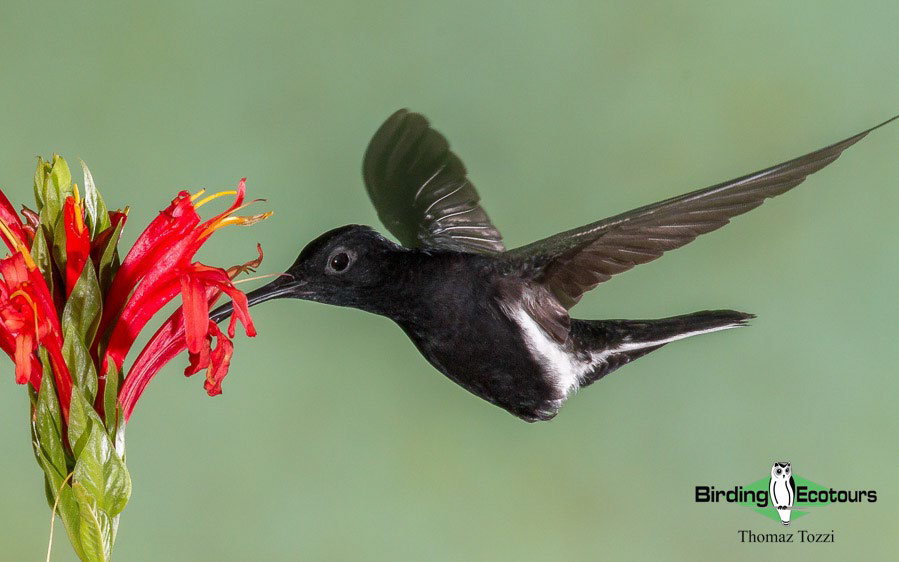
Black Jacobin, a striking Brazilian hummingbird with dark plumage and contrasting white flank
Southeast Brazil can be very rewarding. On our September 2024 Southeast Brazil tour, we recorded 18 hummingbird species while exploring famous Atlantic Forest areas such as Intervales, Ubatuba and Itatiaia. Several sites have excellent feeders, providing opportunities to watch and photograph Brazilian Ruby, Festive Coquette, Black Jacobin and Violet-capped Woodnymph. Around Ubatuba, endemic Saw-billed Hermit is another major target, while Itatiaia can produce the tiny and spectacular Frilled Coquette.
Travel inland into Minas Gerais and the hummingbird experience changes completely. The rocky highlands and campos rupestres around Serra do Cipó are home to the beautiful Hyacinth Visorbearer, a Brazilian endemic with a very restricted range. Horned Sungem can also be found in these open landscapes, while endemic Stripe-breasted Starthroat occurs in the drier interior.
Northeastern Brazil offers yet another very different hummingbird experience. Here birders travel through dry Caatinga, rocky highlands and patches of Atlantic Forest. The region holds several particularly special species, including endemic Hooded Visorbearer, Hook-billed Hermit and Broad-tipped Hermit. Hooded Visorbearer is one of the standout birds of Chapada Diamantina and one of the most sought-after hummingbirds in Brazil.
Our November 2023 Northeast Brazil tour recorded an impressive 28 hummingbird species. At one flowering site we encountered seven species, including a magnificent male Horned Sungem, while an afternoon at the Lajedo dos Beija-flores hummingbird garden produced nine species. These included localized Hook-billed Hermit, as well as Ruby-topaz Hummingbird, Stripe-breasted Starthroat, Sapphire-spangled Emerald and Swallow-tailed Hummingbird.
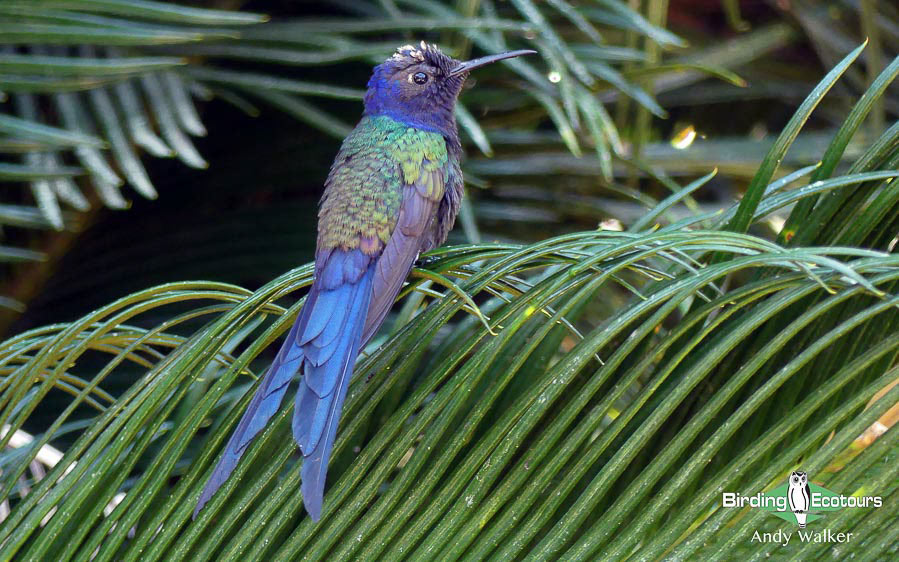
Swallow-tailed Hummingbird, a large and unmistakable hummingbird, named for its deeply forked blue tail
This variety gives Brazil a very different hummingbird identity from the Andean countries. In the Atlantic Forest, birders can watch coquettes, Brazilian Ruby and Saw-billed Hermit around forest gardens and feeders. Farther inland, the search moves into open Cerrado and rocky mountain habitats for visorbearers and sungems, while the dry landscapes of northeastern Brazil hold another collection of endemic and localized species.
Brazil’s hummingbird list may be smaller than those of the Andean countries, but its species and landscapes are wonderfully distinctive. From Frilled and Festive Coquettes in the Atlantic Forest to Hooded and Hyacinth Visorbearers in Brazil’s mountains, the country is a fitting final stop on our journey through five of the best places in the world to see hummingbirds.
These five destinations are by no means the only places in the world to see hummingbirds, but for anyone wanting to experience this extraordinary family, they provide a fantastic place to start. If you have already spent time watching hummingbirds, perhaps this article has given you a few ideas for where to go next. And if you are only just beginning your hummingbird journey, any one of these destinations could open the door to a completely new kind of birding experience.
At Birding Ecotours, we have been leading birding tours to many of these destinations for years, with experienced guides who know where to find the species that make each region special. Whether you want to target a particular hummingbird, see as many species as possible, or build a wider birding trip around some of the world’s best hummingbird destinations, get in touch with us. We would love to help you plan the right trip. You can contact us at [email protected].