by Adam Cruickshank (written 02 February 2026)
Taxonomy is the scientific system used to classify living organisms, organizing them by how closely they are related, similar to a family tree. It is structured in levels: individual organisms belong to a species, related species are grouped into a genus, genera into families, families into orders, and orders into classes. All bird species in the world fall within the class Aves.
For decades, bird taxonomy has been complicated by the existence of multiple taxonomic authorities, each with its own global bird list. Major global taxonomic authorities, including International Ornithological Congress (IOC), Clements/eBird, BirdLife International, and Handbook of the Birds of the World (HBW), recognized this problem and combined to release AviList, which harmonizes multiple major taxonomic authorities into a single accepted list.
The 2025 AviList Checklist recognizes 11,131 bird species across 252 families (representing 46 orders). For many birders, this global list provides strong motivation to see as many species as possible. The desire to grow a life list comes from many places, but for many people, birding and listing are closely linked.
Birders keep many kinds of lists, and one that has become increasingly popular is family listing. This focuses on seeing as many of the world’s 252 bird families as possible by recording at least one representative species from each. It can be relatively straightforward to add large families such as the tyrant flycatchers — which include more than 400 species across the Americas — since only a single species is needed. At the opposite extreme are monotypic families, represented by just one living species (37 are currently recognized). These tend to be more specialized, with no close living relatives, and are often confined to particular regions or habitats.
To complete the world’s 252 families, every species representing a monotypic family needs to be seen and in this article, we explore these 37 monotypic bird families. By exploring these families one by one, this article brings together taxonomy, identification, behavior, and conservation. The species below are arranged according to the AviList sequence. At the end of the article, you will also find a table listing every species mentioned, along with a suggested Birding Ecotours tour where each monotypic family can be seen (although some species can be seen across several of our tours). This makes it easy to connect family listing goals with real world birding opportunities.
Family: Anseranatidae
English name: Magpie Goose
Scientific name: Anseranas semipalmata
Despite its name, the Magpie Goose is not a true goose. It belongs to its own family, Anseranatidae, and sits apart from ducks, geese, and swans. It is most closely related to the South American screamers (Anhimidae) than to other waterfowl.
The Magpie Goose is a tall, long-necked bird with black-and-white plumage. It has partially webbed feet, rather than fully webbed ones, and adults have bare skin on the head and face. Its upright posture and slow wingbeats give it a very distinctive look in flight and on the ground.
This species is found mainly along the northeast coast of Australia and in southern New Guinea. It lives in wetlands, floodplains, and shallow swamps, as well as areas that dry out seasonally. Unlike many other waterbirds, Magpie Geese often remain tied to the same wetland systems throughout the year.
During the breeding season, Magpie Geese form large, noisy colonies. They are well known for their unusual breeding system, where one male commonly pairs with two females. Both females lay eggs in the same nest, and all adults help defend the site. Outside the breeding season, the species gathers in large flocks that can number in the thousands.
Although the Magpie Goose is not currently threatened, its numbers have declined in parts of its range. Wetland drainage and agricultural expansion have reduced suitable habitat, and some birds have been poisoned in farming areas. Even so, it remains one of the most unusual and easily recognizable waterbirds in the world.
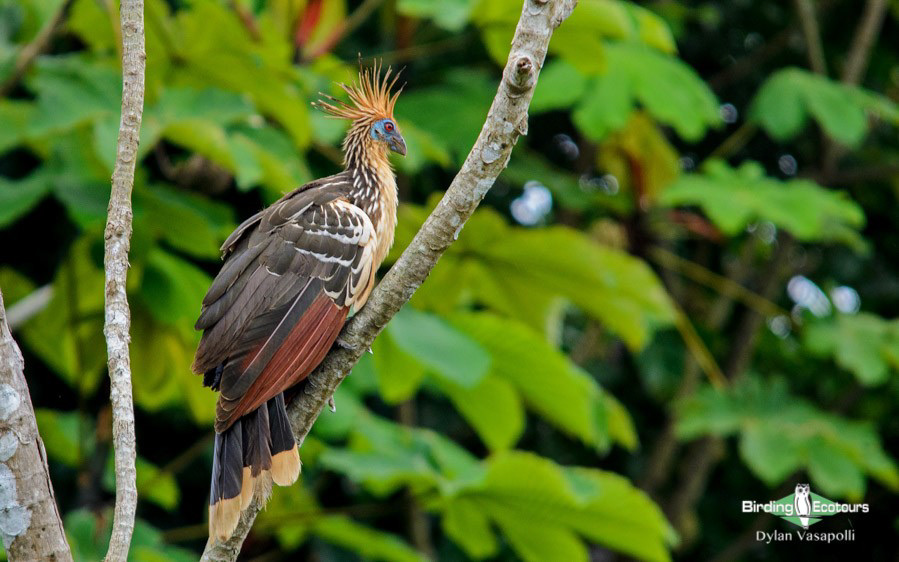
The Hoatzin is one of the most unusual-looking birds in the world.
Family: Opisthocomidae
English name: Hoatzin
Scientific name: Opisthocomus hoazin
With its proud orange crest, bare bright-blue face, striking red eyes, and stubby bill, the prehistoric-looking Hoatzin is one of the world’s most strange-looking birds. It belongs to its own family, Opisthocomidae, and has long puzzled ornithologists because its evolutionary relationships remain unclear. Its unique traits do not place it comfortably alongside any other living bird group, making it a clear outlier. As such, it stands as the only surviving representative of the order Opisthocomiformes. The only other bird order reduced to a single living species is Leptosomiformes, home to the Cuckoo-roller (see below).
The Hoatzin is an almost entirely arboreal species with a bulky body and weak flight. Its distinctive body shape, upright stance, and clumsy movements through vegetation contribute to a strikingly primitive impression, reinforcing its reputation as one of the strangest birds in the Neotropics.
This species is widely distributed in the lowlands of northern and central South America. It is closely associated with tropical lowland forests along rivers, oxbow lakes, and swampy areas, where dense riverside vegetation provides both food and cover.
Hoatzins are usually seen in pairs or small groups. They are noisy and conspicuous birds, often crashing clumsily through dense riverside vegetation and giving away their presence with loud, grating calls.
Although common in parts of its range, the Hoatzin’s bizarre appearance and behavior make it unforgettable for birders. Few birds combine such unusual appearance, behavior, and unresolved evolutionary history in a single form.
Family: Aramidae
English name: Limpkin
Scientific name: Aramus guarauna
The Limpkin is a distinctive and fascinating bird. Although it resembles an ibis in shape and stance, it is not closely related to the ibis (and spoonbill) family Threskiornithidae. Instead, it belongs to its own family, Aramidae, and is more closely related to rails (Rallidae) and cranes (Gruidae). The Limpkin’s name likely comes from the bird’s walking style. Early observers thought its deliberate, slightly uneven gait looked like a limp, and the English name seems to be a descriptive nickname built from limp + the diminutive -kin.
The Limpkin is a tall, brown bird that is heavily marked with white streaks and spots across the neck, breast, and wings. Its long legs and slightly hunched posture give it a characteristic appearance when walking slowly through shallow water or wet grasslands. The bill is long, slightly decurved, and highly specialized.
This species feeds almost exclusively on apple snails of the genus Pomacea. Its bill is perfectly shaped to slide into the snail’s shell and draw out the flesh, a specialized feeding strategy that few other birds can match. This close link between bill shape and diet defines much of the species’ behavior and habitat use.
Historically, the Limpkin ranged from Florida through the Caribbean and into Central and South America. In recent years, sightings have increased dramatically, with this species now appearing far beyond its traditional range, even reaching eastern Canada, a trend linked to the spread of invasive apple snails.
There are four recognized subspecies of Limpkin, differing mainly in size, the amount of white spotting on the plumage, and overall color depth. The species is also well known for its loud and eerie call, a series of wails and screeches, that are among the loudest bird calls in the Florida wetlands. With its expanding range, birders now have more opportunities to add this remarkable bird to their life lists.

Ongoing population declines make the Magellanic Plover one of the world’s rarest shorebirds.
Family: Pluvianellidae
English name: Magellanic Plover
Scientific name: Pluvianellus socialis
The Magellanic Plover is one of the rarest shorebirds in the world. With an estimated global population of around 300–350 mature individuals (as of 2023), the species represents a serious conservation concern. Molecular studies have confirmed that it belongs within the shorebird group, with its closest living relatives thought to be the sheathbills (Chionidae).
The Magellanic Plover is a small, dumpy bird with dove-grey upperparts, a short bill, and striking pink legs. Its compact shape and subdued plumage make it distinctive when seen at close range, especially against the open landscapes it inhabits.
This species is found only in southern South America, occurring in Chile and Argentina. Breeding is restricted to the southernmost parts of Patagonia, where birds occupy open grasslands, coastal flats, and shallow wetlands. Outside the breeding season, individuals may move locally but remain within this limited geographic range.
Magellanic Plovers are usually seen in pairs or small groups. They forage along shorelines and in shallow water, often using a unique feeding behavior in which they stomp on wet mud to liquefy it, bringing small invertebrates to the surface.
The species faces several ongoing threats. These include the loss and degradation of natural Patagonian grasslands, due to livestock grazing as well as increased human disturbance, predation, and the deterioration of estuarine habitats. Together, these pressures place the Magellanic Plover among the most threatened shorebirds on Earth.
Family: Pluvianidae
English name: Egyptian Plover
Scientific name: Pluvianus aegyptius
Despite what its name suggests, the Egyptian Plover no longer occurs in Egypt. It belongs to its own family, Pluvianidae, and sits apart from other shorebirds. Historically, the species occurred along the Nile River into Egypt, but its present distribution extends westward to Senegal, eastward to Ethiopia, and southward into portions of the Democratic Republic of Congo (DRC) and Angola.
The Egyptian Plover is a striking and easily recognizable shorebird. It has a broad white supercilium that wraps around the crown, creating a bold black cap. The black facial markings extend down the back and around the neck to form a collar, while the blue-grey wing coverts and tail add to its vivid appearance.
This species is closely tied to large rivers and sandy banks. It is most often seen along broad river margins, sandbars, and open shores, where it feeds and rests in exposed areas. Unlike many shorebirds, it is typically encountered in pairs rather than large flocks.
The Egyptian Plover is widely known by the nickname the Crocodile Bird. According to a long-standing legend, it enters the open mouths of crocodiles to clean their teeth. While this story has been repeated for centuries, there is no scientific evidence to support it, and it is now considered a myth.
Myths aside, the Egyptian Plover remains a memorable species. Its bold plumage, unusual distribution, and isolated evolutionary position make it one of Africa’s most distinctive shorebirds.
Family: Ibidorhynchidae
English name: Ibisbill
Scientific name: Ibidorhyncha struthersii
The Ibisbill has a wide range across Central Asia and the Himalayas and remains a highly sought after species for many birders, largely due to the remote, dramatic, and often inaccessible habitats in which it lives. It belongs to its own family, Ibidorhynchidae, and sits apart from other shorebirds in both morphology and evolutionary lineage.
The Ibisbill resembles an ibis more than a typical shorebird (wader), but it is not related to ibises and is placed in the family Threskiornithidae. It is more closely related to stilts and avocets (Recurvirostridae) and oystercatchers (Haematopodidae). Like an ibis, it has a long, decurved bill that it uses to probe beneath rocks for food. The bill color changes with age, from brown in younger birds to deep crimson in adults.
The Ibisbill has greybrown upperparts and white underparts, separated by a bold black breast band. Its black face and crown are outlined by a fine white border. Although it is a medium-sized bird, it can be extremely difficult to see when standing motionless among the stony riverbeds it inhabits, where its plumage blends perfectly with its surroundings.
This species is typically found along clear, fast-flowing mountain rivers with gravel or shingle beds. It usually occurs between 1,600–14,500 feet (500–4,400 meters) in elevation, with many birds moving to lower altitudes during winter. Its reliance on clean, undisturbed river systems limits where it can survive, despite its wide overall range.
Although the Ibisbill is currently listed as Least Concern, it is considered locally uncommon. River damming, pollution, and water extraction pose growing threats to the specialized habitats on which this remarkable bird relies.
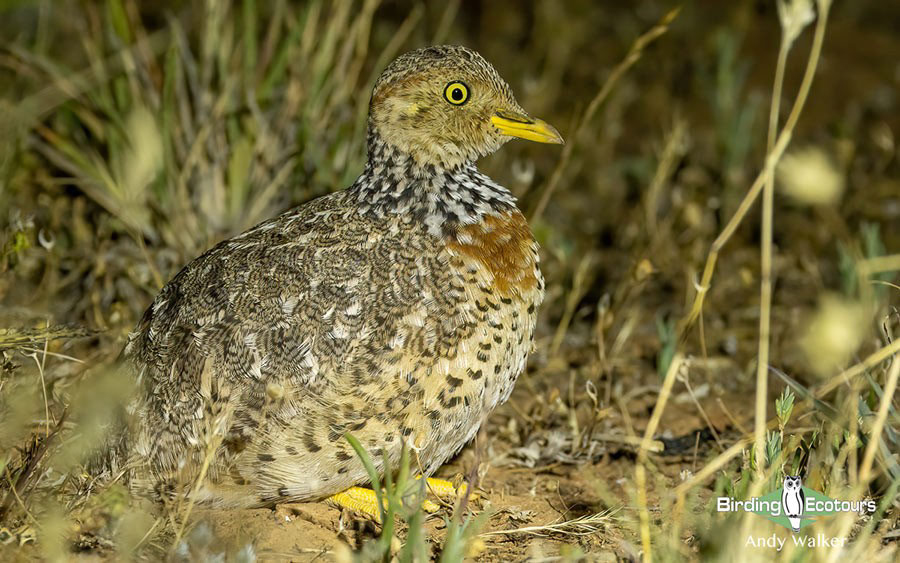
The Plains-wanderer is one of the most difficult birds to find in Australia!
Family: Pedionomidae
English name: Plains-wanderer
Scientific name: Pedionomus torquatus
The Plains-wanderer is one of Australia’s most unusual birds. This small, quail-like species belongs to its own family, Pedionomidae, and has no close living relatives. Although it resembles a quail in shape and behavior, it is more closely related to shorebirds than to gamebirds.
The Plains-wanderer is extremely well camouflaged. Its finely patterned plumage blends perfectly with dry grasslands, making it very difficult to detect. When threatened, it depends more on concealment and camouflage than on flight, typically crouching low and edging quietly through the vegetation.
This species inhabits remote regions of eastern Australia, closely associated with native grasslands that combine open and denser cover, offering foraging opportunities and shelter from predators. Although once widespread, it has suffered severe declines as grasslands have been converted to croplands and pastures.
The Plains-wanderer is mostly sedentary, typically occupying a home range of about 12 hectares. It will usually only move in response to major habitat changes such as flooding or fire. The species can survive without permanent water, obtaining moisture from food, dew, and rainfall collected on vegetation.
The Plains-wanderer is now listed as Critically Endangered. Habitat loss, pesticide use, and predation have all contributed to its decline. Due to its secretive behavior and remote habitat, it remains one of the toughest birds to find in Australia, and sightings are often only possible with the help of experienced guides.
Family: Dromadidae
English name: Crab-plover
Scientific name: Dromas ardeola
The Crab-plover is one of the most distinctive shorebirds in the world. With its bold black-and-white plumage and heavy, black bill, it stands out immediately among shorebirds, both in size and appearance. Its body is mostly white, contrasting sharply with the black back and flight feathers, giving it a clean and striking look.
Despite its name, the Crab-plover is not closely related to true plovers. It belongs to its own family, Dromadidae, and is more closely related to coursers and pratincoles in the family Glareolidae. This unusual relationship places it apart from most other coastal shorebirds.
As its name suggests, the Crab-plover feeds mainly on crabs. Its thick, powerful bill is specially adapted to dig into sand and mud and extract hard-shelled prey. This feeding style sets it apart from most other shorebirds, which rely more on probing or picking small invertebrates from the surface.
The Crab-plover is found along the coasts of East Africa, including Madagascar and occassionally as far south as South Africa, and extends east to southern India and southwest Thailand. During the breeding season, from April to July, birds gather in large colonies that can number up to 1,500 pairs. Most breeding takes place around the Arabian Peninsula, along the Red Sea, Persian Gulf, and adjacent Indian Ocean coastlines.
One of the most remarkable features of this species is its breeding behavior. Unlike most shorebirds, whose chicks are able to leave the nest shortly after hatching, Crab-plover chicks remain in the nest and depend on their parents for food and protection. The birds also use an unusual nesting strategy, excavating deep burrows in sandy banks where eggs are laid and incubated.
Although the Crab-plover encounters certain localized pressures, it is not regarded as globally threatened. Its extensive range and robust population make it one of the more secure representatives among the above-mentioned specialized monotypic shorebird families.
Family: Eurypygidae
English name: Sunbittern
Scientific name: Eurypyga helias
The Sunbittern, with its appearance reminiscent of both a finfoot and a heron, is a truly captivating bird. Of the roughly 11,000 bird species worldwide, distributed across 46 orders, only the Sunbittern and the Kagu survive as representatives of the order Eurypygiformes. Their unique lineage makes them striking evolutionary outliers in the avian world and remarkable species in every respect.
The Sunbittern has a long neck and tail, and a long, pointed bill. It has two white stripes, one above and one below the eye. The rest of the plumage is beautifully barred in black, brown, and white. But when the bird spreads its wings, whether in courtship, a threat display, or to scare off predators, it reveals a stunning red-yellow-and-black sunburst pattern, the feature that gives the species its name.
The Sunbittern is distributed from Guatemala to Brazil, living in humid Neotropical forests. It is normally found near rivers, streams, ponds, or lagoons. It is generally a solitary species, only coming together to mate. It walks with a slow, deliberate gait, creating a characteristic head-bobbing motion as it moves. When frightened, it flies up to perch in trees, spreading its wings to show off its dramatic sunburst display.
Like herons, pigeons, and parrots, the Sunbittern possesses specialized “powder down” feathers. These feathers continuously grow and disintegrate into a fine, waxy powder, which the bird uses to maintain and care for its plumage, a trait shared by only a few bird groups.
Though the bird is typically silent, it produces a beautiful, metallic song that seems oddly out of place.
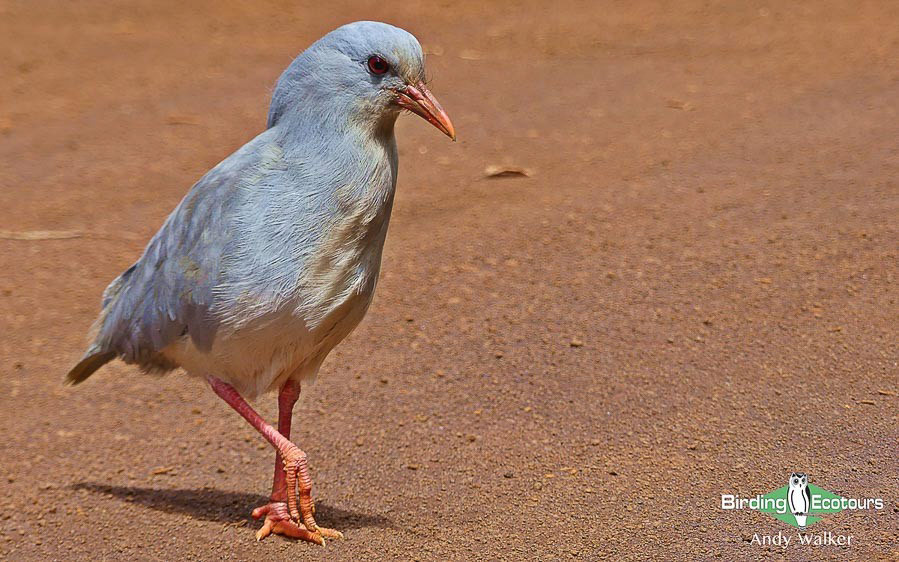
The Kagu is one of the world’s most sought-after species
Family: Rhynochetidae
English name: Kagu
Scientific name: Rhynochetos jubatus
The Kagu belongs to its own family, Rhynochetidae, and is found only on the island of New Caledonia. Deeply woven into local culture, the Kagu appears on national stamps, currency, and official emblems, and its calls and crest feathers have long featured in Kanak (Melanesian inhabitants of New Caledonia) traditions.
The Kagu is mostly flightless and spends nearly all of its time on or near the ground. It has a soft, ash grey plumage, bright orange-red legs and bill, and a prominent crest that can be raised during alarm or display. One of its most unusual features is the presence of nasal corns, structures found in no other bird, which cover the nostrils and help prevent debris from entering while foraging on the forest floor.
This species occupies a range of forest habitats across New Caledonia. It occurs in humid lowland and montane rainforests, as well as drier forests and shrublands. Despite this habitat flexibility, it remains highly sensitive to disturbance and relies on intact forest systems to survive.
The Kagu is well known for its loud and haunting call, often compared to a barking dog. These calls can carry for long distances and may continue for many minutes, particularly during territorial defense or pair bonding.
Fewer than 2,000 mature individuals remain in the wild. Introduced predators such as dogs, cats, pigs, and rats pose the greatest threat, along with habitat loss from mining and logging. Low reproductive rates further limit recovery, making the Kagu one of the most conservation-dependent birds in the Pacific.
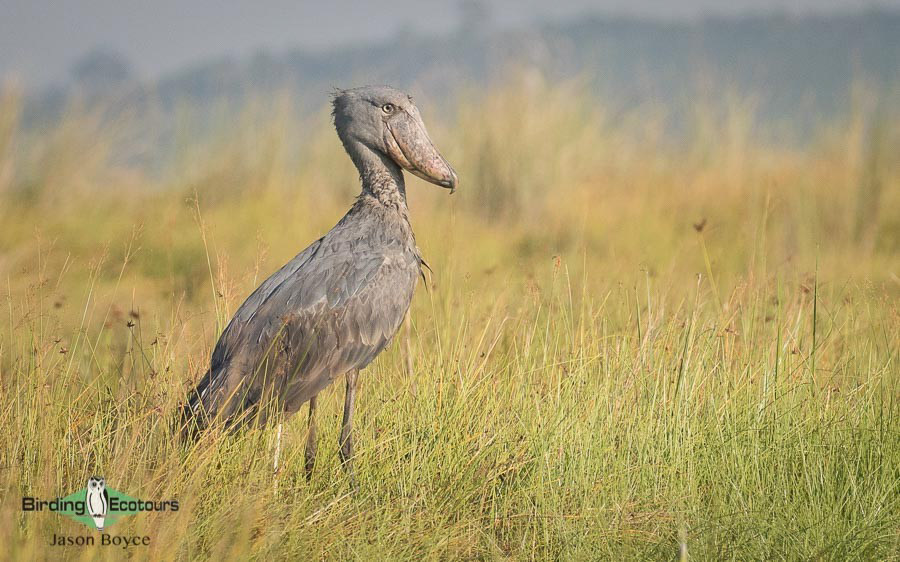
Shoebill is one of Africa’s most iconic species
Family: Balaenicipitidae
English name: Shoebill
Scientific name: Balaeniceps rex
The Shoebill is one of Africa’s most sought-after birds. It gets its name from its massive shoe-shaped bill, which can reach nine inches (23 centimeters) long. Though it looks stork-like, and was once grouped with storks (Ciconiiformes), it’s now placed in the order Pelecaniformes (which includes the pelicans, ibises, herons and Hamerkop families) based on recent genetic studies.
Shoebills are large, heavy birds, standing at 3.5–4.5 feet (1.1–1.4 meters) tall with a wingspan of about 7.5–8.5 feet (2.3–2.6 meters). Males weigh slightly more than females, between 10–15 pounds (4.5–7 kilograms). Adults are mostly slate grey, with darker heads and lighter underparts.
The Shoebill is found in tropical East-Central Africa, from South Sudan and western Ethiopia through to Uganda, eastern DRC, western Tanzania, and northern Zambia. Smaller populations also exist in Rwanda and neighboring regions. It inhabits freshwater swamps and floodplains characterized by dense stands of papyrus and reeds. It will often use wetlands with low oxygen levels where fish must surface often to breathe, which helps the birds hunt more easily.
The species is listed as Vulnerable by the IUCN Red List, with an estimated population of 5,000–8,000 birds. Habitat loss, disturbance, and illegal trade are the main threats. Wetlands drained or burned for farming, and even light human activity near nests can cause adults to abandon chicks. Shoebills are also captured for zoos or private collectors, which further reduces wild numbers.
The species is safeguarded across much of its range and is listed under CITES Appendix II. Conservation measures include nest protection, wetland preservation, and the promotion of community-based ecotourism—for example, in Zambia’s Bangweulu Wetlands, where local residents monitor nests and derive income from Shoebill tourism. Such initiatives are easing pressures on this rare and striking bird.
Family: Scopidae
English name: Hamerkop
Scientific name: Scopus umbretta
The Hamerkop is a medium-sized waterbird found in sub-Saharan Africa, Madagascar, and coastal southwest Arabia. The species has a distinctively shaped head that resembles a hammer, which gives the bird its name. The word Hamerkop comes from Afrikaans (one of South Africa’s 12 official languages) and means “hammerhead”.
Because the species is so distinctive, it has proven difficult to classify. It was initially grouped with the storks (Ciconiiformes), but further studies showed it to be more closely related to pelicans and the Shoebill (Pelecaniformes). Although it is the only living member of its family, one extinct relative, Scopus xenopus, is known from fossils found in South Africa and appears to have been slightly larger and more aquatic.
The Hamerkop is well known for building massive stick nests during the breeding season, which can measure up to six feet (two meters) in diameter and height. Unusually for a wading bird, the nest contains an internal nesting chamber where the eggs are laid. Both parents take part in incubating the eggs and raising the chicks.
Two subspecies of the Hamerkop are currently recognized. The widespread nominate form, S. u. umbretta, occurs across most of the species’ range, while a smaller West African form, S. u. minor, was described in 1931. Other subspecies have been suggested, but these are not widely accepted, and no additional subspecies are formally recognized at present.
One of the more unusual social behaviors recorded in the Hamerkop is false mounting. In this behavior, one bird stands on another without copulation. It has been observed between mated and unmated birds, between members of the same sex, and even in reversed mountings where females mount males. This suggests the behavior is social rather than linked to breeding.
The Hamerkop also features strongly in traditional beliefs. In Zuluculture, in South Africa, the bird is believed to possess burning power. According to legend, anyone who damages a Hamerkop nest will see their home burn down within a day. As a result, the bird, known locally as uThekwane, is highly respected by Zulu hunters.
Family: Steatornithidae
English name: Oilbird
Scientific name: Steatornis caripensis
The Oilbird is among the most extraordinary birds on Earth, renowned for its ability to navigate and fly in total darkness. It is the sole member of its family, Steatornithidae, and is restricted to the Neotropics. Remarkably, it holds the distinction of being the only nocturnal fruit-eating bird known to science.
The Oilbird has a dumpy, rufous brown body marked with pale spots on the wings, tail, and body. It has a pinkish, hooked bill and long wings adapted for slow, buoyant flight. Its large eyes (adapted to enable it to navigate in low light conditions) give it a distinctive appearance.
This species is found across northern South America and into Central America, even occurring on the island of Trinidad. It roosts and breeds deep inside caves and rocky ravines, but forages widely over surrounding forests. Although closely tied to cave systems, Oilbirds may travel long distances each night in search of fruit.
The Oilbird has an exceptional sense of smell, which it uses to locate fruit at night. It also has among the most light-sensitive eyes of any vertebrate. Amazingly, to move through caves and dark ravines, it uses echolocation, producing audible clicking sounds to navigate its surroundings.
Although often difficult to see away from colonies, the Oilbird is an unforgettable species. Few birds combine such specialized senses, unusual behavior, and ancient lineage in a single form.
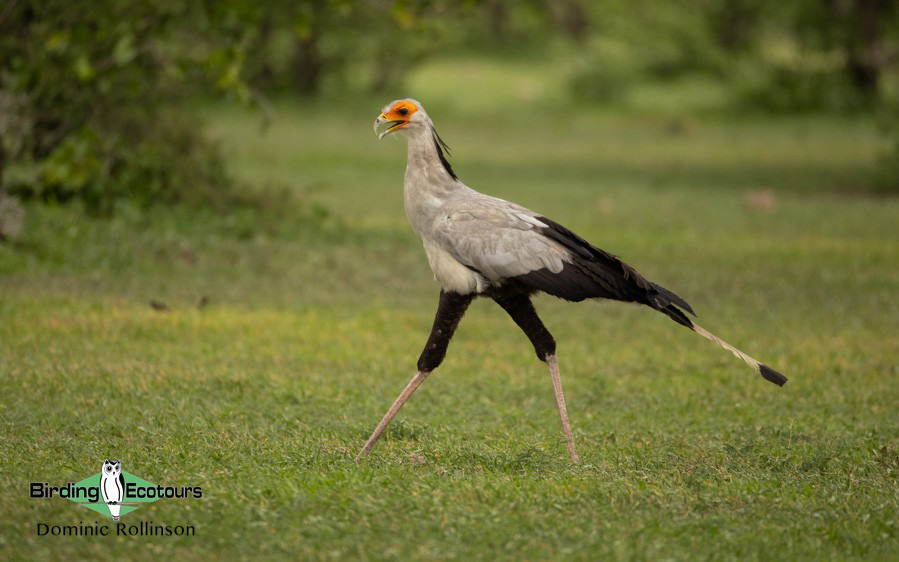
Secretarybird is typically seen striding across the African savanna.
Family: Sagittariidae
English name: Secretarybird
Scientific name: Sagittarius serpentarius
The Secretarybird, with its long legs and quill-like crest on the top of its head, is a species that most birders would easily recognize. The species has been described as resembling an eagle perched atop crane-like legs. It is mostly gunmetal-grey, with an orange to red face, and long black quill feathers on top of the head.
This mostly ground-dwelling bird of prey is endemic to sub-Saharan Africa, with its range extending from Senegal to Somalia and south into South Africa. The species is renowned for its ability to hunt snakes, is found in open savannas, grasslands, lightly wooded shrublands, and even farmland. It favors habitats with good visibility, making it easier for it to spot and hunt its prey.
The Secretarybird has adapted to be able to hunt on foot, making it unique, unlike many other birds of prey which hunt on the wing. It will walk around 1.2–1.9 miles per hour (2–3 kilometers per hour) while hunting, covering up to 12.4 miles (20 kilometers) in a day’s foraging. Although the Secretarybird is famous for killing snakes, insects form the bulk of its diet. Arthropods, including locusts, beetles, and spiders, constitute nearly 87% of its food intake, whereas rodents, lizards, and birds form only minor components. Snakes, despite the species’ reputation, represent roughly one percent of its typical food intake.
Its long legs are perfectly adapted for hunting snakes. The legs are covered in thick, hard scales which help protect it from bites by venomous snakes. It also has short toes, unlike most other birds of prey, which are designed to help them stomp and kill snakes with precision.
These unique characteristics make the species challenging to classify. With no close relatives, the Secretarybird stands alone as the sole representative of the family Sagittariidae. It is assigned to the order Accipitriformes, together with hawks, eagles, and vultures.
Due to habitat loss and other human-induced threats, the species is classified as Endangered on the IUCN Red List. Despite its broad distribution, the Secretarybird occurs at generally low densities throughout its range.
Family: Pandionidae
English name: Osprey
Scientific name: Pandion haliaetus
With fish widely available and the ability to migrate long distances, the Osprey occurs across much of the globe. This means it is well known by many people – even non-birders. It has even made its way into popular culture. The American NFL football team, the Seattle Seahawks, is named after the regional name for the Osprey.
The Osprey is the sole living species in the family Pandionidae and is found on every continent except Antarctica. There are four recognized subspecies, although some suggest that the Australasian Osprey should be split into its own species.
The Osprey is dark brown above, contrasting with its white underparts. It has a distinctive dark stripe that runs through the eye, giving the bird a masked appearance.
This mid-sized raptor is highly adapted for its fish-catching lifestyle. It is normally found near water favoring shallow water bodies where it can hunt fish with ease. The species has a zygodactyl (two toes pointing forward and two toes pointing backwards) grip when hunting, which is rare among raptors. The Osprey also has rough, spiny pads called spicules on the soles of its feet, which helps grip slippery fish.
The Osprey has a dense, oily plumage that prevents its feathers from becoming waterlogged, as well as nostrils that close during dives to keep water out. When hunting, the Osprey can spot fish from 30 to 130 feet (10 to 40 meters) above the water and dive at speeds of up to 50 miles per hour (80 kilometers per hour), talons first, to catch its prey.
Around 99 percent of the Osprey’s diet consists of fish, and nearly every part of this incredible bird has been adapted for catching its prey.
Although the species has faced conservation challenges in the past – particularly due to pesticide use – it is now considered of Least Concern on the IUCN Red List, with healthy global populations.
Family: Leptosomidae
English name: Cuckoo-roller
Scientific name: Leptosomus discolor
Despite the Cuckoo-roller’s appearance, being a blend between a cuckoo and a roller, its name is misleading – the species is neither a cuckoo nor a roller. Endemic to Madagascar and the Comoros Islands, it is the only species in its family and the sole species in the order Leptosomiformes. Some call it a “living fossil,” because its ancient relatives once ranged across the Northern Hemisphere during the early Paleogene period. Those relatives died out, and only the Cuckoo-roller remained – offering a window into a lineage that has remained relatively unchanged.
There are three subspecies, each confined to separate islands. Some authorities suggest that the Grand Comoro subspecies (L. d. gracilis), which is slightly smaller and shows subtle differences in plumage and vocalizations, should be treated as a separate species.
The Cuckoo-roller has a grey head, white underparts, and an iridescent green back. Its stout bill and short neck give it a somewhat large-headed appearance. Unlike rollers and many of its forest relatives, it shows sexual dimorphism – males and females look markedly different.
The species also has an unusual foot structure for a tree perching bird: like parrots and woodpeckers, it has a zygodactylous foot arrangement (two toes forward and two backwards).
It feeds on a variety of animals caught in the forest canopy, including reptiles such as chameleons and geckos, and insects, such as locusts and caterpillars. Interestingly, its stomach linings are often found coated with caterpillar hairs due to frequent consumption of those insects.
Despite its restricted range, the Cuckoo-roller is classified as Least Concern by the IUCN Red List. Its resilience is partly due to its ability to live in a wide range of forest habitats, including altered landscapes such as plantations and secondary growth.
This species gives one more reason why birders should try to visit a place like Madagascar at least once in their lifetime.
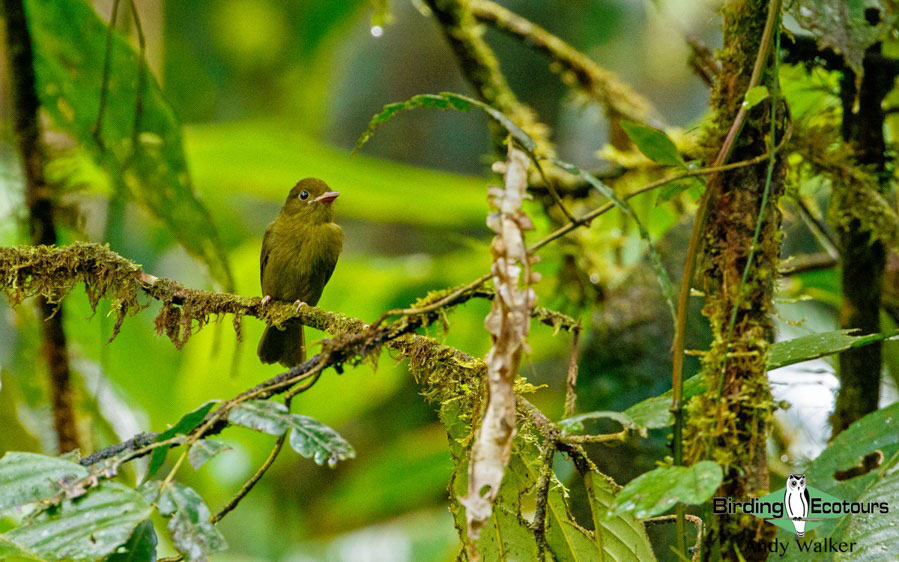
Sapayoa is a small bird with a complicated taxonomy history.
Family: Sapayoidae
English name: Sapayoa
Scientific name: Sapayoa aenigma
This small olive-green passerine, the Sapayoa, has long posed a taxonomic puzzle. When Ernst Hartert first described the species in 1903, he placed it within the manakins (family Pipridae) because of similarities in plumage and toe arrangement. But with advances in DNA and genetic evidence, it became clear that the species is not a New World suboscine (a division of the order Passeriformes) such as tyrant flycatchers (Tyrannides); rather, it is an Old World suboscine (of the infraorder Eurylaimides) most closely related to broadbills and pittas. Its syrinx (voice box) and skull structure resemble those of Asian broadbills (Eurylaimidae), rather than any New World bird. Around 2010, it was placed in its own family, Sapayoidae.
Its range is limited in the Neotropics, making the Sapayoa a “holy grail” species for birders. It occurs from eastern Panama, south through western Colombia, and into extreme northwestern Ecuador. It lives in humid tropical forests, especially in the lower and mid-levels of the forest interior. Because its plumage is inconspicuous and its habits are quiet, this bird can be hard to detect.
Similar to its Old World relatives, the Sapayoa has a mixed diet of animal and plant matter. When feeding on insects, it often perches still, then strikes quickly. It also eats small fruits.
Although the Sapayoa is classified as Least Concern on the IUCN Red List, its numbers appear to be gradually declining due to habitat loss within its range. In the long term, its survival depends on the preservation of remote wet forests.
Family: Oxyruncidae
English name: Sharpbill
Scientific name: Oxyruncus cristatus
The Sharpbill is an attractive passerine with green upperparts, spotted underparts, and a distinctive sharply pointed bill, which gives the species its name. The Sharpbill has a scattered Central and South American distribution, ranging from Costa Rica and Panama through the Guianan Highlands and the Andes, south to northern Argentina.
The species is poorly known and often difficult to observe. It is typically found in dense, humid forest, where it feeds mainly on fruit but also takes insects. The Sharpbill is often encountered as part of mixed-species feeding flocks, which can make it easier to detect but still challenging to see well.
For many years, scientists struggled to place the Sharpbill within bird classification systems. Its appearance and behavior did not clearly align with any single group. This uncertainty has been resolved through modern DNA studies, which show that the Sharpbill belongs to a broader group of birds known as Tyrannides, which includes flycatchers and their relatives.
Within this group, the Sharpbill stands alone in its own family, Oxyruncidae. Its closest living relatives are royal flycatchers and their allies, followed by the large tyrant flycatcher family. This helps explain why the Sharpbill looks and behaves differently from most other flycatcher-like birds, while still being part of the same wider lineage.
One of the key features to listen for when encountering this species is the male’s distinctive call. For birders who enjoy calls, this is a must-hear sound. Its unique call sounds like an electric saw cutting through wood in a workshop.
Family: Rhagologidae
English name: Mottled Berryhunter
Scientific name: Rhagologus leucostigma
The Mottled Berryhunter is certainly not the most colorful bird on this list, but it is no less fascinating. It is named for its mottled plumage. Unlike many species, the female is slightly more colorful than the male. The male has grey-brown upperparts, paler underparts, with faint mottling on its underparts. The female (and immature birds) has a rufous wash on its face and crown and is more heavily streaked on the back and breast. Both sexes have a rufous‑colored undertail patch.
This species is endemic to New Guinea, favoring dense, cool, moist montane forests. It rarely ventures into lowland habitats. The species is primarily a frugivore, eating mainly small fruits and berries found in the rainforest.
The Mottled Berryhunter was initially placed in the whistler family (Pachycephalidae) based on perceived similarities. But after further research in 2014 it was reassigned to its own family, Rhagologidae. Its precise relationships remain uncertain, though some evidence suggests affinities with woodswallows, boatbills, and butcherbirds.
This species is classified as Least Concern on the IUCN Red List, largely because it inhabits montane forest zones, thus escaping much of the deforestation pressure affecting lowland forests.
Its role as a consumer of forest fruits also gives it an important role in seed dispersal, contributing to the health of its ecosystem.
Family: Pityriasidae
English name: Bornean Bristlehead
Scientific name: Pityriasis gymnocephala
The Bornean Bristlehead, also known as the Bristled Shrike, Bald-headed Crow, and Bald-headed Wood Shrike, is a monotypic family that is endemic to the southeastern Asian island of Borneo. This unusual-looking species, with its chunky, hooked crow-like bill, gets its name from the short, bristle-like skin projections on its crown that give it a bald appearance.
When one delves into the meaning of the Bristlehead’s scientific name, it almost makes you feel sorry for the species. The word Pityriasis comes from the Greek word meaning ‘bran’ – a term often used to refer to the flaking of skin, more commonly known as dandruff. The word gymnocephala means ‘naked head’. Putting this together, the bird has the dubious honour of being called “dandruff naked head.”
Due to its distinctive appearance and limited distribution, the Bornean Bristlehead is a highly sought-after species by birders. The Bristlehead is a heavy-bodied passerine. It has a mostly black body, with the face, neck, and thighs bright red. The ear coverts are bristle-like and charcoal grey, and its short tail gives it a top-heavy appearance.
The species favors peat swamp forests and is also commonly associated with lowland dipterocarp forests, typically below 3,900 feet (1,200 meters) above sea level. Its diet consists mostly of insects and arthropods, though it will also feed on small reptiles and amphibians. Occasionally, it will take fruit. It forages in the canopy and subcanopy of the forest, often in flocks of up to ten individuals, and is regularly seen feeding in mixed-species flocks.
The IUCN lists the Bornean Bristlehead as Vulnerable due to rapid habitat loss across Borneo, where forest habitat is being lost at a rate of 2–3% per year, with projections of up to 33% loss over three generations. What is sobering is that the species is expected to decline at approximately the same rate as the forest itself.
In Part 2, we will turn our attention to the next 17 monotypic families, highlighting their unique characteristics and drawing attention to the must-see species they contain. The spreadsheet below lists every species mentioned here, along with a suggested Birding Ecotours tour where each one can be seen.